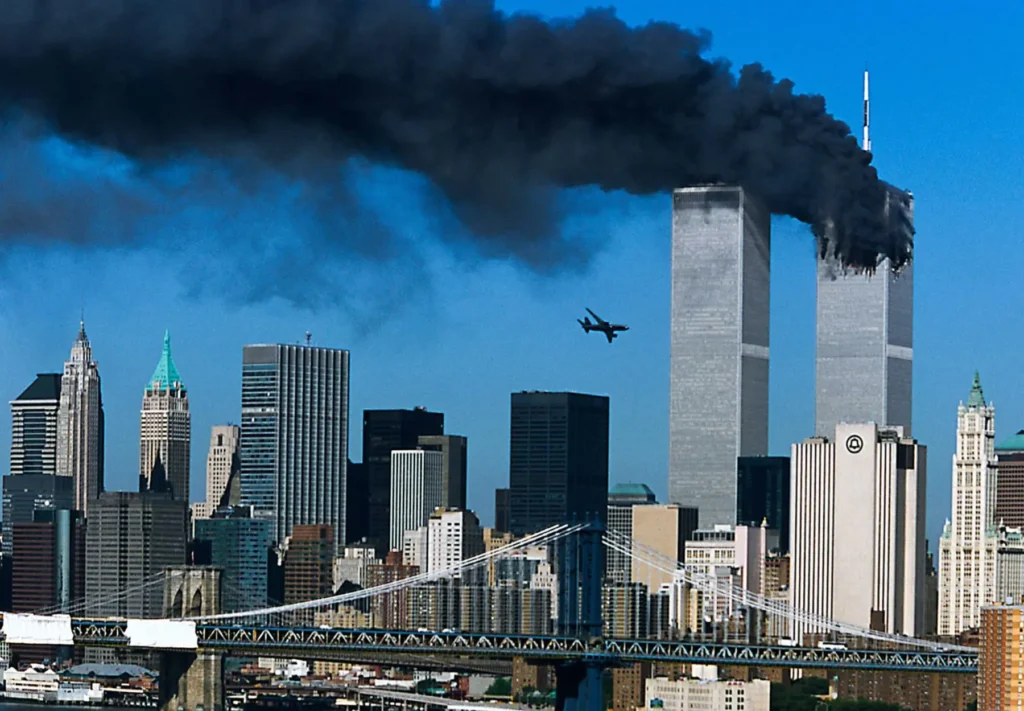
I would like to touch on one important point in this address. The actions by these young men who destroyed the United States and launched the storm of planes against it have done a good deed. They transferred the battle into the US heartland. Let the United States know that with God’s permission, the battle will continue to be waged on its territory until it leaves our lands, stops its support for the Jews, and lifts the unjust embargo on the Iraqi people who have lost more than one million children. The Americans should know that the storm of plane attacks will not abate, with God’s permission. There are thousands of the Islamic nation’s youths who are eager to die just as the Americans are eager to live.
Sulaiman Abu Gaith claiming responsibility for 9/11 on behalf of Al-Qaeda in a video on Al Jazeera, 2001
In the immediate aftermath of 9/11, US intelligence agencies intensified their investigation into Osama bin Laden and the network he led. Bin Laden had already been identified before 9/11 as the head of al-Qaeda, which had carried out earlier attacks on US targets, including the 1998 bombings of American embassies in East Africa and the 2000 attack on the USS Cole. Intelligence suggested that they were being housed in Afghanistan, controlled by the Taliban, a militant Islamist group that had emerged in the mid-1990s from the extremist elements of the Mujahideen. Drawing support from religious students educated in Pakistani Islamic education institutions and local warlords, the Taliban promised to restore order amid Afghanistan’s civil war following the collapse of the communist government. By 2001, they controlled most of the country and provided sanctuary to Osama bin Laden and al-Qaeda, allowing the group to plan and train for international attacks in exchange for loyalty and support.
While bin Laden initially denied direct involvement in 9/11, multiple sources, including intercepted communications, videotapes, and statements from captured al-Qaeda operatives, confirmed that he had authorised and overseen the attacks. By 2004, he publicly acknowledged responsibility. Evidence indicated that al-Qaeda had operated as a coordinated transnational network, with bin Laden at its helm, rather than as a loose collection of extremists acting independently. The US initially sought a diplomatic resolution, demanding that the Taliban surrender bin Laden and dismantle terrorist training camps. The Taliban responded that they would consider extradition only if evidence of bin Laden’s guilt was presented and if he were tried in an Islamic court, conditions that Washington rejected. With negotiations stalling, Bush issued an ultimatum, to surrender al-Qaeda’s leadership or be treated as enemies of the United States.
[T]he United States of America makes the following demands on the Taliban. Deliver to United States authorities all the leaders of al Qaeda who hide in your land. Release all foreign nationals, including American citizens, you have unjustly imprisoned. Protect foreign journalists, diplomats and aid workers in your country. Close immediately and permanently every terrorist training camp in Afghanistan, and hand over every terrorist, and every person in their support structure, to appropriate authorities. Give the United States full access to terrorist training camps, so we can make sure they are no longer operating.
These demands are not open to negotiation or discussion. The Taliban must act, and act immediately. They will hand over the terrorists, or they will share in their fate.
Bush’s ultimatum, September 20th, 2001

Congress authorised the use of force and negotiations rapidly collapsed. On 7 October 2001, US and allied air strikes began against Taliban and al-Qaeda positions. Ground operations followed, coordinated with the Northern Alliance, an Afghan coalition opposed to Taliban rule. By the end of the year, the Taliban regime had fallen, and a new Western-backed government was installed in Kabul. However, bin Laden escaped during the Battle of Tora Bora in eastern Afghanistan and fled into Pakistan, while Taliban and al-Qaeda fighters dispersed into rural and mountainous regions, beginning a prolonged insurgency. Bin Laden was eventually killed in his safe house in Abbotobad, Pakistan, in 2011.
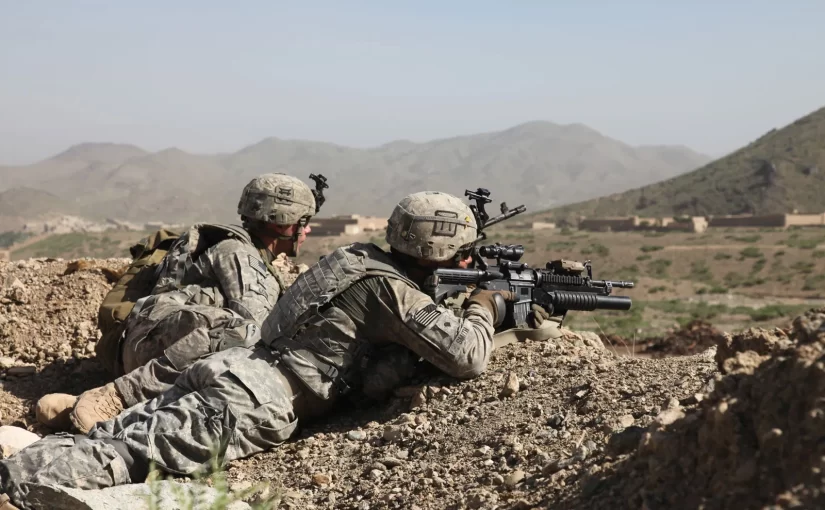
Once the occupation began, two new tasks fell upon the Americans and the other coalition forces that invaded, to reconstruct a new new government in a war torn nation whilst also countering terrorism. Due to the American occupation, insurgency groups had sprung up out of the remnants of the Taliban, who had established training camps in Pakistan. Much like Vietnam before it, the insurgents used asymetric warfare to counter the Americans, often resorting to disguising as civilians or using women and children to perpetrate terror attacks. Many Conservative media outlets struggled to justify Bush’s actions in both Afghanistan in Iraq as that war developed, but a teenager with genocidal coded writing found a way.
I am getting really sick of people who whine about “civilian casualties.” Maybe I’m a hard-hearted guy, but when I see in the newspapers that civilians in Afghanistan or the West Bank were killed by American or Israeli troops, I don’t really care. In fact, I would rather that the good guys use the Air Force to kill the bad guys, even if that means some civilians get killed along the way. One American soldier is worth far more than an Afghan civilian.
[…]
The Afghans tolerated and supported the Taliban for years, no matter what President Bush says. A group doesn’t conquer 95 percent of a country unless it has some support among the populace. The Afghans are fundamentalist Muslims. They didn’t seem to mind too much that their women were treated like dogs or that the Taliban enforced Shariah (Muslim law). So frankly, it doesn’t matter to me if some of their “civilians” get killed for involvement with the enemy. I’m glad the U.S. military decided to use a massive air campaign rather than going in full force with ground troops. The fewer dead American soldiers, the better.
[…]
If only Israel had acted as decisively as America did in Kabul, it would have gone in with F-16s and leveled Jenin. Civilian casualties? So be it. That might have struck a note of fear into the Palestinians – putting in ground troops sure doesn’t. […] In the end, this is a war to save humanity from the barbarity of fundamentalist Islam. It is inevitable for enemy civilians to be killed in war.
Ben Shapiro, Townhall, July 2002
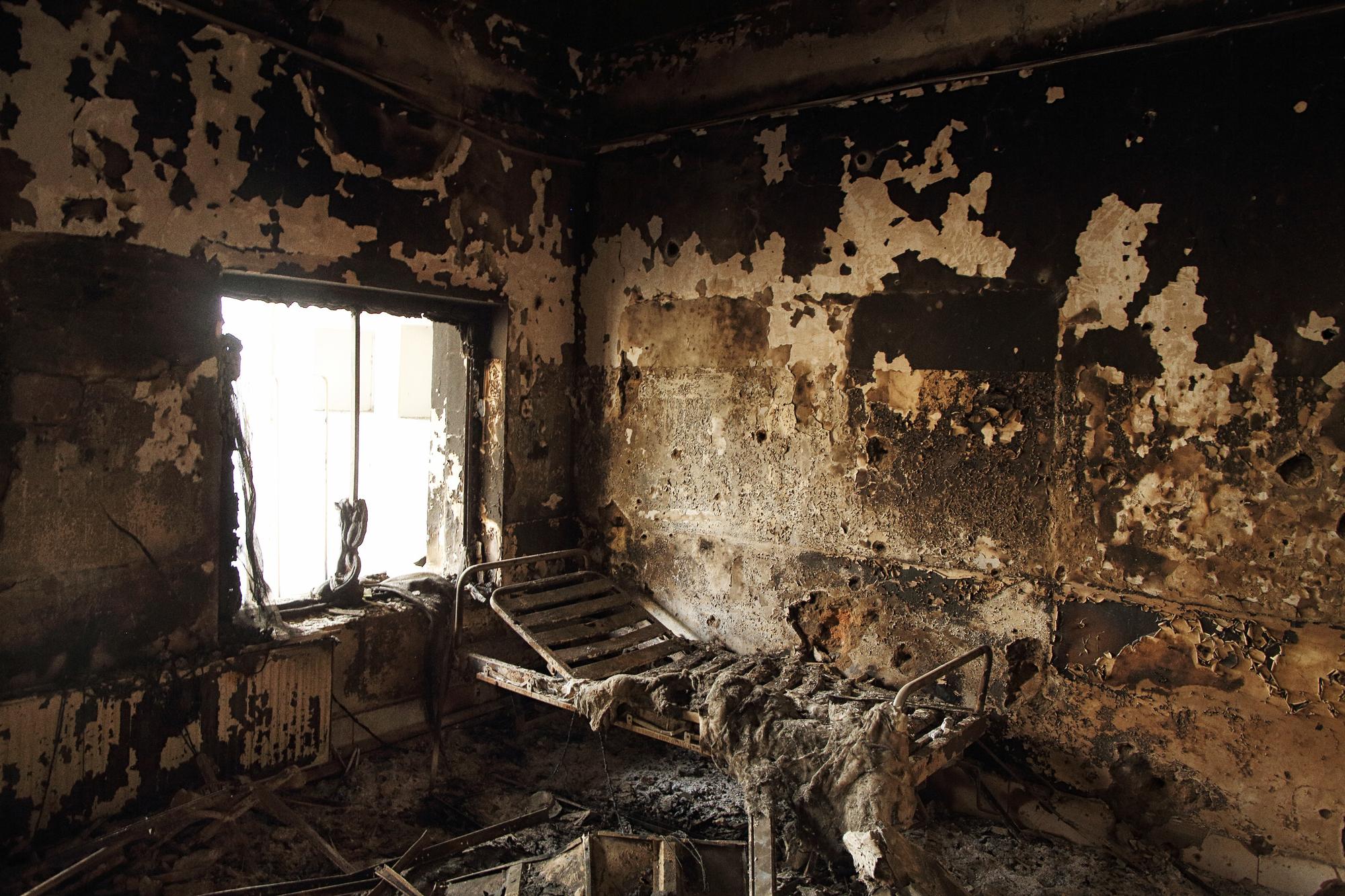
Upon election, Obama initially escalated US involvement rather than ending it. In 2009 he authorised a troop “surge” aimed at weakening the Taliban and stabilising the Afghan government before a gradual withdrawal in an attempt to avoid permanent occupation, but prevent outright collapse. The result was an extended war fought increasingly through training missions, special forces operations, and airpower, rather than conventional invasion. These operations were justified as a way to combat terrorism without deploying large numbers of troops, but they raised legal and ethical concerns, especially when multiple civilians were killed. Most notably was the airstrike on Kunduz Hospital in Afghanistan, which killed 15 innocent civilians. The left accused him of being no different than the neo-Conservatives who started the war whilst the right saw him as sabotaging a plan that would’ve made Afghanistan stable if he’d just waited a few more months. The expansion of remote warfare also allowed Obama to claim he was ending wars while simultaneously broadening the geography of counterterrorism operations.
Due to these mass airstrikes, the occupying Americans began to slowly be despised by the Afghan population, leading to the Taliban making a comeback. They would organise terrorist attacks in the country, that would end up killing hundreds of innocent people and coalition soldiers. US Soldiers began training the Afghan army to combat the terrorists once they left and equipped them with American Weapons.
Twenty years passed since the Invasion of Afghanistan, and the war was still going. Whilst many saw Afghanistan as the greatest symbol of the “forever war,” the actual logistics of withdrawal were much harder than they seemed. If the President was to pull out troops, it would cause the almost immediate collapse of the Afghan government and the return of the Taliban, which would be political suicide to whoever was President when the collapse occurred. However, if the President didn’t pull out troops, they’d be open to the accusation of intentionally prolonging the war far longer than it had already been going on for. Donald Trump’s solution to this impossible dilemma was an incredibly cynical yet effective one, at least for him politically.
He decided to remove the Afghan government from the equation and directly negotiate with the Taliban. From 2018 to 2020, multiple ceasefire deals were proposed but ultimately shot down by the Taliban. However, a peace deal was signed in February 2020. An incredibly simplistic interpretation of Trump’s deal with the Taliban involved the withdrawal of all NATO troops from Afghanistan, a Taliban pledge to prevent al-Qaeda from operating in areas under Taliban control, a Taliban pledge to not attack United States troops and talks between the Taliban and the Afghan government.
Trump did not see the withdrawal of troops during his presidency however, due to his defeat in 2020. In fact, Trump intentionally extended it into the next term, so if he won he could portray himself as the guy who got the US out of Afghanistan but if he lost and it went horribly wrong, which was inevitable, Trump could simply blame the next guy. After his loss in the 2020 election but before Joe Biden’s inauguration, he purged a large amount of the Pentagon staff and replaced them with Trump loyalists, with orders to pull out as many troops as quickly as possible. Biden was now faced with an even more impossible version of the existing Afghanistan dilemma, either: Pull the unsustainably small deployment, which wouldn’t give enough time or resources to the Afghan government to peaceably transition and functionally guarantee immediate collapse or; deploy more troops which would make transition more sustainable but going back on the deal, betraying the Taliban and perceived as escalating the war that you promised to end. Very much a rock and a hard place position.
“I’m now the fourth United States President to preside over American troop presence in Afghanistan: two Republicans, two Democrats. I will not pass this responsibility on to a fifth.”
Biden in a speech in the White House
In an attempt to honour the deal set up by his predecessor, Biden went ahead with the withdrawal. This announcement gave the Taliban an opportunity to take back control, advancing on Kabul, forcing many Afghan soldiers to surrender themselves to the Taliban, before the Islamic Republic of Afghanistan was eventually toppled. In one of the largest airlifts in history, 122,000 people were airlifted from Kabul airport. American soldiers managed to fend off the Taliban for over 2 weeks as the Taliban captured Kabul. The last US plane left on August 30th, with the Taliban capturing the airport the next day and declaring a victory, taking the large amounts of US weapons left behind. The War in Afghanistan is considered by many to not only be a somewhat pointless war but its ending is considered to be one of the greatest military catastrophes in history. Much of the blame is pinned on Biden, but it could be argued that Trump intentionally set this up and political historians argue that it would’ve been a catastrophe for anyone. As of today, the Taliban still run the country, and are not recognised by any nation as a legitimate government, with only 11 countries supporting the Taliban government.

Casualties
- Afghan Security Forces – 66,000-69,000
- Coalition – 3,579
- Taliban – 52,893
- Civilians – 70,000