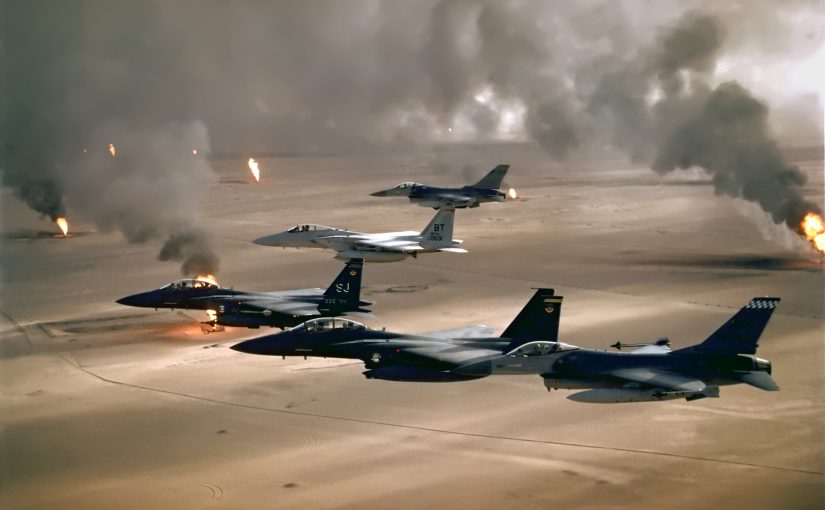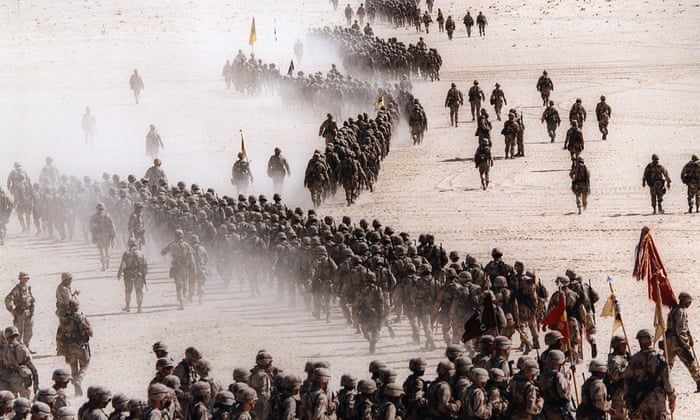
The millennium dawned and, that November, a new President was to be elected. Bill Clinton served his two terms as allowed in the 22nd Amendment the Democrats needed a new candidate to lead them this election. The obvious choice fell to Clinton’s VP, Al Gore, who had Joe Lieberman, a Senator and former Attorney General from Connecticut, as his running mate. Whilst the Republican Primaries were a lot more competitive, George Bush, son of George H. W. Bush and Governor of Texas, came out on top, choosing Dick Cheney from Wyoming, the Secretary of Defence for his father and a former House Minority Whip, as his pick for VP. A lot of both the campaigns focused on domestic policy as, at the time, the United States was not involved in a single conflict.
I don’t think our troops ought to be used for what’s called nation-building. I think our troops ought to be used to fight and win war.
George Bush, Second Presidential Debate, 2000

Election day came and no-one won. The states were relatively evenly divided, with Gore having 266 Electoral Votes and Bush having 246, out of the 270 needed to win. However, the problem was Florida. Their problem was that the ballots were designed to cater to old people, a large part of Florida’s population and especially in the county of Palm Beach, wherein a hole would be punched in the ballot as many could not hold a pen properly. Which seems reasonable enough until you see how the ballot was formatted.
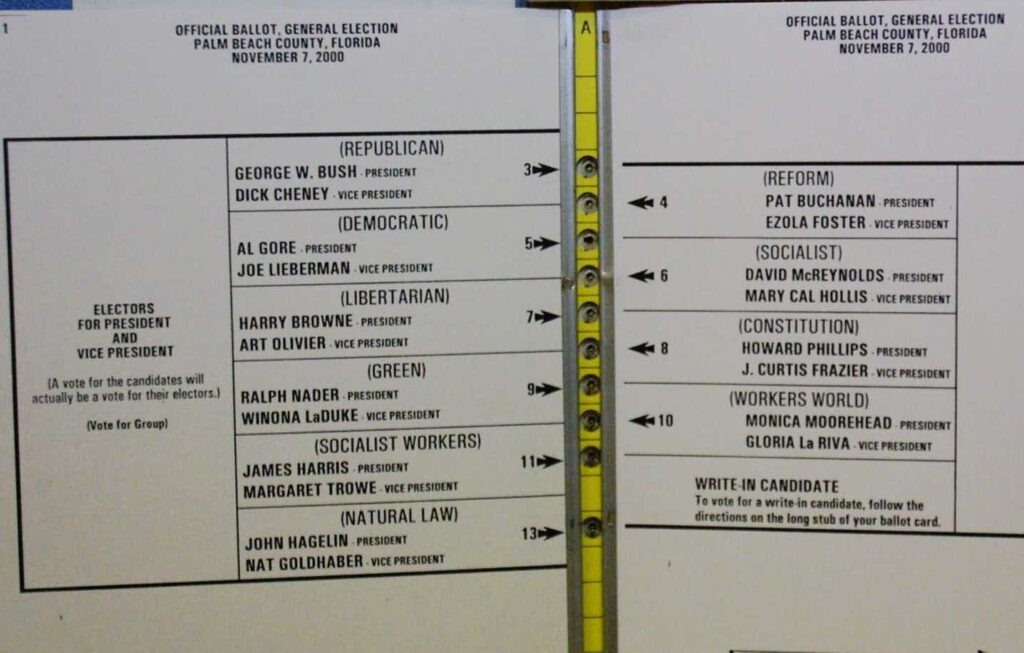
Some punched two holes in a ballot, some punched a hole that wasn’t even in one of the designated holes and some suspected that many Gore supporters were attempting to vote for him but voted for Pat Buchanan of the Reform Party by mistake, as Buchanan occupied the second hole whilst Gore occupied the third which doesn’t quite make sense as Gore was the candidate for the second largest party in the country. In the end, the whole thing was a disaster. At one point it seemed like Gore had the lead, which would mean he would win. At others, it seemed as though Bush had the lead, meaning he would win.
Eventually the results came through and Bush won. However, the margin was so narrow that a recount was demanded. Once the recount came through, Bush still won but the margin was even smaller than before, with now only a 300 vote difference. Eventually, Gore ended up going to the Supreme Court to demand another recount. After 5 weeks of proceedings, Gore eventually conceded the election, with the official count standing at 570 votes in favour of Bush in Florida, meaning he won the election and became the 43rd President of the United States, with only 271 Electoral Votes. Gore still won the popular vote on a national scale by a 0.52% margin. This election was one of if not the closest in history. And it was an election that would change the world.
For the first few months of George Bush’s Presidency, he was considered relatively fine. He didn’t do much to change any of what had come before and mostly stuck to his campaign promises. However, all that changed one fateful day.
In a response to 9/11, Congress, through the Authorisation for Use of Military Force, gave Bush the right to go to war against terrorism anywhere in the world, effectively declaring a War on Terror. With the Taliban removed from power and al-Qaeda weakened but not destroyed, senior officials increasingly turned toward a second objective. Much of the foreign policy of the Bush administration in the 2000s was centred around neo-Conservatism, the belief that the United States not only has the capacity but the duty to shape geopolitics. Under Ronald Reagan, it largely targeted communist militias. However, under Bush it morphed into a different force.
Following 9/11, Congress passed the Authorisation for Use of Military Force, granting the President broad powers to wage what became known as the “War on Terror.” Although the initial campaign focused on al-Qaeda and the Taliban in Afghanistan, attention within the Bush administration soon shifted toward Iraq. Senior officials, including Secretary of Defence Donald Rumsfeld, Dick Cheney, and Deputy to Rumsfeld Paul Wolfowitz, argued that Hussein represented a continuing threat to international security. This view was shaped partly by Iraq’s previous use of chemical weapons against Iran and its own population, its obstruction of United Nations weapons inspectors in the 1990s, and its defiance of earlier UN Security Council resolutions. Although no operational link was ever found between Hussein’s regime and al-Qaeda or any other terror group, members of the administration increasingly framed Iraq as part of the wider terrorist threat. Officials warned that Iraq could be supplying WMDs to extremist groups, a claim that did not rely on actual confirmed evidence in any capacity. Cheney asserted there was “no doubt” that Iraq possessed such weapons, while Rumsfeld suggested that Iraq’s failure to account fully for past programmes implied the existence of hidden stockpiles. In his 2002 State of the Union Address, Bush declared Iraq part of an “axis of evil” between itself, Iran and North Korea, accusing Hussein of creating nuclear, chemical, and biological weapons.

Britain played a central role in reinforcing this narrative. Labour Prime Minister Tony Blair strongly supported the American position and committed Britain to a close alliance with Washington. His director of communications, Alastair Campbell, was instrumental in shaping the public presentation of intelligence. In September 2002, the British government published a dossier claiming that Iraq possessed WMDs that could be deployed within 45 minutes. This document was later criticised for overstating the certainty of its conclusions and for using unverified intelligence reports. A second dossier, released in early 2003, drew heavily on plagiarised academic material and outdated sources, earning it the nickname the “dodgy dossier” in the British press. Some of the claims published in the dossier were suggested to have been sourced from popular action films according to a public inquiry into Iraq. The inquiries also found that political pressure had encouraged intelligence to be presented with greater confidence than the underlying evidence justified.
It was pointed out that glass containers were not typically used in chemical munitions; and that a popular movie [The Rock] has inaccurately depicted nerve agents being carried in glass beads or spheres. […] The questions about the use of glass containers for chemical agents and the similarity of the description to those portrayed in The Rock had been recognised by [MI6]. There were some precedents for the use of glass containers but the points would be pursued when further material became available.
A transcript from the Chilcot Inquiry into the Iraq War

By early 2003, more than 700 inspections by the UN had failed to uncover any chemical, biological or nuclear weapons. Hans Blix, head of the UN Inspection Commission, stated that, while Iraq had previously possessed such arms, there was no conclusive evidence that they still existed. Nevertheless, the United States and Britain argued that Iraq’s incomplete cooperation and past concealment justified military action.
In February 2003, Secretary of State Colin Powell addressed the UN Security Council, presenting satellite photographs, intercepted communications, and testimony from defectors as proof of hidden weapons facilities. One of his most memorable demonstrations involved holding up a small vial to illustrate the lethal potential of anthrax. He said that the small vial contained one teaspoon of a substance and claimed the same amount of anthrax shut down the US government. This conclusion was based on the Anthrax Attacks that took place throughout the autumn of 2001, including one letter sent to Senator Tom Daschle’s office on Capitol Hill. When it was discovered that over a hundred people had inhaled a lethal dose of anthrax, due to spores that had reached the air vents, the Capitol building, the seat of the US Government, was shut down and Congress was temporarily adjourned, at the height of debate regarding the controversial Patriot Act. In all, 5 people were killed and 17 were injured across Washington DC, Florida, New York, New Jersey and Connecticut due to letters sent containing anthrax. Whilst it was later revealed that the culprit was a domestic threat, according to the FBI’s report on the case, the killer used fake jihadist messaging, allowing the Bush administration to claim it was a biological islamic terror attack. He then claimed that Hussein had “enough to fill tens of thousands of teaspoons,” and that Hussein had supplied jihadists with the anthrax used in the attacks.

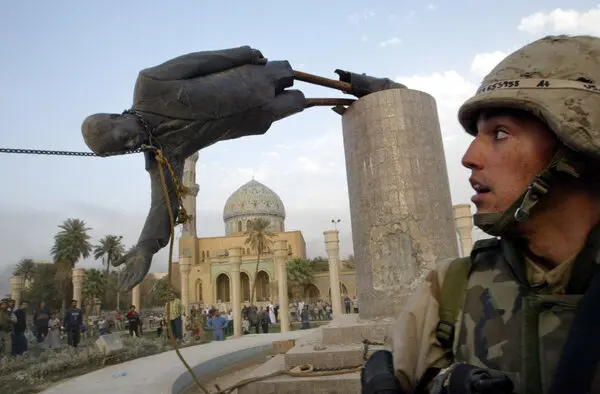
When it became clear that the Security Council would not authorise force, Washington and Westminster chose to proceed without UN approval. On March 19th 2003, coalition forces led by the United States and Britain launched Operation Iraqi Freedom. The invasion was publicly justified as a necessary act of pre-emption to prevent Iraq from deploying or transferring weapons of mass destruction, and later as part of a strategy to reshape the Middle East in the name of security and democracy. Hussein was eventually captured in late 2003 and executed. On May 1st, 2003, Bush declared “Mission Accomplished” aboard the USS Abraham Lincoln in a now infamous speech declaring that the invasion was a success and that Iraq would never be a problem again.
The collapse of Saddam Hussein’s regime in 2003 did not bring stability to Iraq. Instead, it created a political and security vacuum. The rapid dissolution of the Iraqi army and the Baʿath Party left hundreds of thousands of armed men unemployed and excluded from the new political order. Many former soldiers and officials joined local resistance groups, motivated by nationalism, fear of marginalisation, or hostility toward foreign occupation. At the same time, weak border controls allowed foreign Islamist fighters to enter Iraq, transforming what began as a largely nationalist insurgency into a hybrid conflict involving sectarian militias and transnational jihadist organisations.
One of the most significant developments was the emergence of al-Qaeda in Iraq (AQI) under the leadership of Abu Musab al-Zarqawi. The Sunni jihadist organisation sought to provoke civil war by deliberately targeting Shiite civilians and religious sites, hoping to destabilise Iraq and undermine the US-backed government. Sectarian violence escalated sharply after the bombing of the al-Askari Mosque in 2006, triggering widespread killings between Sunni and Shiite militias. Improvised explosive devices (IEDs), suicide bombings, and ambushes became defining features of the conflict, causing heavy casualties among coalition forces and Iraqi civilians alike. What had initially been presented as a swift regime change evolved into a prolonged and chaotic asymmetric counter-insurgency war.
Although Zarqawi was killed in a US airstrike in 2006, his organisation survived and adapted. During the late 2000s it split from the main al-Qaeda command and rebranded itself as the Islamic State of Iraq, attempting to present itself not merely as a terrorist organisation but as a state claiming territorial authority. The withdrawal of most US forces in 2011, combined with continued political exclusion of Iraq’s Sunni population by the Shiite-led government, allowed the group to build its strength. The outbreak of civil war in neighbouring Syria after 2011 further accelerated this process, providing new territory, recruits, and resources. By 2014, the organisation had expanded across borders and declared itself the Islamic State of Iraq and Syria, more commonly and infamously known as ISIS. During its time in power, ISIS became one of the most brutal terror organisations and became a symbol abroad for the evils of fundamentalist Islam.
The insurgency had major political consequences at home. In the United States, rising troop deaths and the failure to locate any WMDs steadily eroded public support for the war. Revelations of prisoner abuse at Abu Ghraib prison further damaged the credibility of the intervention, reinforcing the perception that the occupation was poorly planned and morally compromised. Although George W. Bush won re-election in 2004, the worsening situation in Iraq contributed to growing distrust with the Republican Party and fuelled large scale anti-war protests across the country. By the 2006 midterm Congressional elections, public frustration over Iraq helped deliver control of Congress to the Democrats and later the White House by 2009. In the United Kingdom, the insurgency undermined confidence in the war and in the government that had supported it. British forces were heavily involved in southern Iraq, particularly around Basra, where they faced sustained and brutal resistance from Shiite militias. As casualties mounted and instability persisted, criticism of Blair intensified. The exposure of flaws in the government’s intelligence claims led to public inquiries and long-term damage to trust in official statements about national security. The war became deeply unpopular, contributing to declining support for Blair’s New Labour and reinforcing scepticism about future British military interventions alongside the United States.
“[The Iraq War] divided parliament and set the government of the day against a majority of the British people as well as against the weight of global opinion. […] It was an act of military aggression launched on a false pretext as the inquiry accepts and has long been regarded as illegal by the overwhelming weight of international legal opinion. It led to the deaths of hundreds of thousands of people in Iraq and the displacement of millions of refugees. It devastated Iraq’s infrastructure and society. […] By any measure, the invasion and occupation of Iraq was a catastrophe. The decision to invade in 2003 on the basis of what the Chilcot report calls “flawed intelligence” about weapons of mass destruction has had a far-reaching impact on us all. It also led to a fundamental breakdown in trust in politics and our institutions of government.”
Jeremy Corbyn, Labour Party Leader at a speech in Westminster in 2016
When Barack Obama entered office in 2009, he inherited two active wars and a populace whose opinion on foreign intervention was deeply skeptical at best and downright opposed at worst. His campaign had criticised the invasion of Iraq as a strategic error and promised a shift away from large scale occupations toward diplomacy and limited military engagement. In practice, however, Obama pursued a mixed approach of reducing America’s physical footprint in the Middle East while expanding indirect forms of warfare. In Iraq, Obama oversaw the withdrawal of most US combat troops by 2011, fulfilling a key campaign pledge. However, the fragile political settlement left behind proved unstable. The Shiite government marginalised Sunni communities, and unresolved sectarian tensions created space for militant groups to reemerge. These conditions enabled the rapid rise of ISIS, which captured large parts of Iraq and Syria by 2014. The United States was drawn back into the conflict through airstrikes and support for local forces. Whilst nowhere near the levels of troops sent in 2003, it was still perceived as too much by the public.
Overall, the Iraqi insurgency transformed the meaning of the war. What had begun as an invasion justified by weapons inspections and regime change became a prolonged struggle against decentralised militant groups, and ultimately gave rise to a new extremist movement in the form of ISIS. At home, it reshaped political debate in both Britain and America, weakening confidence in political leaders, deepening public distrust of intelligence based justifications for war, and leaving caution toward foreign intervention that would influence policy for years to come.