The Atomic Bombings of Hiroshima and Nagasaki

In 1932, in Cavendish University, J. D. Cockcroft and E. T. S. Walton bombarded lithium with protons from a particle accelerator. The protons caused the lithium atom to split. Many scientists, the most notably of whom were under Nazi governance in Germany, realised that if they continued to split uranium and plutonium atoms, with the protons from one atom splitting another and the process repeating in a process called fission, they could make a new source of energy. However, with this power, the results could also be used for much more sinister means.

August, 1939. About a month before the outbreak of WW2, Albert Einstein, a highly accomplished scientist who discovered the theory of relativity (E=mc2) sent a letter to Franklin D. Roosevelt, then President of the United States, on a highly serious matter. Einstein believed that the Germans were working on a super weapon, a super weapon that would harness the power of Cockcroft and Walton’s work and make a fission bomb, that could wipe cities off the map. Despite being a pacifist, Einstein believed that such a weapon would be better in the hands of the Americans than the Germans. By August of 1942, the development of an atomic weapon was granted by FDR. A group of hundreds of scientists all were called upon by the US government to assist in the development of the technology.

One of the top scientists on the project, who led the scientific research and design of the bomb, was Dr J Robert Oppenheimer. He graduated in chemistry from Harvard and obtained his doctorate in physics from the University of Göttingen in Germany. Whilst abroad in Europe, he learned a lot about quantum physics, a field that was not that expanded in the United States. One of the most notable German physicians was Werner Heisenberg, who thought of the famous Heisenberg Uncertainty Principle. Many believed that Heisenberg was working on the German Nuclear bomb.

A photo of Oppenheimer

Back to Oppenheimer, he joined the faculty of the University of California, Berkley, where he expanded the field of Quantum Physics in the United States, becoming a professor in 1936. He even partially discovered a black hole in 1939. He was considered to be one of the greatest minds in Atomic Research, the kind of man that the US was after. However, he was under observation by the FBI since 1941 due to his ties to communist groups and union activity whilst in California. Most notably, he was a leading figure in the Federation of Architects, Engineers, Chemists, and Technicians (FAECT), a white collar union for technical professions, and met many close friends through the Communist Party of the USA, of which his brother Frank was a member.

His wife, Kitty, was a former member of the Communist Party before leaving in the 1930s before they met. He also had an on and off affair with active Communist Party member, Jean Tatlock, who committed suicide in 1944. However, whether he was actually a member of the party was heavily debated. During his 1954 security clearance hearing, he testified that he agreed with many of the ideas of communism but would not tow a party line. He also openly campaigned and funded the Republicans in the Spanish Civil War, before joining the American Committee for Democracy and Intellectual Freedom, which campaigned against Jewish persecution in Nazi Germany. The group was later branded as communist during the era of McCarthyism. As Chief of Security for the Manhattan Project, Colonel Boris Pash was asked to assess Oppenheimer regarding his alleged communist ties. Whilst stating that he “may still be connected with the Communist Party”, Pash did not believe Oppenheimer to be a spy, believing that “Oppenheimer’s personal honour and concern for his reputation would deter him from such action”. Pash therefore did not recommend his removal from the project, but instead that Oppenheimer be accompanied by counter-intelligence agents.

Oppenheimer, as well as many other notable scientists such as Richard Feynman, Edward Teller and Isidor Isaac Rabi, were gathered in Los Alamos, a remote part of the New Mexican Desert where a small town was built in order for the scientists to do their research and accommodate their families. The bomb, codenamed the Manhattan Project, was worked on for months on end. The first contained chain reaction occurred in a secret lab under a Chicago University football stadium. The theory’s were now fact and the development of the bomb begun. During the time creating the bomb, Italy fell after an allied invasion and a small civil war. The Axis powers were on the ropes and the President, now Harry Truman after the death of FDR on April 12th of 1945, was confident that this bomb would be the final push to end the German War Machine. However, it ended a lot sooner than expected.

A newspaper about the death of Hitler

On the 21st of April 1945, the Soviet forces entered Berlin. Only 9 days later, Hitler fed cyanide to his wife, Eva Braun, and shot himself in his bunker in Berlin. A little over a week later, Germany surrendered. 2 out of the 3 major Axis powers were out of the war as well as the bomb’s target. Truman began to reconsider the target. He had been bombing the Japanese for months on end and he believed that a mainland invasion of Japan would only cost more American lives. With the Soviets beginning to invade Japanese occupied Manchuria, he decided what to do.
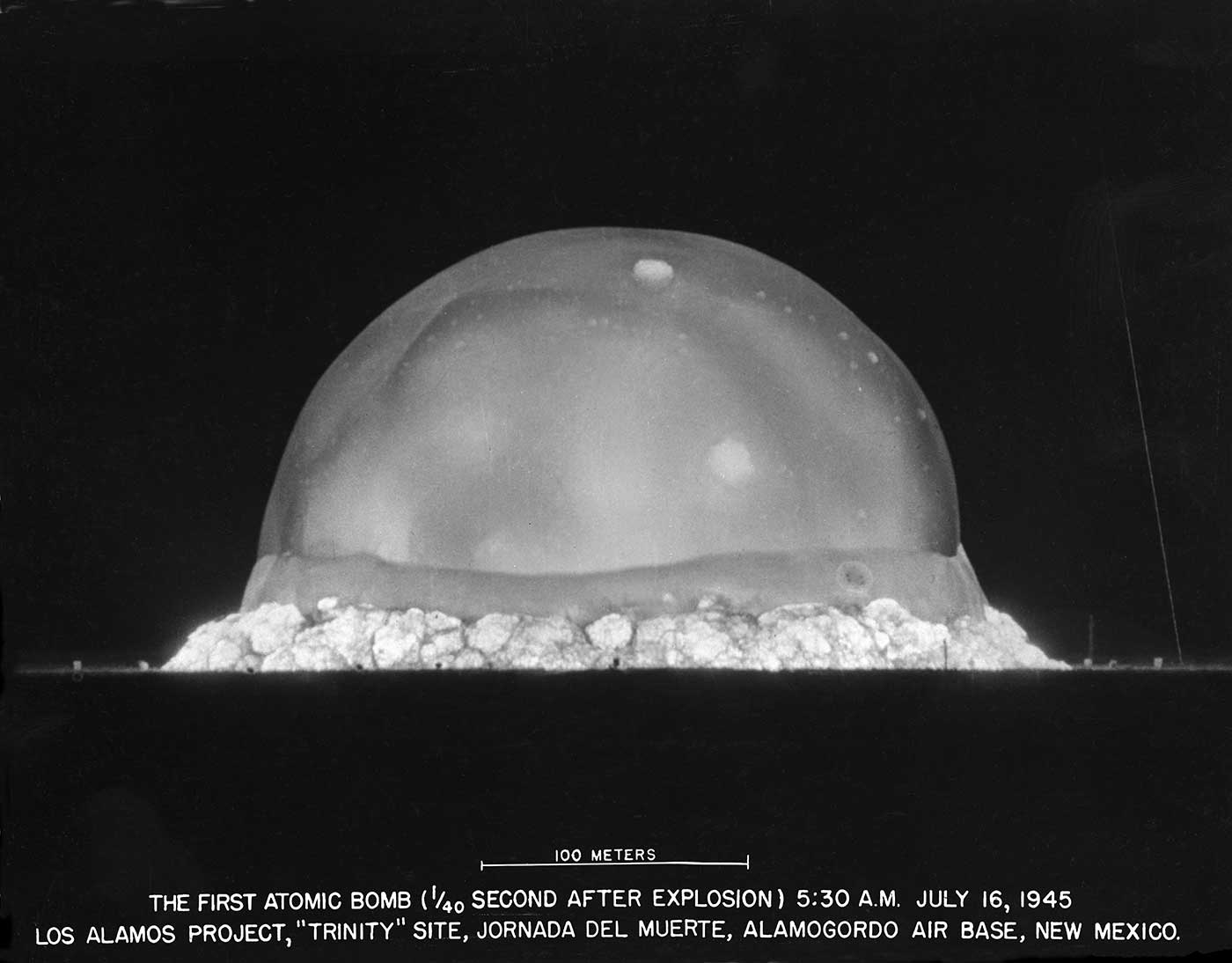
A photo of the bomb test

On July 16th 1945, in the middle of the New Mexican desert, a fireball erupted. The infamous Trinity Test had been conducted. The bomb worked. Around a month later, in the city of Hiroshima, Japan, the first bomb was dropped.
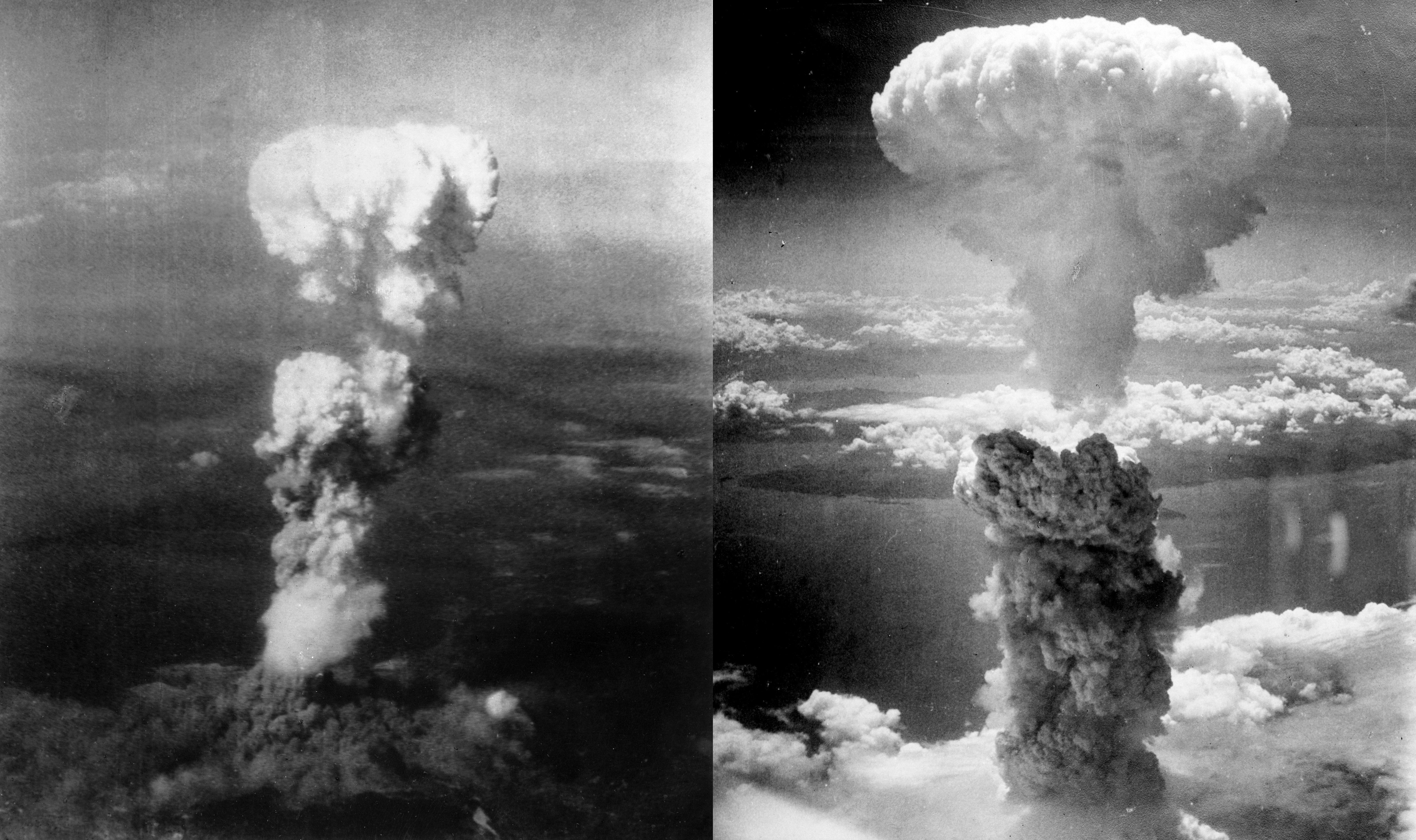
Photos of the bombings (Hiroshima left and Nagasaki right)

Buildings were instantly turned to rubble and people were vaporised on the spot, leaving only their shadows on the pavement. However, some would consider these the lucky ones. Akiko Takakura was at the Bank of Hiroshima when the bomb dropped. Despite being within 300 metres of the hypo-centre, she survived the initial bomb.

When I regained consciousness, I found myself in the dark. […] After a while, it began to rain. The fire and the smoke made us so thirsty and there was nothing to drink, no water, and the smoke even disturbed our eyes. As it began to rain, people opened their mouths and turned their faces towards the sky and try to drink the rain, but it wasn’t easy to catch the rain drops in our mouths. It was a black rain with big drops. […] We opened our mouths just like this, as wide as possible in an effort to quench our thirst. Everybody did the same thing. But it just wasn’t enough.

Takakura’s account of the aftermath of the bombing
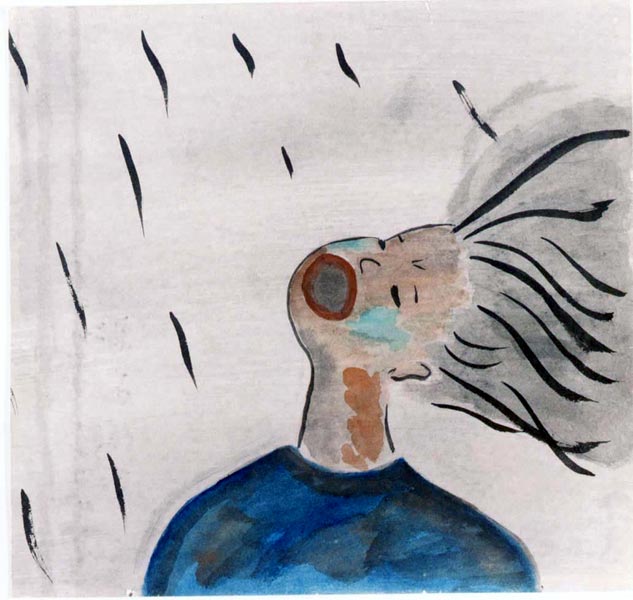
A drawing that Takakura made of her drinking the thick black rain

Takakura’s account is likely due to the bomb vapourising all the exposed water in the surrounding area, hence her dire thirst. The evaporated water had then mixed with the radioactive soot in the atmosphere, producing the thick black rain. Her friend, who also drank the water, succumbed to radiation sickness.

Private Shigeru Shimoyama just stepped into a concrete reinforced warehouse that was only 6 blocks away from the hypo-centre. He was flug against a back wall by the force of the explosion, saving him from falling debris. When he awoke, he found that his arms and shoulders had been impaled on nails protruding from the wall, leaving him hanging about a metre off the ground. Upon freeing himself and leaving the building, he spotted a group of bureucrats carrying a life sized portrait of Hirohito (Emperor Shōwa) throught the rubble. He spied a naval vessel patrolling through the river, full of dead bodies, which paused and the crew bowed to the Emperor.

A photo of Hirohito

He then turned around and saw a peculiar, pinkish white, fleshy horse. It was then that he realised the horse had gone through a phenomenon known as de-gloving, in which the skin of the horse was removed by the force of the blast, but still kept the horse alive. Shigeru, horrified, ran from the scene. Whenever he turned back, the horse continued to follow him.

Another soldier stationed outside the city heard the bomb go off and saw the mushroom cloud arise from the horizon. At the train station he was at, a passenger train rolled through from Hiroshima, all its windows smashed and most of its passengers burnt to a crisp. Those who weren’t stared out the windows with blank expressions on their faces. Every coach was at least smouldering with two coahces entirely engulfed in flames. After bringing a train to a stop, the group of soldiers decided to turn back in an effort to help survivors. On their way back, they encountered lines of people walking along the railway line, who all had their clothes, skin and muscles peeling off. These people were dubbed the Ant Walkers of Hiroshima.

A drawing of the Ant-Walkers by a survivor of the bombing

3 days later, another bomb was dropped, this time on Nagasaki, another nearby city. Anywhere between 150,000 and 246,000 people were killed in the bombings, the majority of which were civilians. The Japanese issued surrender on August 15th, with the surrender taking effect on September 2nd. World War 2 was over, lasting 6 years and 1 day.

The Japanese Minister of Foreign Affairs, Mamoru Shigemitsu, signing the peace proclamation aboard the USS Missouri

In the ensuing Tokyo Trials, seven out of the 28 people on trial were executed for crimes against peace, war crimes or crimes against humanity, including the Japanese Prime Ministers, Kōki Hirota and Hideki Tojo. Other Prime Ministers during this time were not executed, either sentenced to prison, dying before Japanese surrender or simply not being tried. Most notably, Senjūrō Hayashi and Fumimaro Konoe both died before Japanese surrender, from a brain haemorrhage and cyanide ingestion respectively. Kiichirō Hiranuma was sentenced to life at Tokyo before passing away in 1953. Nobuyuki Abe was arrested by the American occupation government but was never tried for any war crimes. The Emperor, however, was not tried on such crimes, despite being complicit in them, as the United States believed that in order to secure Japan for a democratic future, a stable Emperor must help them in their efforts. In addition, no-one on trial ever implicated Hirohito in any of the atrocities they committed in China and the Pacific.

However, the head of Unit 731, the Japanese human experimentation unit, Shirō Ishii, was not indicted for such crimes, as the Americans wanted to exchange their findings for immunity in court. Some of Unit 731’s experiments involved largely biological research. On occasion, they would release the bubonic plague into populated Chinese villages to study the rate of infection. They would give various diseases to prisoners of war and vivisecting them to observe the results on the human body. They would also cut open a person whilst they were still alive to remove organs to observe what impact it would have on the human body, including connecting the guts back up to the throat. This is only the tip of the iceberg of these experiments and the man behind these experiments got off Scott free.

After the bombing, Oppenheimer became and advisor to the United States Atomic Energy Commission (AEC), where he strongly advocated for international control of nuclear power in order to prevent a nuclear arms race with the Soviets. After the testing of the first Soviet nuclear bomb in 1949, Oppenheimer was suspected of allowing Russian spies into Los Alamos due to his communist ties. He had a feud with Lewis Strauss, the commissioner of the AEC, who felt sidelined by Oppenheimer’s contributions to the commission and atomic policy at large. Most notably, Oppenheimer believed that the government should be more open about American nuclear capabilities, whilst Strauss believed that such openness would benefit nobody but Soviet military planners. In 1949, Oppenheimer mocked a suggestion by Strauss in a public hearing regarding the medical use of isotopes. This was something that Strauss found humiliating and would never forget.
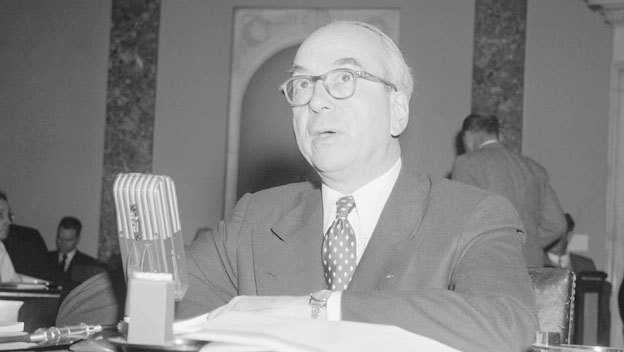
A photo of Strauss testifying in the 1950s

Eventually, Strauss began to develop a feud beyond just personal and political disagreements. He eventually began to suspect Oppenheimer of being a Soviet Spy. Strauss requested of J Edgar Hoover that he conduct surveillance on Oppenheimer, who discovered no evidence of disloyalty to the United States. However, Strauss persisted, organising with William L. Borden, former executive director of the United States Congress Joint Committee on Atomic Energy, to revoke Oppenheimer’s security clearance. Borden sent a letter to the FBI, stating that “more probably than not J. Robert Oppenheimer is an agent of the Soviet Union.” The clearance hearing was organised by Strauss, who appointed the board of three men as well as the lawyer to lead the case against Oppenheimer. Most of the evidence used against Oppenheimer was obtained illegally and was not shared with Oppenheimer’s lawyers in advance. Many government officials and scientists at Los Alamos testified at the hearing. Most notably, Lieutenant General Leslie Groves, Military Director of the Manhattan Project, stated the following.

In this case I refer particularly to associations and not to the associations as they exist today but the past record of the associations. I would not clear Dr. Oppenheimer today if I were a member of the Commission on the basis of this interpretation.

Excerpt from Groves’ testimony on Oppenheimer

Oppenheimer’s clearance was revoked in a 2-1 vote. He was shunned from the scientific community and political life for years until Lyndon B. Johnson gave him the Enrico Fermi Award, named after the Italian Physicist who created the first artificial nuclear reactor.

Many scholars today still wonder if the use of nuclear bombs on Japan was necessary. Some say that Japan would’ve surrendered regardless and that the bombing was merely Truman showing the power of the United States. No matter what you may think of the ethics of the bombing may be, the impact of the bombing was undeniable, with many people fearing nuclear annihilation due to rising tensions between nuclear powers, a fear that began in the 40s and is still very prevalent to this day.
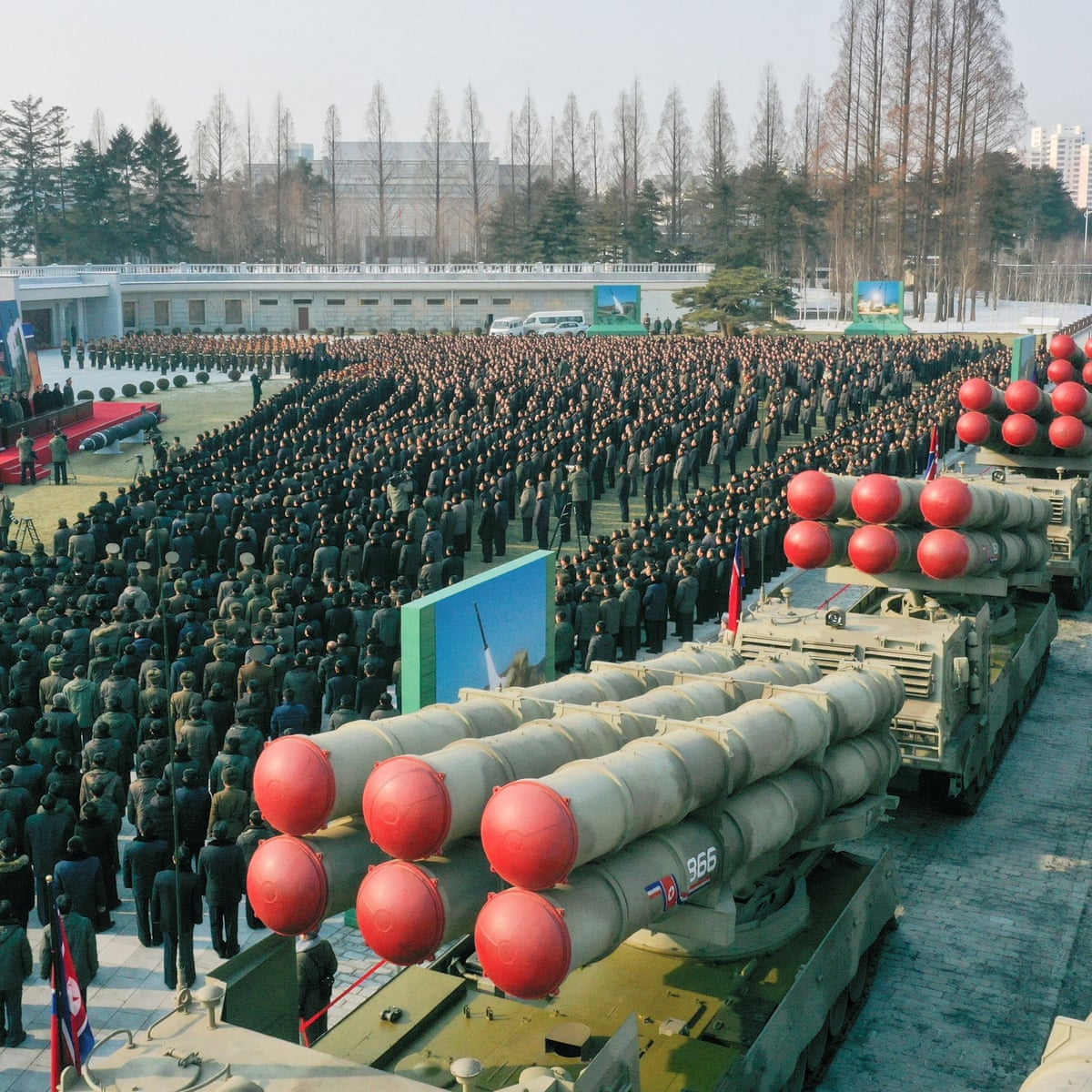
A military parade in North Korea in present day, showing off North Korea’s nuclear warheads

The longer the fighting goes on [in Ukraine], the more lives will be lost and the greater risk of nuclear escalation. Those who fuel escalation must know that in the event of a nuclear war, nobody wins.

Jeremy Corbyn, former UK Labour Party Leader, in an article for ‘Tribune’ magazine
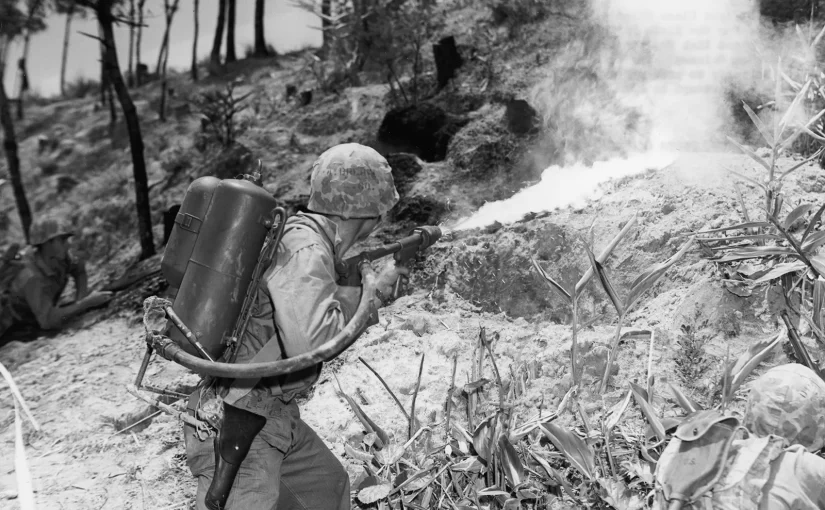
The Battle of Okinawa

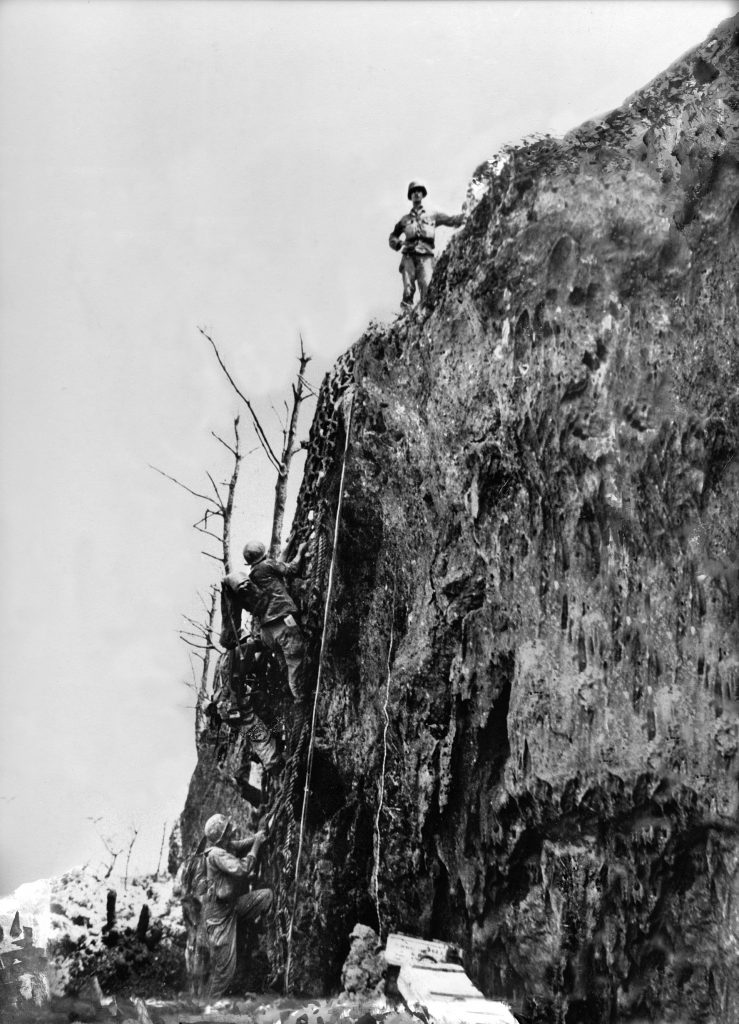
On May 2nd, 1945, the 77th and 307th Infantry Division alongside the remnants of the 96th and 381st looked up at the intimidating Maeda Escarpment on the island of Okinawa, known to the soldiers as Hacksaw Ridge, a 400 foot cliff which was a natural barrier to a series of trenches, tunnels and fortifications set up by the Imperial Japanese Forces. The climb up Hacksaw Ridge would determine the outcome of the Battle of Okinawa.

A photo of Hacksaw Ridge

By April of 1945, the Empire of Japan was on the ropes. With all their allies in the Axis Powers out of the picture, with Mussolini dead at a service station and Hitler cowering in the Führerbunker, the Japanese were the last members of the Axis with their homeland intact. Facing increasing partisan activity from the Chinese, causing massive losses on the front, and the United States having captured almost every island of theirs in the Pacific, including Iwo Jima a month prior, the last obstacle between the Americans and mainland Japan was the small island of Okinawa.

Located just 563km (350 miles) off the coast of Kyushu island, the southern most part of mainland Japan, Okinawa was a 1,207km² island, home to a vast amount of naval and air bases that would be useful in the event of an invasion of mainland Japan by the United States. Despite the fact that the 10th Army, commanded by Lieutenant General Simon Bolivar Buckner Jr, and the 5th Fleet, overseen by Admiral Raymond Spruance, vastly outnumbered the Japanese forces on Okinawa, the Japanese had come prepared.

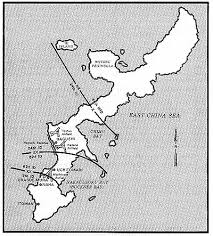
Map of Japanese Army positions on Okinawa

Lieutenant General Mitsuru Ushijima of the Japanese 32nd Army stationed only what was necessary in other parts of the island, focusing the majority of his forces in the south, due to its irregular and hilly terrain, opting to build a vast complex of tunnels, trenches and fortifications. By April, they had constructed 96km (60 miles) of tunnels, enough to accommodate the entire 32nd Army and everything it needed to fight against the Americans. In order to prevent the Americans from getting any supplies of their own, command ordered the massacre of every livestock animal on the island and that the civilians and soldiers live off sweet potatoes instead of the traditional rice.

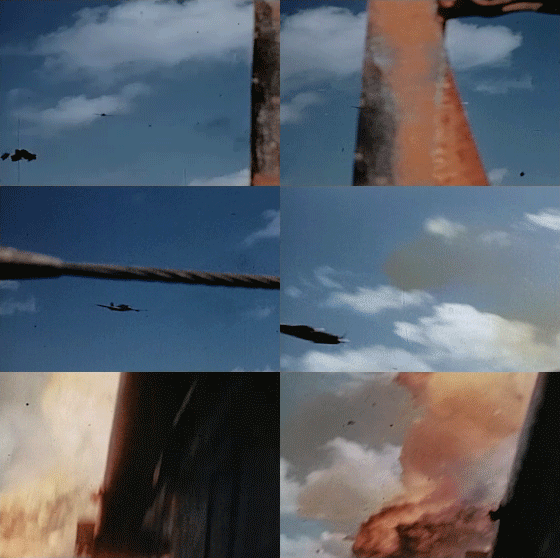
By now, the Japanese fighting doctrine of Fumeiyo Yorimo Shi, or Death Before Dishonour, had really been set in stone, with many Japanese soldiers, airmen and naval vessels doing suicide runs against American forces. With the infantry, “Banzai attacks”, in which mass numbers Japanese infantry would run at American forces with bayonets screaming “Tenno Heika Banzai” meaning “Long live the Emperor” had become common place. Planes would often fly into American naval vessels, in what were dubbed Kamikaze attacks, named after the Japanese term for “divine wind”, which dates back to at least the 13th century.

A GIF of a Kamikaze aircraft crashing into a US Warship in May 1945

On March 25th, 1945, the US Navy began shelling the island in a week long bombardment in order to soften up defences and support mine clearing. The next day, US Marines landed in the archipelago of Kerama Retto, rooting out Japanese forces there over the next five days, with its capture providing a sheltered anchorage for ships attacked by Kamikaze strikes. Eventually, the full battle began on April 1st, known as L-Day. However, the beach head was formed relatively easily, due to the fact that there was literally no Japanese resistance at the beaches that they landed at.

Having eventually secured a decent chunk of the island, with 60,000 US Troops having landed, they eventually encountered opposition in the North and South. Whilst the North was very easily taken care of, the South, where all the fortifications were, was a bloodbath. Americans would often advance into carefully prepared Japanese killing zones where they were slaughtered in their hundreds by concealed machine guns and mortars. Their idea for an offensive would involve mass artillery shelling of Japanese positions before advancing towards the Japanese pillboxes, which often included the use of flamethrowers against Japanese positions. However, this strategy lead to little success, due to the Japanese remaining sheltered in their fortified tunnels, and caused more bloodshed on both sides, as the Japanese would often launch night attacks after Americans had captured positions. Eventually, the battle reached a stalemate on the Shuri Line, a heavily fortified area located near Shuri Castle.

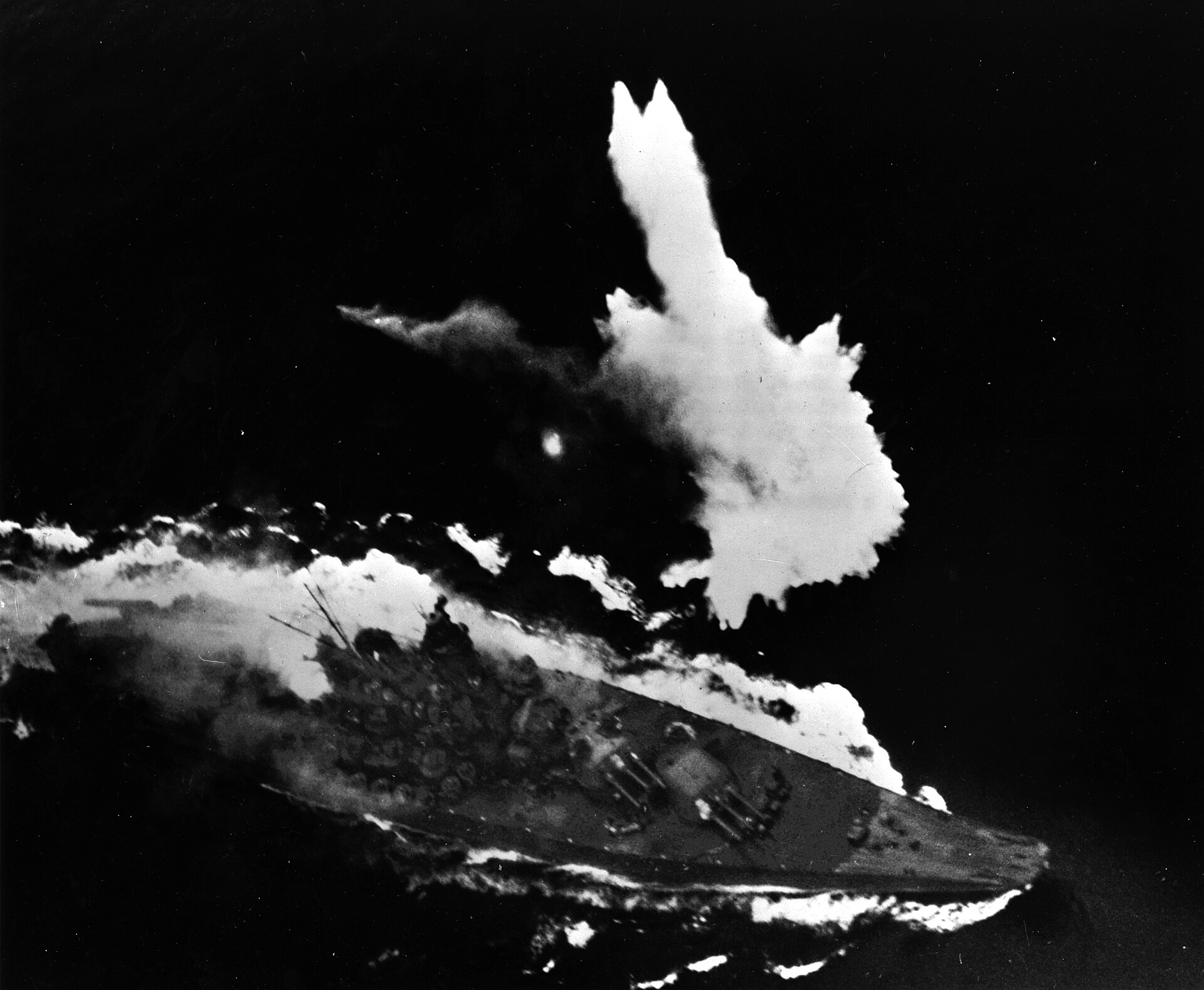
Meanwhile, Operation Ten-Go went ahead, a one way suicide mission by the Japanese, dispatching the Yamato, the largest battleship ever constructed, to counter offensives by the US Navy on Japanese infantry positions. It was spotted before it could reach Okinawa and was sunk, along side 5 of its escort ships and the destruction of 100 Japanese fighters, largely in Kamikaze attacks, by an American carrier force, which only lost 10 fighters in comparison. It demonstrated US air superiority and served as a great anti-climax to the largest battleship to ever be made.

A photo of the Yamato being attacked

Despite the stalemate and consistent bloodshed, Buckner refused to change his tactics, much to the surprise of both US Army high command and the Japanese. Whilst a somewhat successful counter offence was launched by the Japanese after his refusal to change tactics, they still lost 7,000 men in doing so. This allowed Buckner’s forces to gain the upper hand and gain back half a mile of land

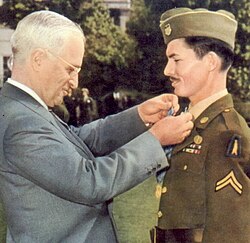
During the stalemate on the island, a combat medic known as Desmond Doss served at Hacksaw Ridge, managing to rescue hundreds of men from the rain of fire without being armed with a single weapon due to his Christian beliefs. He was awarded the Medal of Honour, of which Truman said “I’m proud of you. You really deserve this. I consider this a greater honour than being president.” Doss passed away in 2006 due to breathing complications and his memory was immortalised in the 2016 Mel Gibson Film “Hacksaw Ridge”, in which Doss is played by Andrew Garfield.

Desmond Doss receiving the Medal of Honour

Over the next few months, the situation became progressively more dire for the Japanese. Whilst spring rain had slowed the American advance even more than before, Nazi Germany had surrendered and more forces from Europe were now available. In a desperate effort to maintain control over the island, mass Kamikaze strikes were ordered against American Vessels, including the USS Bunker Hill and the USS Enterprise, knocking both vessels out of the war.

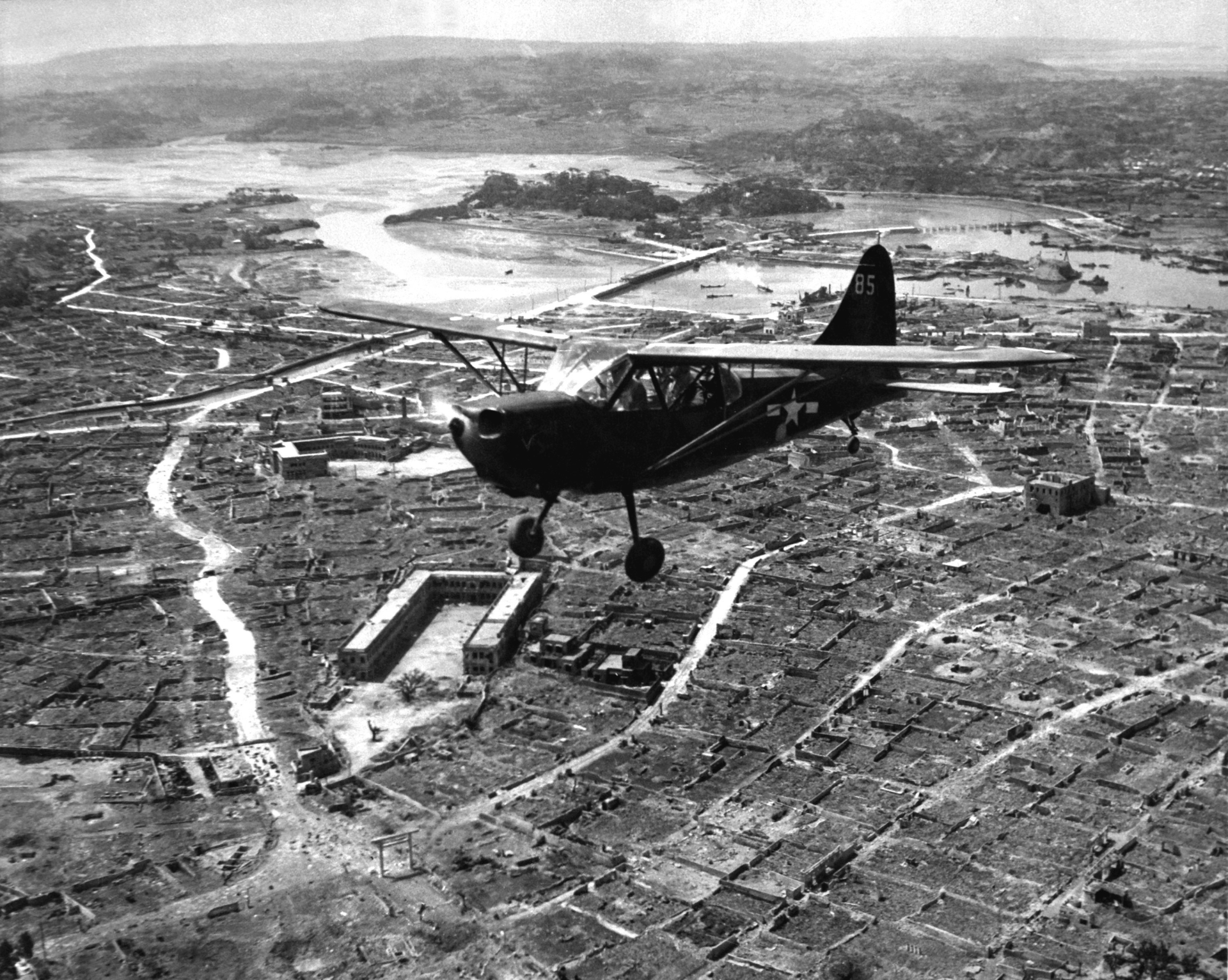
Eventually, the Shuri Line became untenable by late May. The Japanese began organising a retreat in stages to the Kiyan Peninsula, the southern most point of the island. Starting on May 24th, the Japanese slowly retreated down the island towards the peninsula. Despite the death of Buckner on the battlefield during an artillery strike, making him the highest ranked US Military officer killed in action during WW2, the entire Japanese garrison was massacred to a man, with a little over 7,000 troops surrendering to the Americans out of the 110,000 stationed on Okinawa before the battle. Out of shame, Ushijima committed Seppuku or more commonly referred to as Harakiri, a traditional Samurai form of suicide via disembowelment, on June 21st. The military garrison on Okinawa had also used much of the civilian population as human shields and convinced many of them to commit suicide or simply killed them, in order to cover up their atrocities perpetrated on the island, saying that the Americans would do worse. The Americans too lost many men in the battle of Okinawa, leading them to question if a mainland invasion of Japan would simply cost more lives, possibly influencing the decision to drop the atomic bombs on Japan 2 months later.

US Marine Corps plane flying over the razed capital city of Okinawa

Casualties

  • United States – ~50,000
  • Empire of Japan – 94,136
  • Civilian – 150,000

John F. Kennedy and the PT-109

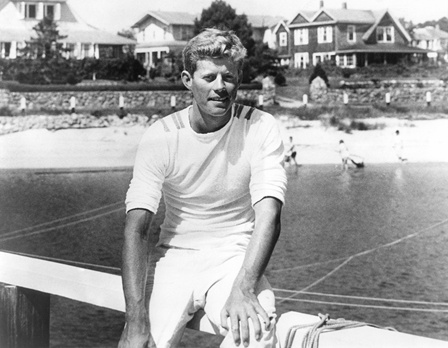
John F. Kennedy was, in 1941, a young up-and-comer in the political and law world. His father, Joseph Kennedy, was appointed as the US Ambassador to the United Kingdom by Franklin Roosevelt. Once World War 2 had begun, Joe spoke on this, saying that “Democracy is finished in England. It may be here [in the United States]” and was forced to resign his position due to the controversy around this statement. Due to his father’s position in government, the young John travelled all across Europe, accompanying his father on diplomatic missions during the lead up to the war. During this time, he wrote his thesis for Harvard, on Neville Chamberlains appeasement methods with Adolf Hitler. The thesis was published and, as one of the first sources of information about these events, quickly became a best-seller. Kennedy was adamant that the US must intervene in the war, opposing his father’s beliefs.

A photo of the young JFK in 1941

He attempted to join the Officer Candidate School, but wasn’t allowed in due to his physical health, which may have included the chronic back pain that he may have had since he was very young. Eventually, he was assigned to the United States Naval Reserve, commissioned to ensign in October of 1941.

Once Pearl Harbour was attacked by the Japanese, the US was thrust into World War 2. In January of 1942, Kennedy was assigned to the Office of Naval Intelligence field office in Charleston. Kennedy had wanted to command a Patrol Torpedo Boat but believed that he would be stopped from doing so due to his medical conditions. His father ended up falsifying medical records and convincing PT command that his son’s presence would bring good publicity. He completed his sixth months training and was assigned to the PT-101. Not wanting to be stuck in the Panama canal, Kennedy convinced the Massachusetts Senator to assign him to the South Pacific in order to get some real combat action. By April 1943, he had been assigned to the PT-109.

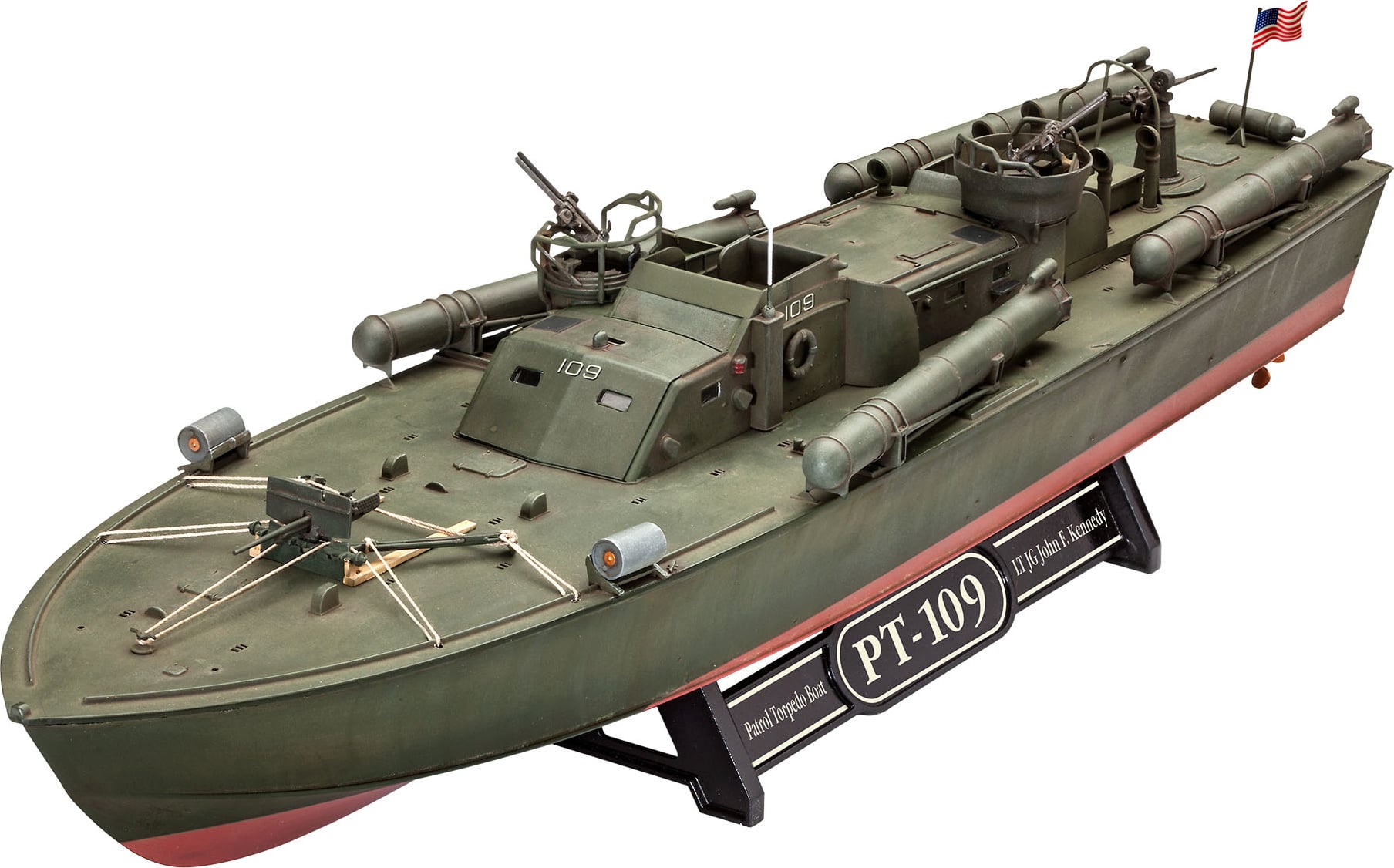
A model of the PT-109

The PT-109 was a 80 foot (20m) long patrol torpedo boat. It had 3 twelve cylinder, 1,500 horsepower engines, and had a top speed of 41 knots (76 km/h or 47 mph). It was fitted with four 21-inch torpedoes and a 20mm anti-aircraft gun and four .50 calibre machine guns but was not equipped with a radar. At the start of the ship’s deployment, it had a crew of 15:

  • Lieutenant and Commanding Officer John F. Kennedy
  • Executive Officer Leonard Jay Thom
  • Quartermaster, cook and signalman Edgar E. Mauer
  • Radioman John E. Maguire
  • Gunners Raymond Albert, Charles A. Harris, Harold W. Marney, Maurice L. Kowal, Edmund T. Drewitch, Leon E. Drawdy and William Johnston
  • Motor Mechanics Gerald E. Zinser and Patrick Henry McMahon
  • And Torpedomen Raymond L. Starkey and Andrew Jackson Kirksey
The crew of the PT-109. Top row left to right are Al Webb (friend and not a crew member) Leon E. Drawdy, Edgar E. Mauer, Edmund T. Drewitch, John E. Maguire. Bottom row left to right are Charles A. Harris, Maurice L. Kowal, Andrew J. Kirkesy, Leonard J. Thom, and John F. Kennedy.

In June of 1943, Drewitch had to be discharged after an injury occured when a depth charge was dislodged and landed on his bunk bed. Kowal and Drwady were both injured in July during an attack from Japanese Aircraft.

By the time of the 109’s final mission, there were 13 men aboard, as George H. R. Ross was assigned after his boat was destroyed and was an observer aboard the boat. A 37mm gun was lashed down to the front of the boat in August.

On the night of August 1st, fourteen PT boats, including the 109, were assigned to Kolombangra, an island in the middle of the Solomon islands, where 4 Japanese destroyers were alleged to appear, carrying food supplies and 900 Japanese soldiers to the Japanese Garrison on the island and were set to pass through that night. Their orders were to repel or block the Japanese advance to the island. 24 torpedoes were shot from 8 of the PTs and not one hit the convoy. The entire convoy arrived unscathed at the Naval Base in Kolombangra, due to attacks taking place at night and radio silence being enforced throughout the PTs

The region that the PTs were assigned. The naval base is stationed on the south of the island and was coming south through the Vella Gulf

At around 2:27 am, Kennedy spotted a Japanese destroyer, the Amagiri, returning from the base, heading north, straight at them. Kennedy decided to turn the boat to attack the destroyer with a torpedo and the newly mounted 37mm. Ross was assigned to the 37mm but he unfortunately suffered from night blindness, meaning that the could not effectively attack the boat. Within the next ten seconds, the 109 began to turn to the starboard side, with the Amagiri being commanded to match the turn.

The collision path of the two boats, graphics by Historigraph (YouTube)

After having made a sharp right turn to avoid a potential collision, the PT-109 was rammed by the Amagiri and split in half. A large fireball erupted from the 109, rising to around 100ft (30m) in the air. Some of the oil that had spilled from the boat had ignited the surface of the water. Kirksey and Marney were killed instantly, whilst McMahon was burnt from being thrown into the flaming water.

A drawing of the crash

The 11 survivors clung to the side of the bow, that had not yet gone under water. They drifted south, down the Vella Gulf. Eventually, Kennedy decided that they needed to reach land before another destroyer found them or the bow sunk. The two largest islands wither side of them, Kolombangara and Ghizo were, at the time, occupied by Japanese forces. Kennedy decided to go to the small Plum Pudding Island, about 3.5 miles (5.6km) south west of their position. Unfortunately, McMahon was unable to swim, as well as two others who had been badly injured during the crash. Kennedy decided to make a raft out of a spare piece of drift wood, broken off from the boat. He then loaded two of the injured men onto the raft, whilst he hoisted McMahon onto his back and swam to Plum Pudding Island. They started the swim at 2pm on August 2 and lasted 4 hours.

Eventually, Kennedy with McMahon on his back reached the northern tip of the island, with the other 9 survivors arriving a little behind. The nearby American naval base at Rendova had received word of the 109’s crash but due to the size of the fireball reported believed that there would be no survivors so no rescue attempt was made. However, American coast watchers on Kolombangara had seen the wreckage of the bow drift down the gulf, who sent out the message to look out for any survivors

Both Kennedy and Ross swam out relatively far off the coast of the island on separate occasions. Both times came up fruitless. The crew had now been stranded for 2 days and were beginning to get hungry and thirsty. Kennedy organised the group to swim a mile (1.6km) south to the larger island of Olasana in search of supplies. Upon arrival, there was no fresh water and nothing to eat but unripe coconuts. That night, the weather worsened, meaning that they could not travel to another island in search of supplies

The next day, Kennedy and Ross swam half a mile over to Naru Island, finding an abandoned wreckage of a Japanese Barge upon their arrival, where there was food, water and other various supplies, including a small canoe. Meanwhile, a patrol boat of Solomon Natives, on the orders of the coast watchers, were investigating the barge from the water and saw Kennedy and Ross aboard the island, heavily sunburnt. Believing them to be the survivors of the barge, they decided to turn away from Naru Island, heading north to Olasana for some water. They passed by the beach, spotting the rest of the heavily sunburnt crew, believing them to also be Japanese. However, Thom’s distinct blonde beard made them realise that they were not Japanese.

The scouts informed the coast watch of the survivors, who immediately organised food and provisions to be sent over to the crew. A torpedo boat was then deployed to rescue the crew and brought them back to the base on Rendova. Battered, bruised but breathing, the crew had made it home.

The much more seriously injured crew were treated while the rest were reassigned to other PT boats. Kennedy would later go on to tell this story of survival whilst campaigning for Senator of Massachusetts and President of the United States.

A campaign parade for JFK’s 1960 Presidential Campaign