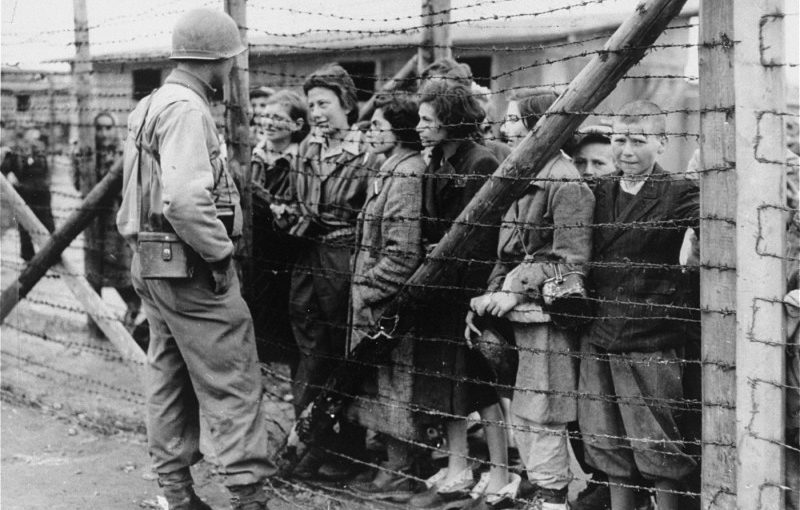
When we went to Nohra, […] we took a day trip into Buchenwald. […]It was just unbelievable to see. You couldn’t—there was so much of it, you couldn’t grasp at all. We just see these people standing, you see the bodies. You see the ashes. You see the ditches. It’s just—I can’t really describe it to tell you, you know, how horrendous it was to see these people treated like animals. You might see even worse than that.
Andrew Kiniry, 45th Evacuation Hospital, describing when the 3rd Army liberated Buchenwald
As the allies advanced from the West and the Soviets from the east, many expected to see the remnants of training camps or POW camps. What they found was beyond their wildest nightmares.
What they found were thousands upon thousands of men, women and children, all on the brink of starving to death, who had been left abandoned in fences like cattle. Not only were these people but specific groups of people. Some were disabled, some were gay, some were slavs. But the most notable among these groups of people were the Jews. The soldiers thought they had seen the worst of it but they were very wrong.
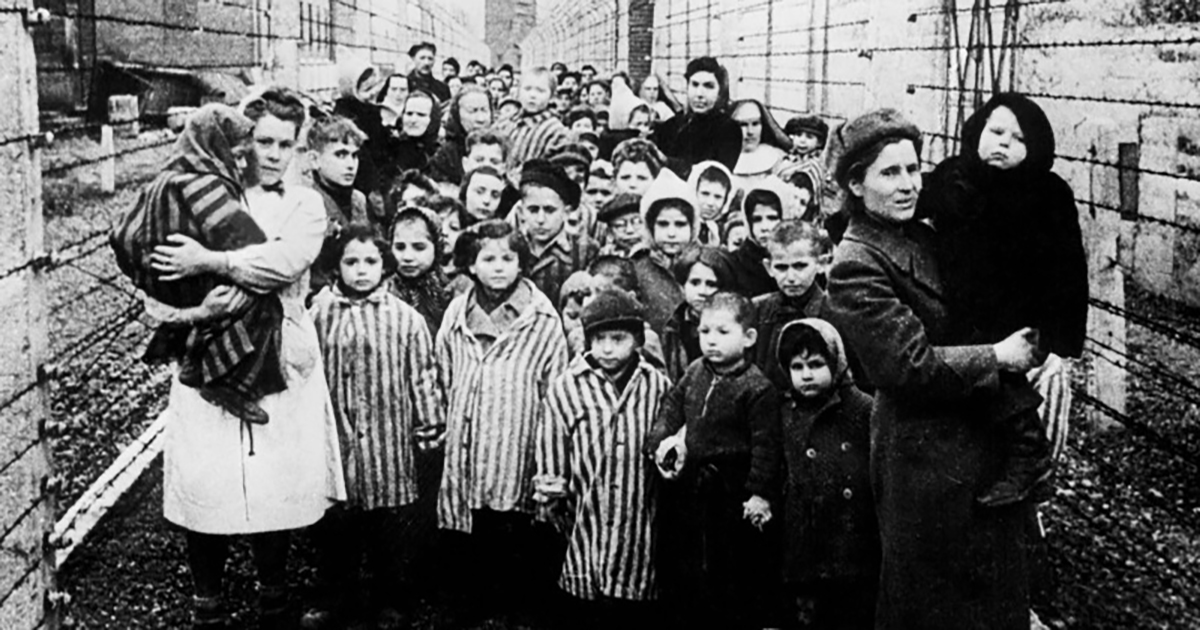
A group of child prisoners at Auschwitz
They found large gas chambers, in which the prisoners would be put inside, under the pretence of having a shower to cleanse themselves. Then, Zyklon B, a pesticide, would be poured in through the showers. Deaths could take anywhere between 3 minutes to 30. The bodies were then dragged out and burnt in ovens nearby. The specific targeting of Jews was called Germany’s “Final Solution”, which involved the eradication of the Jewish population from Europe. This was known as the Holocaust, but many Jews today prefer to call it the Shoah.
Over 5.7 million Jews were killed in the Holocaust. Others killed included 2-3million Soviet POWs, 1.9 million Poles, 1.5 million Romani, 250,000 disabled people, 170,000 Freemasons, 25,000 Slovenes, 15,000 homosexuals, 5,000 Jehovahs witnesses, 7,000 Spanish Republicans as well as countless others. Around half of the Jewish deaths were attributed to the gas chambers, whilst the rest were due to forced labour in the camps, starvation in the camps and ghettos as well as mass shootings, most notably by the Einsatzgruppen, a death squad that tailed the Wehrmacht in their march east.
Upon discovery of the concentration camps, Dwight D. Eisenhower, the Supreme Commander of the Allied Expeditionary Force, told his men to film the horrors they encountered. The film reels were then compiled into a 1 hour long documentary, shown as evidence at the Nuremberg Trials and the Trial of Adolf Eichmann, an architect of the Holocaust, after his capture in 1961
Get it all on record now – get the films – get the witnesses – because somewhere down the track of history some bastard will get up and say that this never happened
Dwight D. Eisenhower speaking to his men about the Concentration Camps
Eisenhower, Omar Bradley, George Patton and American forces at Ohrdruf concentration camp, a part of the Buchenwald network
The survivors were liberated, many only to find that their homes had been repossessed. Many Jews sought shelter in Palestine whilst others stayed in Europe, where persecution still occurs to this day. To this day, people still deny these events happened, either that the statistics are overestimates or that such things never occurred and is simply a victim complex made by Jews, despite the countless amount of evidence recorded not just by the Allies and Soviets but by the Germans themselves. Many cite the Holocaust as the greatest humanitarian tragedy in history.
The only thing necessary for the triumph of evil is for good men to do nothing
Edmund Burke
Oskar Schindler was a German speaking man living in the Sudetenland before war broke out. He was very well known in his youth for being a Casanova, before settling and marrying Emilie Pelzl in 1928. However, their marriage was fraught with strife, as Emilie believed that Schindler only married her when he needed someone to come home to.
By 1938, Schindler managed to land himself as a spy for the Germans, infiltrating Czechoslovakian society. Eventually, he was found out and sentenced to death. However, with days, perhaps even hours of his life left, Hitler annexed the Sudetenland and, in accordance with the Munich Agreement, Schindler was let go. He eventually ended up joining the Nazi party just before the outbreak of World War 2. Him and his wife were moved to the industrial town of Ostrava near the Polish Border, where he would bribe Nazi Officials in order to curry favour. Once Poland was invaded in 1939, Schindler saw this as a new business opportunity.
He set up shop in a Jewish Ghetto set up by the Nazis in Krakow, Poland. He made enamel in the city and hired a Jewish man who used to work in the factory he took over, Abraham Bankier, as floor manager and made him hire the employees. This assistant made it so that as many Jews could be considered essential workers so wouldn’t be taken to concentration camps and killed. He justified this to Schindler by saying that, due to Nazi laws, Jews were payed less so would cost him less money than hiring Poles to do the same work. Schindler agreed whilst enjoying the company of the Nazi party officials due to his new stature as an industrialist. He had landed himself a large contract supplying the army with kitchenware in their new war against France and Britain.
By 1941, a new law was passed stating that Jews could now earn zero money, and all money that would usually be payed to Jews would now be paid to the SS. However, this now meant that the survival of the Jews working in the factory was now Schindler’s choice. Schindler decided to use his connections with the black market to supply his workers with food out of his own pocket. This is the beginning of Schindler’s arc to redemption.
By 1942, the Death Camps had begun to open. Many of the Jews in Krakow were sent to Belzec Death Camp. However, because they were employed by Schindler, the now hundreds of Jews under his employ were saved from the gas chambers. However, things soon began to change.
Amon Göth, a second Lieutenant in the SS, ordered a new camp to be constructed in Plaszow, only 4km from Krakow. Every morning and every night, Jews from Krakow would work on building the new camp and then working inside. Göth was ruthless, he would use Jews at target practice and train dogs to attack them on command. Schindler began becoming friendly with the tyrant of Plaszow, by sending him lavish gifts he found on the black market, taking him to lavish parties and charming him relentlessly.
A photo of Amon Göth
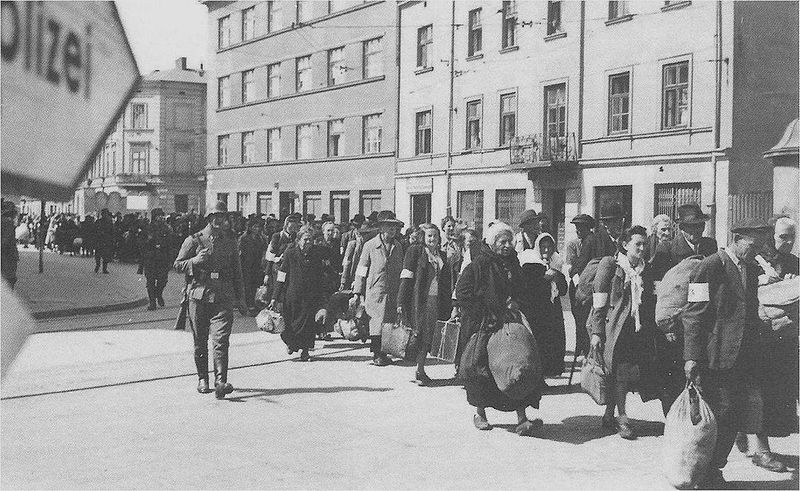
In March 1943, Göth ordered Krakow Ghetto to be liquidated and all the Jews to be moved to Plaszow. 2,000 Jews are moved while another 2,000 are killed during the liquidation. Schindler allegedly hid his employees inside the factory to keep them from harm.
The Liquidation of Krakow Ghetto
After having witnessed the liquidation, Schindler was said to be appalled. Sol Urbach claimed that:
[Schindler] changed his mind about the Nazis. He decided to get out and to save as many Jews as he could
Sol Urbach, Schindlerjude
Schindler moved his operation to Plaszow and bribed Amon Göth to do so and build a sub camp around the factory, whilst still maintaining a relationship with him. Göth allowed Schindler to do whatever he wanted inside the sub camp in Plaszow, which Schindler took to his advantage. The Jews who worked for Schindler inside his camp were given adequate food and living quarters, banning the SS from entering the camp.
As Germany realised it was on a track to losing the war, Göth ordered all Jews to be moved to Auschwitz to be killed. Schindler managed to, at a large personal expense, to get Amon to allow him to take all his workers to Brunnlitz to set up another factory there.
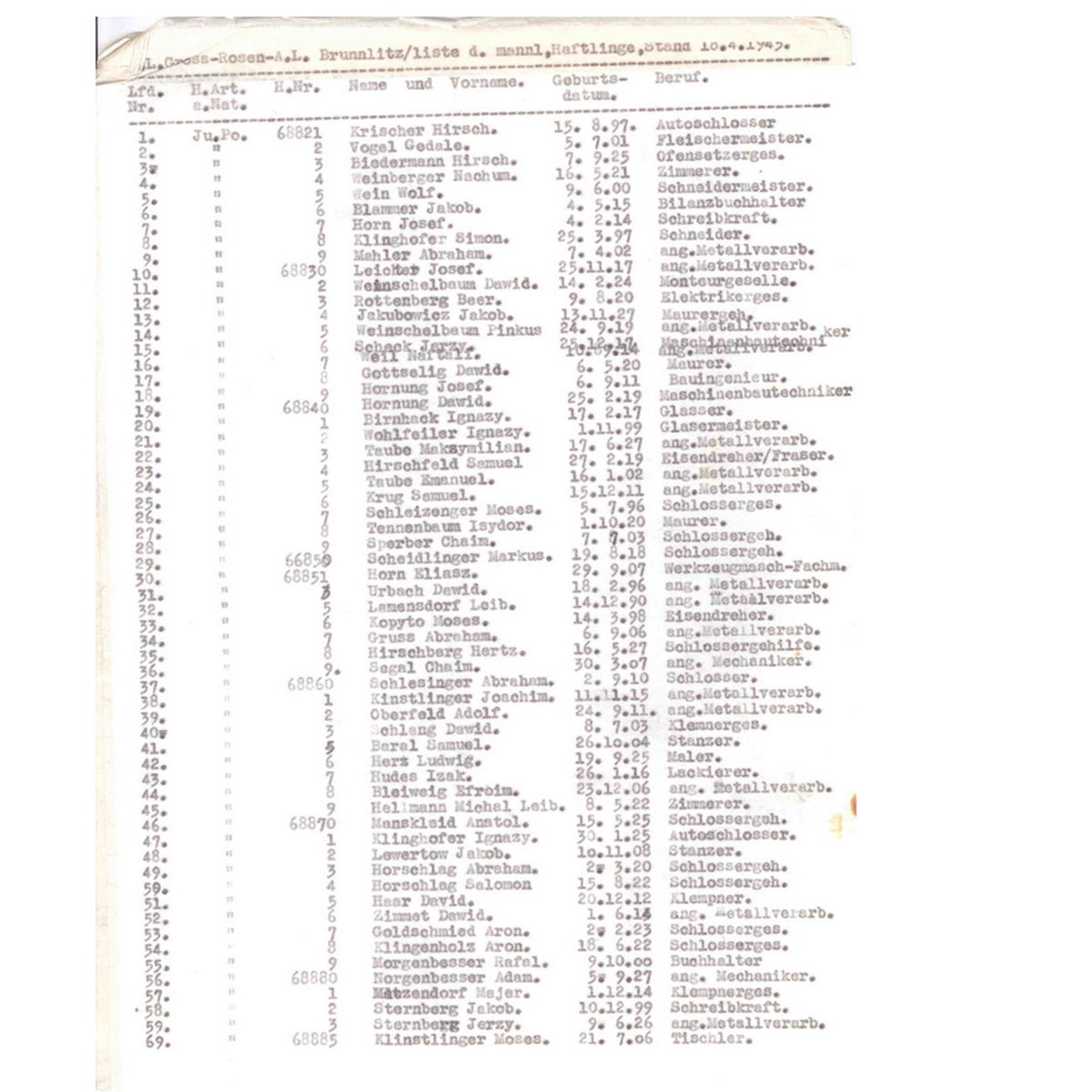
Amon asked him to make a list of every name he needed for his new factory. This list included 1,100 Jewish names. However, Schindler was unable to write it in person, as the SS had arrested Göth for his black market dealings via Schindler. Schindler was ratted out by Göth and also arrested. He assigned Marcel Goldberg to prepare the list.
One page of Schindler’s List. The list ended up being almost 20 pages long
Every man on the list was successfully sent to Brunnlitz. However, a train carrying the women was sent to Auschwitz by mistake. Whilst in prison, Schindler scrambled to save the women from death, sending a representative down to stop the extermination. Despite a very close call with death, all the women were moved safely to Brunnlitz. By now, Schindler had spent a lot of money on bribes, black market dealings and saving the lives of the Jews. He spent the last of his money on decent clothes for his workers. His workers spent the last days of the war intentionally making faulty guns in order to hinder the Nazi war effort as much as possible.
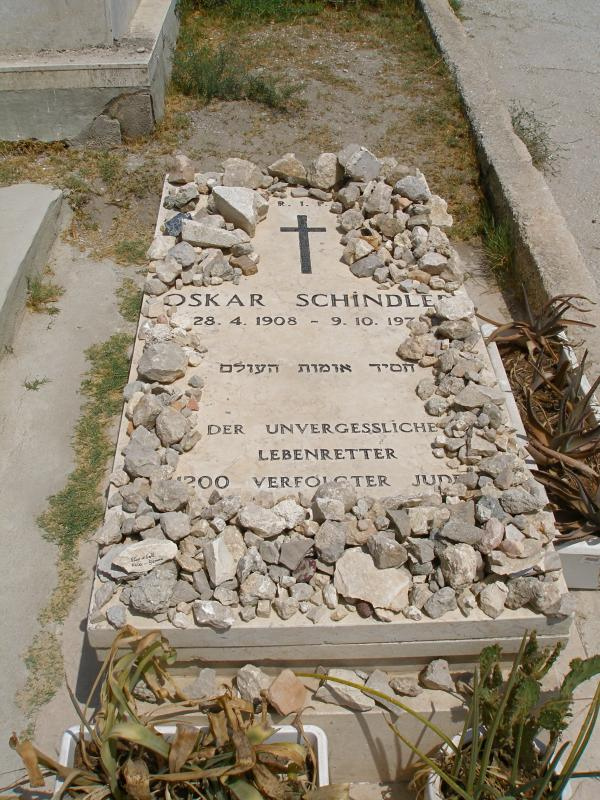
Once the war was over, Schindler was penniless but had saved 1,100 lives from the hands of the Nazis. However, because he was a member of the Nazi Party, a war profiteer and a profiteer of slave labour, he had to go into hiding in Argentina. He left his wife in 1957 and sailed back to West Germany. He died, poor, with a collapsed business and a failed marriage in 1974. However, for those few years, he would recieve small donations from the thousand lives he had saved from the clutches of evil. Amon Göth was hanged for crimes against humanity. The people he saved named themselves the Schindlerjuden, in his honour. Schindler’s name was added to the Avenue of the Righteous in Israel, a place were those who saved Jews during the Holocaust and risked their lives doing so. He was buried upon Mount Zion in Israel. Over 8,500 people are alive because of Schindler’s actions that wouldn’t have been otherwise.
Oskar Schindler’s grave covered in stones, a sign of respect for the dead in Judaism
Schindler’s story was turned into a book, Schindler’s Ark, by Thomas Keneally which was inspired by Poldek Pfefferberg, a Schindlerjude. The book was later adapted into the 1993 film Schindler’s List directed by Steven Spielberg and starring Liam Neeson, Ralph Fiennes and Ben Kingsley. It was nominated for 12 Academy Awards and won 7, including Best Picture. It is considered to be one of the greatest films of all time.
Liam Neeson (left) and Ben Kinglsey (right) portraying Oskar Schindler and Itzhak Stern respectively in Schindler’s List
Within Hitler’s Third Reich, the name Reinhard Heydrich was always whispered with much more than just a hint of fear. Appointed to Director of the Nazi Secret Police, named the Gestapo, Heydrich was as loyal to the Führer as he was ruthless and brutal with his enemies. He also was Director of the Reich Security Main Office and the Deputy to the Reichsführer-SS, Heinrich Himmler, who viewed Heydrich as his loyal protege and right hand man. As one of the main architects behind the Holocaust, he created the system that would lead to 6 million Jews being murdered simply for their ethnicity, most of whom were killed in the gas chambers. Hitler nicknamed him “The Man with the Iron Heart”.
A photo of Reinhard Heydrich
After a large resistance movement had built up in the Protectorate of Bohemia in Moravia, a Nazi Protectorate created out of the modern day Czech Republic, Hitler fired Konstantin von Neurath as Protector and Heydrich was appointed as Protector in September of 1941. Here, Heydrich ruled with an iron fist. Within his first week, he ordered to public hanging of 142 people.
Meanwhile, the exiled Czechoslovak Government in London were becoming increasingly unpopular. Whilst resistance in other Nazi conquered territories, such as Poland and France, were seen as brave heroes, the Czech resistance were merely content with sabotaging a couple factories. Destined to prove themselves, they informed British Intelligence that they would assassinate Heydrich. The name of the mission would be Operation Anthropoid.
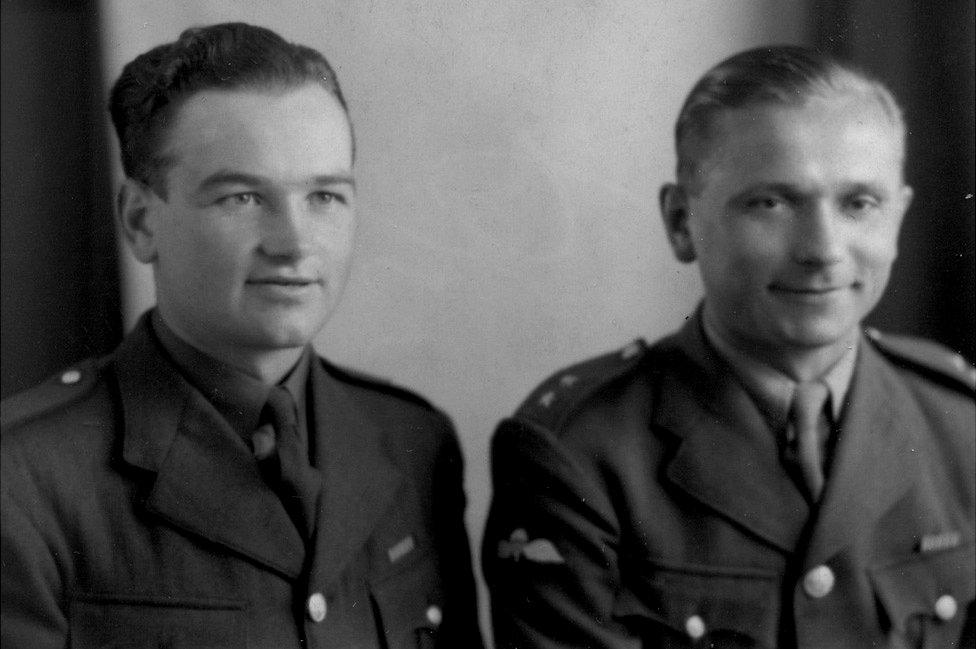
Two men were assigned to the mission, Jan Kubiš and Jozef Gabčík, two former Captains in the Czech Army. The pair, along with some half a dozen commandos, parachuted into a wooded area just outside Prague.
A photo of Gabčík (right) and Kubiš (left)
By now, Heydrich’s mission to pacify the protectorate was complete, not just employing brutality but kindness where necessary, in an effort to distract the population from his crimes. In fact, he felt so confident in achieving his mission that he felt comfortable driving around in an open top car, armed with only handgun, with his driver also equipped with just a handgun.
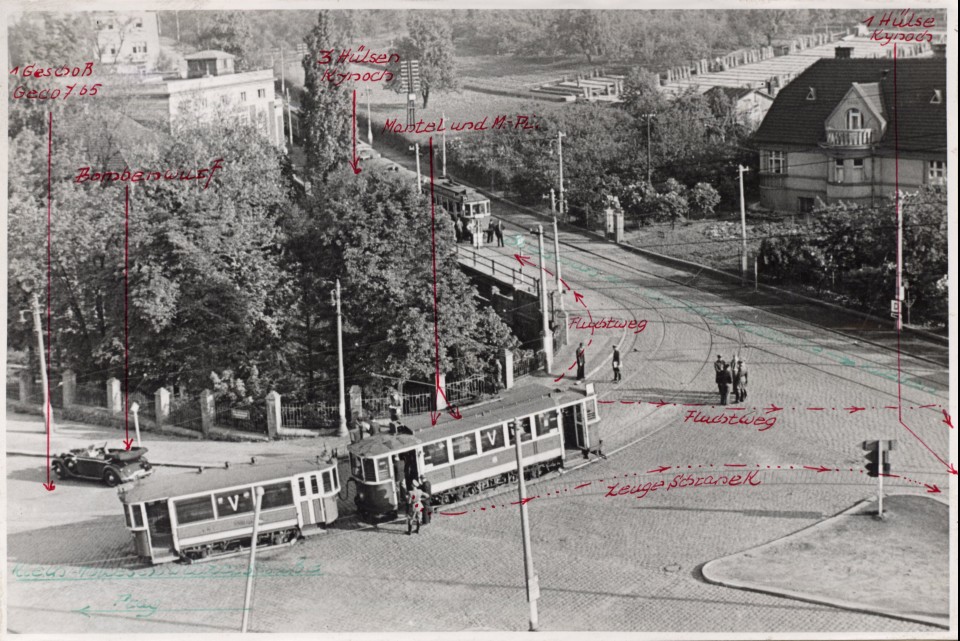
Having been in Prague for five months and making little progress, Kubiš and Gabčík became increasingly frustrated. However, a plan was soon devised. On his morning route to work, Heydrich would go around a hairpin corner near Bulovka Hospital. Due to the slow speed that the car would take at this time, they decided that this would be a perfect opportunity to strike.
An image of the corner where Heydrich was killed
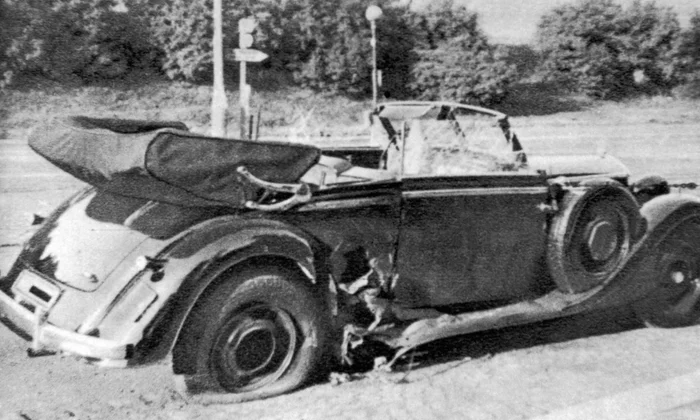
On the morning of May 27th, 1942, Gabčík and Kubiš stood at a tram stop, with a Sten gun and an anti-tank grenade respectively hidden on their persons. As Heydrich’s car turned the corner, Gabčík revealed himself and his gun from underneath his raincoat. Attempting to open fire, his gun had jammed, allowing Heydrich to order the driver to stop so he could shoot back with his Luger. This allowed Kubiš to roll the grenade underneath the car, where it exploded, sending shrapnel flying which wounded Heydrich fatally in his diaphragm, spleen and lungs. Kubiš grabbed a bicycle and tore off, whilst Gabčík escaped on foot. Heydrich also followed on foot, having ordered his driver to go after Kubiš. However, Heydrich, a well known sportsman, ran out of breath after a short pursuit. He looked down to find that he was bleeding from the side.
Despite hospital treatment, his wound became infected with sepsis and he collapsed on June 3rd, 1942, being declared dead the next day. Some suspected that horse hair from the lining of his car and been forced into his body during the explosion. Others suspect it was a pulmonary embolism whilst others believe that the grenade had been laced with botulism as a biological weapon, which potentially ended up in his body during the explosion. However, this last theory is possibly eronious as both Kubiš and a bystander were injured by the blast, neither of whom died. No matter how, the Butcher of Prague was dead.
His state funeral was held on June 7th 1942. Whilst Goebbels weaponised the assassination as pro-German propaganda, Hitler privately blamed Heydrich for his own demise.
Since it is opportunity which makes not only the thief but also the assassin, such heroic gestures as driving in an open, unarmoured vehicle or walking about the streets unguarded are just damned stupidity, which serves the Fatherland not one whit. That a man as irreplaceable as Heydrich should expose himself to unnecessary danger, I can only condemn as stupid and idiotic.
Hitler speaking on Heydrich
A photo of Hitler and Heydrich’s funeral
However, he was still angered with the Czechs. He immediately ordered the massacre of 10,000 randomly selected Czech civillians, in what would become known as the Lidice Massacre. Every male in the village was shot on sight, whilst the females were sent to concentration camps. The village was then set alight whilst all the animals in the village were rounded up and shot. A similar massacre was then carried out in the village of Ležáky. The SS filmed the massacre that they perpetrated, intending it as a message to the world.
A photo of SS Soldiers standing over the bodies of the villagers of Lidice
An informant ratted out the location of Gabčík and Kubiš, who were located in the Saints Cyril and Methodius Cathedral. They held off a group of nearly 800 SS Soldiers for quite some time, before the two committed suicide. In his “honour” the Operation to build Treblinka, Bełżec and Sobibór extermination camps was called Operation Reinhard. In the twilight of the war, Heydrich’s grave was destroyed by the Soviet Army.
At the risk of appearing to talk nonsense I tell you that the National Socialist movement will go on for 1,000 years! … Don’t forget how people laughed at me 15 years ago when I declared that one day I would govern Germany. They laugh now, just as foolishly, when I declare that I shall remain in power!
Adolf Hitler, reporting to a British Correspondent, 1934
One of the regime’s most immediate priorities was reducing unemployment and rebuilding Germany’s military capacity. Public works projects such as expanding the motorway programme, called the Autobahn, were used to provide jobs and to symbolise national revival. Whilst Hitler initially opposed the Autobahn programme when they weren’t in government, they did a 180 on the policy once in government and after part of the Autobahn had already been built. He also made the Volkswagen, a cheap and affordable car for the working class. Behind this visible recovery, however, lay an increasingly militarised economy.
A photo of Hitler digging at an Autobahn construction site
To conceal the scale of rearmament and bypass the restrictions of the Treaty of Versailles, the Nazis introduced MEFO bills in 1934. These were government-backed promissory notes issued through a dummy company, Metallurgische Forschungsgesellschaft (MEFO). Firms producing armaments were paid in these bills, which could be redeemed later through the Reichsbank. This allowed the regime to fund massive rearmament without immediately triggering inflation or exposing the true level of military spending. By 1938, billions of Reichsmarks had been raised through this system, tying economic recovery directly to preparations for war.
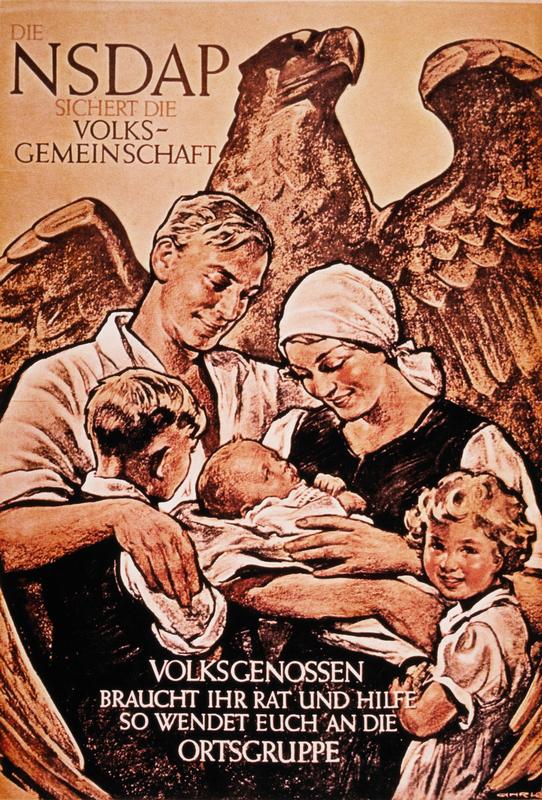
Nazi ideology defined women primarily as wives and mothers whose duty was to produce racially “pure” German children. The regime promoted the slogan Kinder, Küche, Kirche (children, kitchen, church), encouraging women to leave professional employment and return to domestic life. Marriage loans were offered to couples on the condition that the wife left work, and the Mother’s Cross was awarded to women with large families.
A Nazi propaganda poster depicting their ideal for a family
Despite this ideology, economic realities complicated policy. Labour shortages caused by rearmament meant that increasing numbers of women were drawn back into the workforce by the late 1930s. Nevertheless, women remained excluded from political life and higher education, and their legal and social status was subordinated to the needs of the state and its racial goals. They were even paired up with SS officers to have the “perfect” Aryan children, since all SS officers were considered to be pure Aryans.
Central to the Nazi vision of the future was the indoctrination of children. The Hitler Youth became compulsory in 1936, absorbing nearly all German boys and girls into state-controlled organisations. Boys were trained in physical endurance, obedience, and military skills, while girls were prepared for motherhood and domestic service through the League of German Girls.
Hitler meeting a group of Hitler Youth members
Education was reshaped to emphasise racial biology, loyalty to Hitler, and physical fitness. Teachers were required to join Nazi professional bodies, and Jewish teachers were removed from schools. By the end of the 1930s, youth culture had been largely absorbed into the regime’s propaganda system, weakening traditional family and religious authority.
From the outset, Nazi domestic policy targeted Germany’s Jewish population. The boycott of Jewish businesses in 1933, followed by the Nuremberg Laws of 1935, stripped Jews of citizenship and banned marriage between Jews and “Aryans.” Jews were excluded from civil service jobs, universities, and professions such as law and medicine. Economic pressure and social isolation were intended to force Jews to emigrate, though emigration was often blocked by international restrictions. Persecution intensified as the decade progressed, shifting from legal discrimination to organised violence.
A boycotted Jewish business in Germany
Ernst vom Rath, a German diplomat, was killed by Herschel Grynszpan, a German-born Polish Jew who killed Rath for deporting his parents, along with thousands of other Polish Jews to a slum of a refugee camp near the Polish border, as the Polish government were not admitting Jews without valid passports who had lived in Germany for more than five years. Many Polish Jews wanted to return to Poland due to Hitler’s antisemitic laws, but were denied entry. Reinhard Heydrich, head of the Gestapo, forced thousands upon thousands of Polish Jews to illegally cross the border. Due to the increased influx of immigrants, faster than they could build homes, the Polish government denied Polish Jews from entering the country, and the Jews remained trapped between two countries who did not want them.
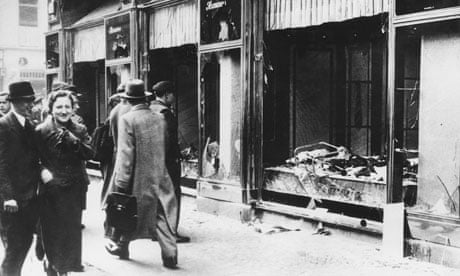
Enraged by the Nazi government’s actions, an angered Grynszpan killed Vom Rath on November 9th, 1938. That night, members of the SS and SA, along with the Hitler Youth and the general public, attacked Jewish businesses, burnt down synagogues and arrested Jews in an attempt to force them out of the country. Over 30,000 Jews were sent to detention camps, where many would die. Herschel was arrested and sent to the concentration camps. He was never seen again. His parents, who had survived the war, requested that his date of death be put as May 8th, 1945, the day Germany surrendered and the European war ended. This night of November 9th 1938 is known as Kristallnacht, or the Night of Broken Glass.
A Jewish business having been attacked as a cause of Kristallnacht, German for Night of Broken Glass
Kristallnacht marked a decisive shift from discriminatory legislation to open, state-directed violence. Jewish property was confiscated, insurance payouts were denied, and the Jewish community was collectively fined for the damage. Concentration camps, originally used mainly for political prisoners, increasingly became instruments of racial persecution.