By the early twentieth century, Europe had become increasingly divided into two rival alliance systems. On one side stood the Triple Entente, an informal partnership between Britain, France and Russia. On the other stood the Triple Alliance of Germany, Austria-Hungary and Italy. The origins of these alliances lay in growing geopolitical tensions. France had never accepted the loss of Alsace-Lorraine to Germany following the Franco-Prussian War of 1870–71 and sought an opportunity to regain the territory. Britain became increasingly concerned by Germany’s rapid naval expansion under Kaiser Wilhelm II, fearing that the German fleet might one day challenge the Royal Navy’s dominance of the seas. Russia, meanwhile, saw itself as the protector of the Slavic peoples of Eastern Europe and increasingly found itself at odds with Austria-Hungary in the Balkans.

Germany’s leaders feared that their country was becoming strategically encircled by hostile powers. To counter this threat, Berlin strengthened its alliance with Austria-Hungary, Germany’s only major and dependable continental ally. Although Italy was formally part of the Triple Alliance, its commitment to the partnership was often uncertain and its interests frequently diverged from those of Germany and Austria-Hungary. The growing rivalry between the great powers was exposed during a series of international crises before 1914. In 1905 and again in 1911, Germany challenged French influence in Morocco, hoping to weaken the Entente between Britain and France. Instead, the crises had the opposite effect. Britain backed France, diplomatic relations between the Entente powers strengthened, and Germany increasingly felt isolated on the international stage.
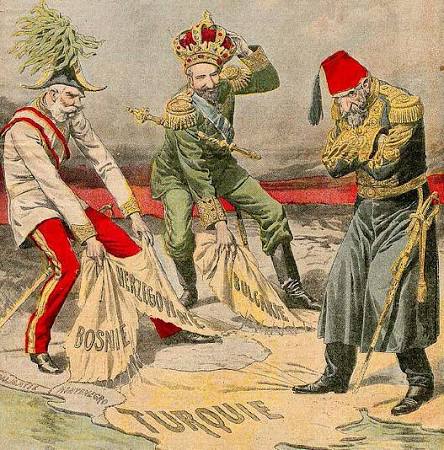
Even more dangerous were the tensions in the Balkans. The declining Ottoman Empire had left a power vacuum across south-eastern Europe, leading to competing nationalist movements and territorial disputes. Austria-Hungary, a vast multinational empire containing millions of Slavic subjects, feared that rising Serbian nationalism could inspire its own minorities to seek independence. Serbia, by contrast, dreamed of creating a larger South Slav state that would unite Serbs living under Austrian rule with those already living in Serbia. These tensions escalated during the Bosnian Crisis of 1908, when Austria-Hungary formally annexed Bosnia-Herzegovina, a territory populated by many Slavs. Serbia was outraged and Russia backed Serbian objections, but both were forced to back down when Germany supported Austria-Hungary. The humiliation left both countries determined not to retreat again in a future crisis.
The situation became even more volatile after the Balkan Wars of 1912–13. Serbia emerged significantly larger and more powerful, alarming Austrian leaders who increasingly viewed the country as an existential threat to the stability of their empire. At the same time, nationalist groups within Serbia began advocating more aggressively for the liberation of Slavs living under Austrian rule. By 1914, Europe had become a continent of competing empires, military alliances, nationalist movements and unresolved diplomatic crises. The great powers had spent years preparing for a major war, building vast armies and drawing up detailed mobilisation plans. What they lacked was a trigger.
June 28th, 1914. Heir to the Austro-Hungarian throne, Archduke Franz Ferdinand was visiting Sarajevo in Bosnia with his pregnant wife, Sophie, Duchess of Hohenberg. The visit was intended to demonstrate Austrian authority over Bosnia-Herzegovina, which Austria-Hungary had formally annexed in 1908. To many young Bosnian nationalists, however, the Archduke represented precisely the political system they wanted to destroy. Bosnia-Herzegovina was a deeply divided territory. Its population consisted principally of Orthodox Serbs, Muslim Bosniaks and Catholic Croats, alongside smaller communities. The territory had spent centuries under Ottoman rule before being occupied by Austria-Hungary in 1878 and formally annexed thirty years later.
The annexation was particularly provocative to Serbian nationalists. Serbia had ambitions to unite the Serb populations of the Balkans into a larger Serbian state, while a broader South Slav movement sought to unite Serbs, Croats, Slovenes and other South Slavs into a common political entity. Austria-Hungary therefore stood directly in the way of these ambitions. For the young men who would eventually participate in the assassination, this was not simply an argument about borders. Many regarded Habsburg rule as foreign domination and believed that Bosnia should be liberated from Vienna.
The most important organisation among the young conspirators was Young Bosnia, or Mlada Bosna. It was a loose revolutionary movement whose members were influenced by Serbian nationalism, South Slav nationalism, revolutionary socialism and anarchism. They were young, radicalised by the political tensions of the Balkans and increasingly convinced that conventional politics could not liberate Bosnia. One of them was Gavrilo Princip.
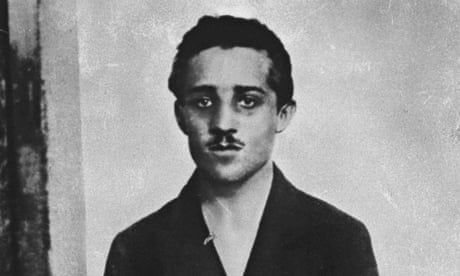
Princip had been born in Bosnia and had become involved in nationalist politics as a teenager. Like many young Bosnian nationalists, he was deeply influenced by the events surrounding the annexation of Bosnia-Herzegovina. The successful Balkan Wars of 1912–13 further strengthened the appeal of Serbian nationalism. Serbia had emerged from those conflicts substantially larger and more powerful, while the Ottoman Empire had been driven from most of its remaining territory in Europe.
To young nationalists, Serbia appeared to demonstrate that the political map of the Balkans could be changed. Austria-Hungary, meanwhile, appeared increasingly determined to prevent that change. The conspirators therefore did not regard Franz Ferdinand merely as an individual. He was the heir to the empire that controlled their homeland. There was, however, an additional reason for making him a target. Franz Ferdinand’s political ideas were more complicated than the conspirators understood. He was not simply an advocate of maintaining the existing Austro-Hungarian system. He had considered reforms that could have given greater political recognition to the empire’s South Slav populations. This created a paradox. The very man who might have reformed the Habsburg system was regarded by some radicals as a particularly dangerous threat because reform might make the empire stronger and undermine the case for its destruction. The conspirators feared that if Franz Ferdinand successfully reorganised the empire and gave its Slavic peoples greater autonomy, the South Slav nationalist cause could lose momentum.
The assassination was therefore intended not simply as an act of revenge, but as a political statement. The young Bosnian conspirators did not have the resources to carry out such an operation alone. They received assistance from the Black Hand, formally known as Unification or Death, a secret Serbian nationalist organisation founded by Serbian army officers. Its objective was the expansion and unification of Serbian lands, particularly territories under Austro-Hungarian rule. The organisation had a network of contacts across the Balkans and was involved in propaganda, espionage and political violence. The Black Hand was connected to influential figures within the Serbian military establishment, most importantly Dragutin Dimitrijević, better known as Apis, the head of Serbian military intelligence. Members of this clandestine network helped provide the conspirators with weapons, training, money and safe passage across the Serbian-Bosnian border.

This is where the assassination becomes particularly complicated. It would be misleading to describe the assassination simply as “the Serbian government ordered Franz Ferdinand’s murder.” There is strong evidence of involvement by elements of the Serbian military intelligence apparatus and the Black Hand, but the full Serbian government was not collectively responsible for planning the attack. Prime Minister Nikola Pašić, in fact, appears to have become aware that something was being planned and attempted to warn the Austro-Hungarian authorities, although the warning was too indirect to prevent the assassination.
The distinction would become extremely important during the July Crisis. Austria-Hungary would regard the assassination as evidence of a wider Serbian conspiracy against the Habsburg Empire. Serbia could therefore argue that the murder had been the work of extremists acting through clandestine networks rather than an official act of the Serbian state. Both positions contained elements of truth. The operation itself involved six principal assassins positioned along the Archduke’s planned route: Muhamed Mehmedbašić, Vaso Čubrilović, Nedeljko Čabrinović, Cvjetko Popović, Gavrilo Princip and Trifko Grabež. Danilo Ilić acted as the organiser in Sarajevo. Most were extremely young; several were still teenagers. Their youth is important. These were not experienced soldiers conducting a conventional military operation. They were young revolutionaries who believed that an act of spectacular political violence could inspire a much larger movement.
These six men were coordinated by Danilo Ilić. Every assassin would be armed with a pistol, a bomb and a cyanide pill. Before the Archduke even got into town, things began to go awry. They were worried the weapons would not get there in time, as they were being smuggled in a sugar shipment to the city. However, the problem was they thought they sent the sugar to the wrong place. Eventually, the weapons did arrive in time.
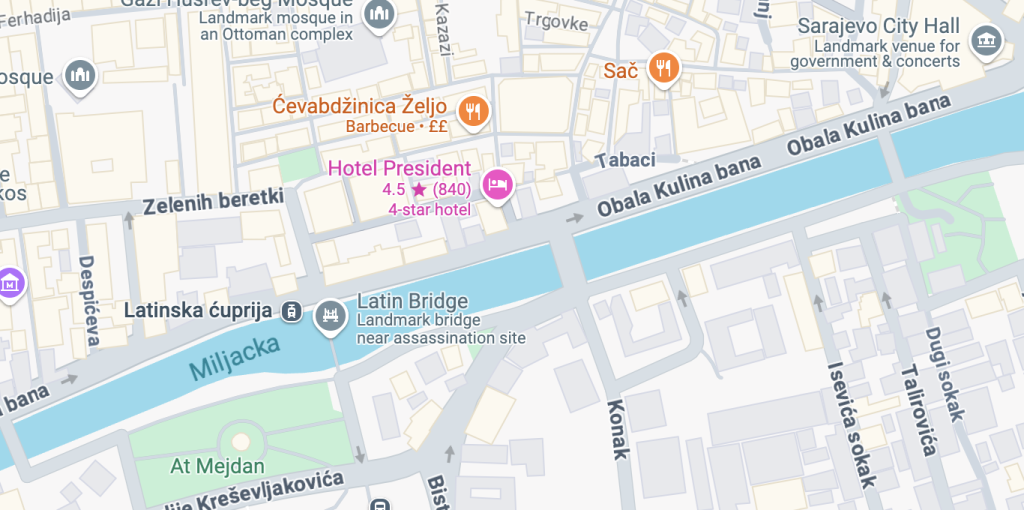
Eventually, the Archduke arrived in the town in an open top car. As he drove down Obala Kulina bana, the street leading up to the City Hall in the third car of a six car motorcade, two of the assassins, Muhamed and Vaso, were stationed next to each other on the side of the street furthest from the Milijacka River and Nedeljko was on the river side of the street. The Archduke passes Muhamed and Vaso. For some unkown reason, Muhamed, who the Archduke is first to pass, does nothing. Many historians suspect it was due to nerves. Vaso, possibly because Muhamed didn’t act, also does nothing.
Eventually, Nedeljko, steps out into the street, throwing a bomb at the Archduke’s car. However, the bomb bounced off the car, rolled into the street and exploded the car behind the Archduke, injuring the guards inside. Realising the plan had failed, Nedeljko takes the cyanide pill and leaps into the river in an effort to drown himself. However, not only was the cyanide pill out of date, the river was also in a dry season. So Nedeljko was now vomiting in knee deep water having just broken his legs from jumping off the bridge. The crowd, mad at the attempt on the Archduke’s life, swarmed him and nearly beat this vomiting crippled man to death, before the police stepped in.
The other 3 assassins, whose whereabouts were unknown during all this, scrammed. Gavrilo decided to make a stop at a local sandwich shop on the corner of Obala Kulina bana and Zelenih berekti. Meanwhile, the motorcade races down to the City Hall, where the Archduke was supposed to make a speech. He burst in, halfway through the mayor’s speech, interrupting him saying:
Mr Mayor, I came here to visit and I am greeted with bombs. It is outrageous.
Archduke Franz Ferdinand upon walking into City Hall
When he wanted to give his speech, he discovered that the speech had been left in the car that had just blown up, so someone was sent back to retrieve the speech, now covered in blood, and hand it to the Archduke. After the speech, the Archduke and a security team decided what to do next, who eventually decided to go back the way they came towards the hospital to see if the guards were doing alright. They all agreed upon this plan, got in their cars and drove away.
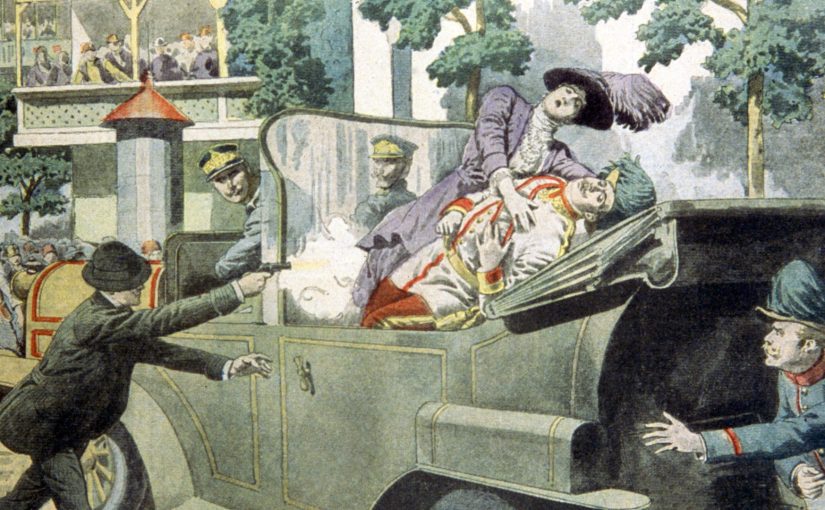
The Archduke was now sat in the back right seat of his car, with Sophie on the back left seat and a guard hanging onto the left side. However, for some unholy reason, everyone neglected to tell the drivers, so they continued on the scheduled route up to the museum, which would involve a right turn onto Zelenih berekti. Just outside the sandwich shop, the guard noticed that they had made a wrong turn. Back in these days, there was no reverse on cars so the driver had to get out of the car and push. Around this time, Gavrilo left the shop and noticed his target stopped right in front of him, with his only guard on the other side of the car. Gavrilo took his chance and, with his pistol, shot the Archduke dead. The guard prepped to return fire and Gavrilo shot at him. However, Sophie, who was tending to her husband, got in the way and was shot instead.
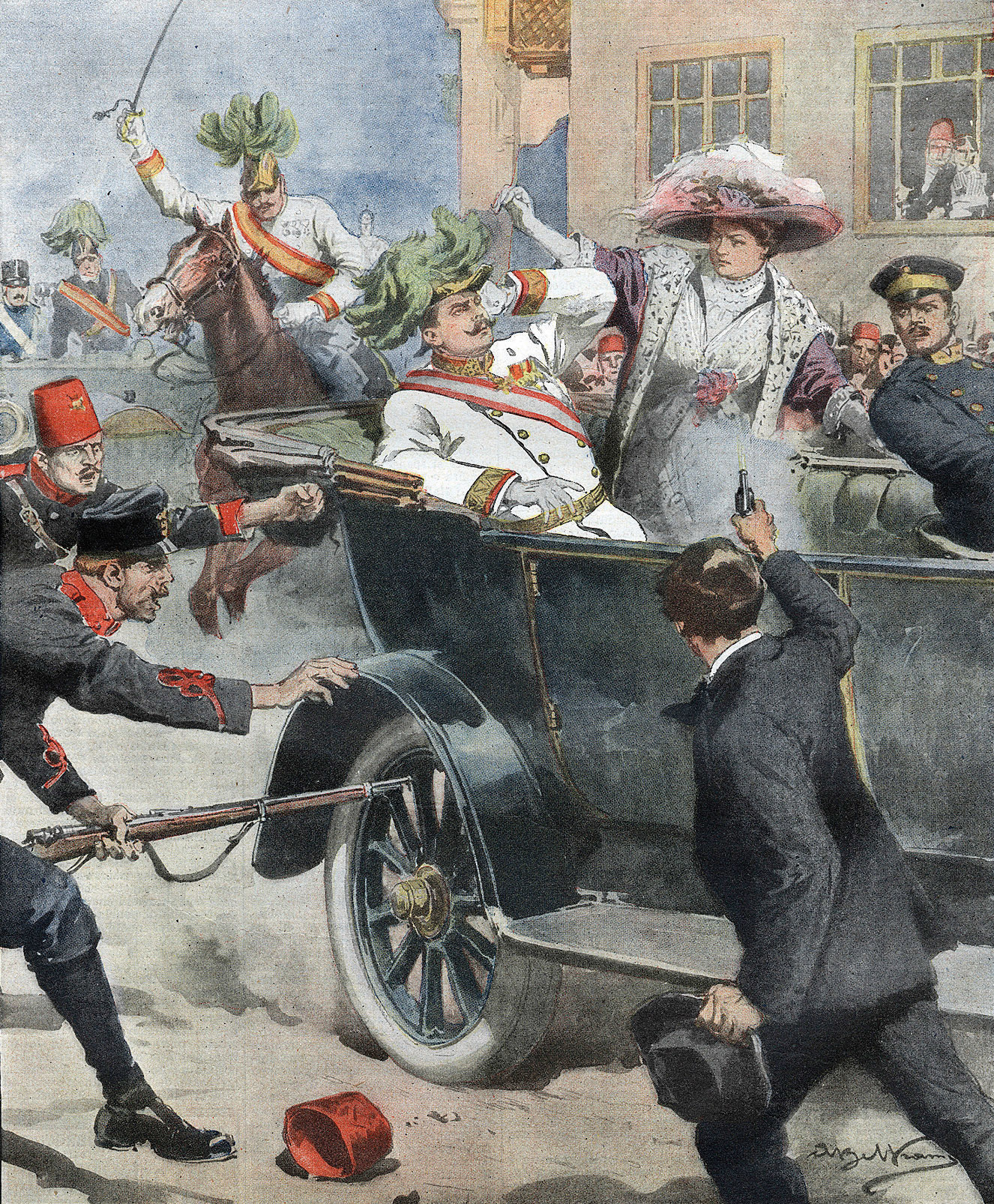
Gavrilo Princip, who was only 19 at the time, was arrested and put on trial. He was too young to be executed so was sentenced to solitary confinement in the Small Fortress, a prison complex in Terezin. He spoke to a psychiatrist, to whom he said that World War 1 would’ve started with or without the assassination. He did not feel responsible for the starting of the war but he did feel awful for killing Sophie. Princip died of tuberculosis on April 28th, 1918, weighing only 40kg (88lb) due to malnutrition inside the prison.
I sincerely regret that you should have been obliged to give up your intention of going to Vienna for the funeral ceremonies. I should have liked personally to express to you my sincerest thanks for your sympathy in my keen sorrow — a sympathy which has greatly touched me. By your warm and sympathetic condolence, you have given me renewed proof that I have in you a true and reliable friend, worthy of confidence and that I may count upon you in every hour of grave trial.
The attack directed against my poor nephew is the direct consequence of the agitation carried on by the Russian and Serbian Pan-Slavists whose sole aim is the weakening of the Triple Alliance and the destruction of my Empire.
By the foregoing declaration, it is no longer an affair at Sarajevo of the single bloody deed of an individual but of a well-organized conspiracy, of which the threads reach to Belgrade [which] constitutes a constant danger to my house and to my realm.
[A]fter this last terrible happening in Bosnia, will see and know that one cannot think of smoothing out the differences that separate us from Serbia, and that the maintenance of peaceful policy by all the European Monarchies will be threatened as long as this furnace of criminal agitation in Belgrade remains unpunished.
Emperor Franz Joseph writing to Kaiser Wilhelm II on July 2nd 1914
For several weeks, European governments manoeuvred around the crisis, deciding whether it could be contained to the Balkans or whether it presented an opportunity – or a necessity – to settle wider rivalries. In Vienna, the assassination was seen as an opportunity to finally deal with Serbia, which Austria-Hungary regarded as a growing threat to its position in the Balkans. The Austro-Hungarian government wanted to punish Serbia, but it also knew that Russia might intervene on Serbia’s behalf. The crucial question was therefore whether Germany would support Austria-Hungary if the crisis escalated.
Germany provided its answer in early July. Through the so-called “blank cheque”, Berlin assured Vienna that it would support Austria-Hungary even if its actions against Serbia resulted in a wider European war. This gave the Austro-Hungarian government confidence to pursue a deliberately severe ultimatum. On July 23rd, Austria-Hungary presented Serbia with a series of demands, giving Belgrade just 48 hours to respond. Several of the demands were designed to be extremely difficult for Serbia to accept, particularly those that would allow Austro-Hungarian officials to participate directly in investigations on Serbian territory. Serbia accepted most of the demands but rejected some of the most intrusive provisions.
Austria-Hungary declared war on Serbia on July 28th. What had begun as a dispute between two Balkan states now threatened to activate Europe’s alliance system. Russia began preparing to support Serbia. Germany warned Russia against mobilisation, while France stood behind its Russian ally. As Russian mobilisation continued, Germany concluded that it could not afford to wait for Russia to complete its preparations. On 1 August, Germany declared war on Russia; two days later, it declared war on France. The crisis had become a European war.
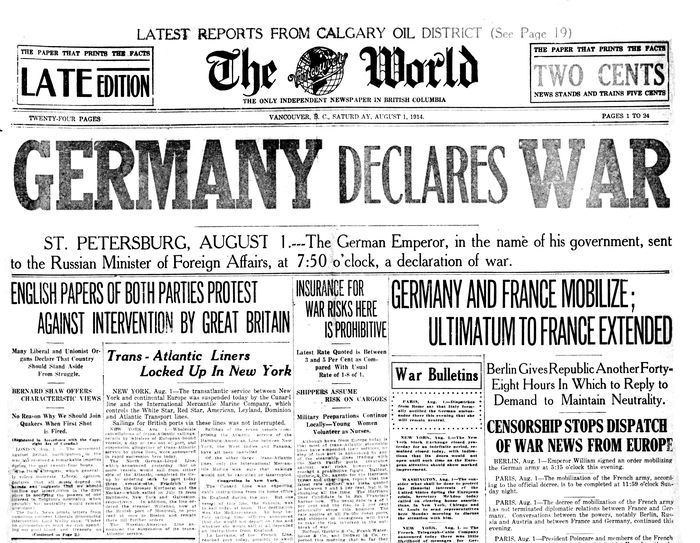
Germany now faced the strategic problem that had troubled its military planners for years: a war against both France in the west and Russia in the east. Germany’s answer was to defeat France quickly before Russia could fully mobilise, then turn its forces eastwards. The plan required German armies to advance through neutral Belgium, bypassing the heavily fortified Franco-German frontier and sweeping into northern France. This was an enormous gamble. Belgium had been recognised as an independent and permanently neutral state by the European powers under the 1839 Treaty of London. Britain was one of the powers that had guaranteed this neutrality. On August 4th, Germany demanded that Belgium allow German troops to pass through its territory. Belgium refused. German forces crossed the Belgian frontier that morning.
The invasion transformed the character of the conflict. What had begun with the assassination of an Austrian archduke and a confrontation between Austria-Hungary and Serbia had now become a war involving the major European powers. Britain demanded that Germany respect Belgian neutrality. When Berlin refused, Britain declared war on Germany later that day. The chain of events had taken Europe from Sarajevo to Brussels in little more than five weeks. The assassination had been the spark, but the fire had been fed by years of military planning, alliance commitments, fears of encirclement, nationalism and great-power rivalry. By the time German troops crossed into Belgium, the original dispute over Serbia was almost irrelevant. Europe was at war.