
At the risk of appearing to talk nonsense I tell you that the National Socialist movement will go on for 1,000 years! … Don’t forget how people laughed at me 15 years ago when I declared that one day I would govern Germany. They laugh now, just as foolishly, when I declare that I shall remain in power!
Adolf Hitler, reporting to a British Correspondent, 1934
One of the regime’s most immediate priorities was reducing unemployment and rebuilding Germany’s military capacity. Public works projects such as expanding the motorway programme, called the Autobahn, were used to provide jobs and to symbolise national revival. Whilst Hitler initially opposed the Autobahn programme when they weren’t in government, they did a 180 on the policy once in government and after part of the Autobahn had already been built. He also made the Volkswagen, a cheap and affordable car for the working class. Behind this visible recovery, however, lay an increasingly militarised economy.

To conceal the scale of rearmament and bypass the restrictions of the Treaty of Versailles, the Nazis introduced MEFO bills in 1934. These were government-backed promissory notes issued through a dummy company, Metallurgische Forschungsgesellschaft (MEFO). Firms producing armaments were paid in these bills, which could be redeemed later through the Reichsbank. This allowed the regime to fund massive rearmament without immediately triggering inflation or exposing the true level of military spending. By 1938, billions of Reichsmarks had been raised through this system, tying economic recovery directly to preparations for war.
Nazi ideology defined women primarily as wives and mothers whose duty was to produce racially “pure” German children. The regime promoted the slogan Kinder, Küche, Kirche (children, kitchen, church), encouraging women to leave professional employment and return to domestic life. Marriage loans were offered to couples on the condition that the wife left work, and the Mother’s Cross was awarded to women with large families.
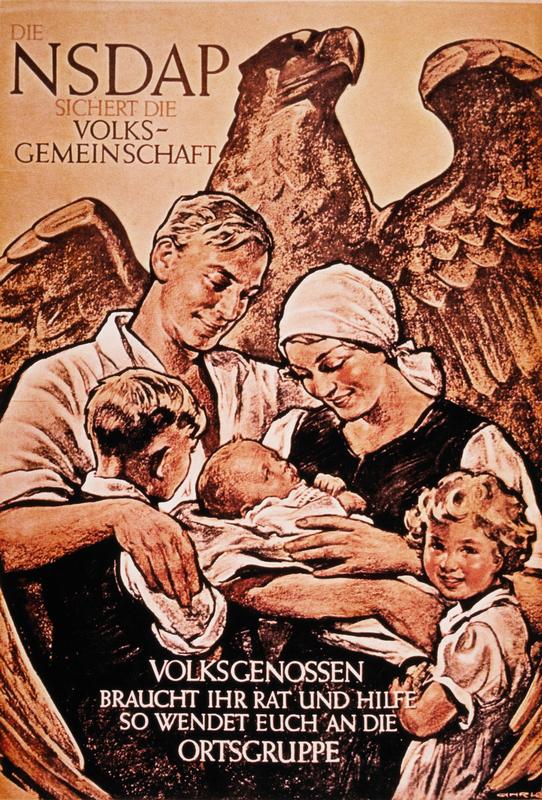
Despite this ideology, economic realities complicated policy. Labour shortages caused by rearmament meant that increasing numbers of women were drawn back into the workforce by the late 1930s. Nevertheless, women remained excluded from political life and higher education, and their legal and social status was subordinated to the needs of the state and its racial goals. They were even paired up with SS officers to have the “perfect” Aryan children, since all SS officers were considered to be pure Aryans.
Central to the Nazi vision of the future was the indoctrination of children. The Hitler Youth became compulsory in 1936, absorbing nearly all German boys and girls into state-controlled organisations. Boys were trained in physical endurance, obedience, and military skills, while girls were prepared for motherhood and domestic service through the League of German Girls.

Education was reshaped to emphasise racial biology, loyalty to Hitler, and physical fitness. Teachers were required to join Nazi professional bodies, and Jewish teachers were removed from schools. By the end of the 1930s, youth culture had been largely absorbed into the regime’s propaganda system, weakening traditional family and religious authority.
From the outset, Nazi domestic policy targeted Germany’s Jewish population. The boycott of Jewish businesses in 1933, followed by the Nuremberg Laws of 1935, stripped Jews of citizenship and banned marriage between Jews and “Aryans.” Jews were excluded from civil service jobs, universities, and professions such as law and medicine. Economic pressure and social isolation were intended to force Jews to emigrate, though emigration was often blocked by international restrictions. Persecution intensified as the decade progressed, shifting from legal discrimination to organised violence.

Ernst vom Rath, a German diplomat, was killed by Herschel Grynszpan, a German-born Polish Jew who killed Rath for deporting his parents, along with thousands of other Polish Jews to a slum of a refugee camp near the Polish border, as the Polish government were not admitting Jews without valid passports who had lived in Germany for more than five years. Many Polish Jews wanted to return to Poland due to Hitler’s antisemitic laws, but were denied entry. Reinhard Heydrich, head of the Gestapo, forced thousands upon thousands of Polish Jews to illegally cross the border. Due to the increased influx of immigrants, faster than they could build homes, the Polish government denied Polish Jews from entering the country, and the Jews remained trapped between two countries who did not want them.
Enraged by the Nazi government’s actions, an angered Grynszpan killed Vom Rath on November 9th, 1938. That night, members of the SS and SA, along with the Hitler Youth and the general public, attacked Jewish businesses, burnt down synagogues and arrested Jews in an attempt to force them out of the country. Over 30,000 Jews were sent to detention camps, where many would die. Herschel was arrested and sent to the concentration camps. He was never seen again. His parents, who had survived the war, requested that his date of death be put as May 8th, 1945, the day Germany surrendered and the European war ended. This night of November 9th 1938 is known as Kristallnacht, or the Night of Broken Glass.
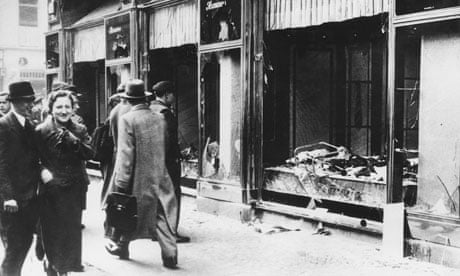
Kristallnacht marked a decisive shift from discriminatory legislation to open, state-directed violence. Jewish property was confiscated, insurance payouts were denied, and the Jewish community was collectively fined for the damage. Concentration camps, originally used mainly for political prisoners, increasingly became instruments of racial persecution.