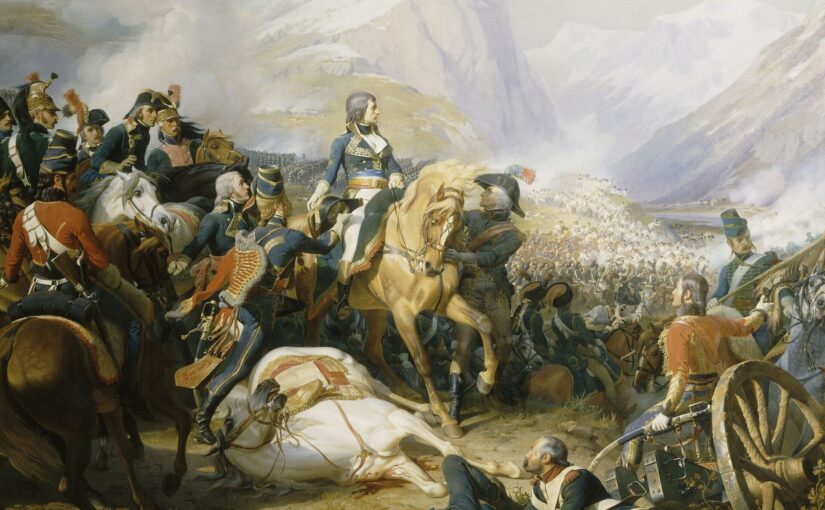
After the Siege of Toulon, and a subsequent crushing of a Parisian Royalist uprising, Napoleon had managed to land himself the rank of Major General, one of the highest ranks in the French Revolutionary Army. He was assigned his own army and decided that, in order to rise the social hierarchy, he needed a woman. Despite many women finding him creepy and disgusting, he managed to marry Josephine de Beauharnais, an older widow with two children and a rather promiscuous background, on March 9th, 1796. Only two days later, the French Government ordered an all out offensive against Austria. Napoleon was assigned to a southern campaign through Italy as more of a distraction away from Jean-Baptiste Jourdan and Jean Victor Marie Moreau. This would be his first major campaign, and it would be the first of many successes for Napoleon, at only 28-years-old.
You to whom nature has given spirit, sweetness, and beauty, you who alone can move and rule my heart, you who know all too well the absolute empire you exercise over it!
A letter Napoleon sent to Josephine in Februrary of 1797, during the Italian Campaign
The army assigned to him was demoralised, underpaid and in desperate need of equipment. However, Napoleon lifted their spirits with inspirational speeches, something that would become a staple of his career to come. Severely outnumbered, he would split his enemies into two and take them on separately, which would later become the iconic Napoleon strategy of dividing and conquering. Using this strategy, Sardinia was knocked out of the war and the Austrians were sent running. During the Austrian retreat, Napoleon was in the fray himself at the famous Battle of Lodi, aiming cannons and getting covered in mud, earning the respect of his men, to such an extent to the point where he ordered an almost suicidal charge over a river, they followed and succeeded.

Napoleon swept through Northern Italy, being welcomed in town after town with open arms, believing them to liberating the people from their Austrian oppressors. However, Napoleon would plunder towns and send riches back to France. It is estimated that Napoleon collected 45 million Francs in money, 12 million Francs worth of jewellery and precious metals, as well as an additional 300 art pieces, such as sculptures and paintings. He also used some of the money he plundered to pay his men, some of the first real money they had seen in ages.
During the campaign, Napoleon also became more influential in French politics. He created two newspapers, one for circulation amongst soldiers and the other for the French populous. Recognising his ambition, French Royalists warned that Napoleon may be on the path to becoming a dictator. In response, Napoleon sent General Charles-Pierre Augereau to Paris to support a coup that purged royalists from legislative councils. This meant that Paul Barras, one of the Directors of the Executive Branch of the French Government, had a firm grip on power but was now more dependent on Napoleon.

Whilst the northern front was at a stalemate, Napoleon began making a bee-line straight for Vienna. Archduke Charles, Duke of Teschen, had to withdraw forces to Vienna, despite gaining a successful victory against the northern forces, due to Napoleon’s assault. After losing to Napoleon at the Battle of Tarvis, the Austrian government sued for peace when they learnt that Napoleon had arrived at Leoben, a city just 100km (62 miles) away from Vienna. With Napoleon overseeing negotiations himself, Austria allowed France to take control of much of Northern Italy as well as the low countries. He managed the establishment of many Sister Republics for the French Republic, of which he wrote constitutions and organised governments. Napoleon’s first success had been a great one, and it was only the beginning of his military career.
From that moment, I foresaw what I might be. Already I felt the earth flee from beneath me, as if I were being carried into the sky.
Napoleon after his victory at the Battle of Lodi
Casualties
- First French Republic – 45,000 killed, captured or wounded
- Coalition Forces (Sardinia, Habsburg Empire, Papal States, Venice) – 27,000 killed, 160,000 captured