The 1905 Russian Revolution

At the start of the 20th century, the Russian Empire was one of the largest and most powerful states in the world, but also one of the most unstable. Ruled by Tsar Nicholas II, Russia remained an absolute monarchy, with little political freedom and growing opposition from liberals, socialists, and workers. Rapid industrialisation had transformed major cities, while millions of peasants still lived in poverty across the countryside. By 1905, economic hardship, political repression, and military failure had pushed the empire to the brink.

One of the Tsar’s most important ministers, Sergei Witte, had spent the 1890s attempting to industrialise the nation. Nicholas supported these efforts in principle, but without fully grasping their social consequences. Witte secured large foreign loans, particularly from France, and invested heavily in railways, coal, and steel production.

A painting of Witte

This rapid industrial growth transformed cities, but at a cost. Factory conditions were harsh: workers endured long hours, low wages, dangerous machinery, and overcrowded housing. Industrialisation had created a growing urban working class, but also deep resentment. Strikes had already been increasing in the years leading up to 1905, and discontent was spreading beyond the cities. Peasants, still burdened by redemption payments from the emancipation of the serfs in 1861, faced poverty and periodic famine. Meanwhile, middle-class liberals demanded political reform and a constitution. In 1904, Russia entered the Russo-Japanese War against Japan. Rather than being a simple attempt to distract from domestic unrest, the war was driven by imperial ambitions in East Asia. It quickly turned into a disaster. Russia suffered a series of humiliating defeats, exposing the weakness of the regime and worsening public anger. By early 1905, tensions were at breaking point.

An Orthodox priest, Georgy Gapon, organised a peaceful march of workers to the Winter Palace on January 22nd (January 9th in the Russian calendar). The marchers carried icons and portraits of the Tsar, believing he would listen to their grievances. Their petition called for better working conditions, civil rights, and an elected assembly. Nicholas was not in the palace at the time, as he had left for Tsarskoe Selo, but troops had been deployed to maintain order. As the crowds approached, soldiers opened fire. The number of deaths is uncertain, but likely ranged from around 200 to over 1,000. The event would become known as Bloody Sunday

A drawing of Father Gapon’s march facing down the Russian military

Although Nicholas had not personally ordered the shooting, he was widely blamed. The event shattered the image of the Tsar as the “Little Father” of the Russian people. Trust in the monarchy collapsed, and unrest spread rapidly across the empire. Strikes broke out in major cities, and peasants began seizing land in the countryside. Mutinies also occurred within the armed forces, most famously aboard the battleship Potemkin. Across Russia, workers began forming councils known as soviets (from the Russian word for “council”). These were not created by a single individual like Leon Trotsky, but emerged spontaneously in different cities. Trotsky later became a leading figure in the Saint Petersburg Soviet.

By October 1905, a massive general strike paralysed the country. Facing the possibility of total collapse, Nicholas was forced to act. On the advice of Witte, he issued the October Manifesto, which promised civil liberties and the creation of an elected parliament, the State Duma. This split the opposition. Many liberals accepted the reforms, while more radical groups continued to push for revolution. At the same time, the government moved to restore order by force. After making peace with Japan in the Treaty of Portsmouth, troops were brought back to crush uprisings across the empire. Although the Duma was established, Nicholas soon limited its power. Through the Fundamental Laws of 1906, he retained control over the military, foreign policy, and the right to dissolve the Duma, something he did repeatedly when it challenged him.

A photo of Tsar Nicholas opening the first Duma

After the revolution, Nicholas replaced Witte with Pyotr Stolypin. Stolypin attempted a combination of reform and repression. He introduced agricultural reforms aimed at creating a more prosperous class of independent farmers, but also cracked down harshly on dissent. Thousands were executed or exiled, and the hangman’s noose became known grimly as “Stolypin’s necktie.” Meanwhile, revolutionary figures such as Vladimir Lenin, still in exile, concluded that the events of 1905 had failed because the movement lacked organisation and decisive leadership. He argued that future revolution would require a disciplined party and, ultimately, an armed uprising. Although the 1905 Revolution did not overthrow the Tsar, it permanently weakened the regime. It exposed the fragility of autocratic rule in Russia and set the stage for the far more decisive revolutions of 1917.

Background to the Russian Revolution

In the 19th century, the Russian Empire lagged behind much of Western Europe in industrial and political development. While countries like United Kingdom and Germany had undergone industrialisation and introduced forms of representative government, Russia remained an autocracy under the Tsar. Most of the population were peasants, many of whom had only recently been freed from serfdom in 1861 by Alexander II. Although this reform ended legal bondage, it did not bring real economic freedom. Former serfs were required to make long-term payments for land, often leaving them in poverty and tied to rural communities.

A painting of serfs listening to the emancipation of the serfs

Industrialisation began later in Russia, particularly under Sergei Witte, the Minister of Finance, in the 1890s. While this helped modernise parts of the economy, it also created new problems. Workers in rapidly expanding cities faced low wages, long hours, and dangerous conditions. This combination of rural hardship and urban exploitation created widespread dissatisfaction. At the same time, the Tsarist system offered little opportunity for political change. Under Alexander III, the government pursued policies of repression and “Russification,” attempting to impose Russian culture and loyalty across the empire. Political opposition was closely monitored by the secret police, and dissent was often punished.

When Nicholas II came to power in 1894, he inherited a system under strain. Though personally committed to his role, he lacked political experience, meaning he often relied on advisors, and remained firmly opposed to sharing power. Early signs of trouble appeared during his coronation in 1896, at the Khodynka Tragedy, when over 1,000 people were killed in a crush during public celebrations. Nicholas’s decision to attend a royal ball that evening damaged his reputation, contributing to a growing perception that the monarchy was out of touch with the suffering of its people.

A painting of Nicholas II’s coronation

By the early 20th century, many Russians had begun to lose faith in the Tsarist system. This loss of trust was driven by economic hardship, political repression, and a lack of meaningful reform. While some reformers looked to constitutional monarchies in Europe as a model, others were drawn to more radical ideas. One of the most influential of these was Marxism, developed by Karl Marx. Marx argued that society was divided into two main classes: the bourgeoisie, who owned wealth and industry, and the proletariat, the working class. He believed that the workers would eventually overthrow the existing system and create a classless society based on equality.

These ideas found an audience in Russia’s growing industrial workforce. Poor conditions, combined with the lack of political representation, made revolutionary ideologies increasingly appealing. Among the Russian Marxists was Vladimir Lenin. Unlike some other socialists, Lenin believed that revolution would not happen spontaneously. Instead, he argued that it required a disciplined and organised group of revolutionaries, a “vanguard party,” to lead the working class.

Lenin’s 1895 mugshot

Lenin’s political activity led to his arrest and exile, first to Siberia and later abroad. From Europe, he continued to develop his ideas and organise revolutionary groups. Within the Russian socialist movement, divisions emerged between the more moderate Mensheviks and the more radical Bolsheviks, led by Lenin. By the early 1900s, Russia was a society under increasing strain. Economic inequality, political repression, and the spread of revolutionary ideas had created a volatile situation. It would take only a major crisis to push the empire into open revolt.

Napoleon’s Crossing of the Alps

By 1800, Napoleon Bonaparte had established himself as First Consul of the French Republic, making himself functionally the autocratic head of state of a centralised republican government. Wielding his newfound and profound executive power, he pacified royalist rebels, established a new national bank to stabilise the economy, cracked down on banditry in the French countryside, reforms that were only exemplified by state owned newspapers. In what many describe as a benevolent dictatorship, Napoleon transformed France from the chaos of the early Republic into the stability of the Consulate. However, France’s foreign affairs position was nowhere near as good as its domestic one.

A portrait of Napoleon as First Consul

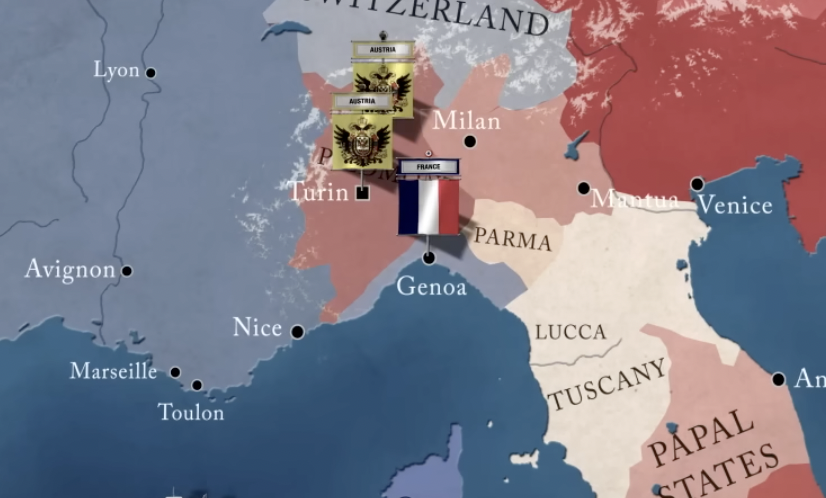
After Napoleon’s initial triumph in Northern Italy, the Second Coalition declared war on France. The powers of the Second Coalition sought to reverse French expansion across Europe, dismantle the satellite republics established during the Revolutionary Wars, and weaken France’s new republican regime. Specifically, Russian Field Marshal Alexander Suvorov had recaptured the Northern Italian territories that Napoleon had conquered in 1797, leaving French forces under the command of General André Masséna starving and in desperate need of supplies on the Mediterranean coast. When Tsar Paul I withdrew Russia from the coalition, it still left almost 100,000 Austrians in Northern Italy, under the Command of Field Marshal Michael von Melas.

Napoleon eventually rallied 60,000 reserve troops in order to liberate the French Forces at Genoa, reclaim Northern Italy and defeat the Austrians. A much more cautious man than Napoleon might have reinforced Masséna from the west, taking advantage of pre-existing friendly supply roots and would avoid a treacherous trek over the Alps. However, he believed that driving back enemy forces on his own supply depots could leave to a stalemate. So he took an incredibly bold plan. Though armies had crossed the Alps many times since antiquity, few had attempted to move a large force with artillery through such difficult terrain at speed and in secrecy. What it did require, however, was Masséna holding the line. By April, this was a very real fear that eventually materialised.

A map of French Positions by 1800 (Epic History, YouTube)

On April 6th, Melas launched a massive offensive against Masséna’s forces, which split his army in two and forced him to retreat into the city of Genoa, beginning a siege from both the land and sea. Fearing that the fall of Genoa would force him to be trapped between the mountains and the Austrian forces, Napoleon rallies his forces on May 6th to advance from Geneva across the Alps.

An army can pass always, and at any season, wherever two men can set their feet.

Napoleon, May 1800

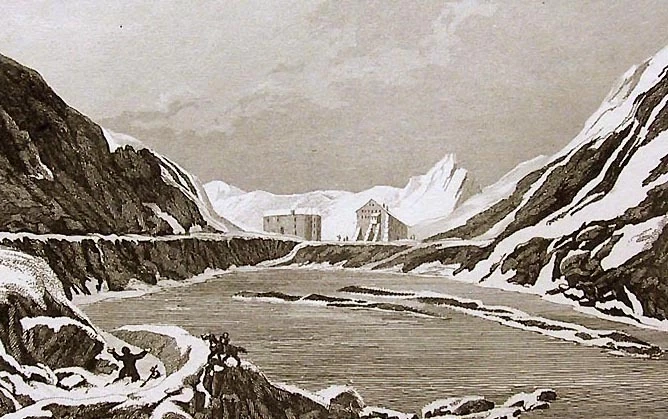
The Alps are a great land to cross. At around 100 miles in width and peaks reaching over 14,000 feet, the Army of the Reserve, numbering roughly 40,000 men, crossed through several Alpine passes, with the main body using the Great St Bernard Pass, which has a peak of around 8,600 feet, a march that was led by General Jean Lannes on May 8th. Despite the spring season, the mountains were blanketed in thick snow and. To reduce the likelihood of an avalanche decimating the troops, they travelled at night and early morning. Despite the men considering mutiny due to the rough conditions, they eventually reached St Bernard Hospice, where food and rest was prepared.

An illustration of the hospice on the pass

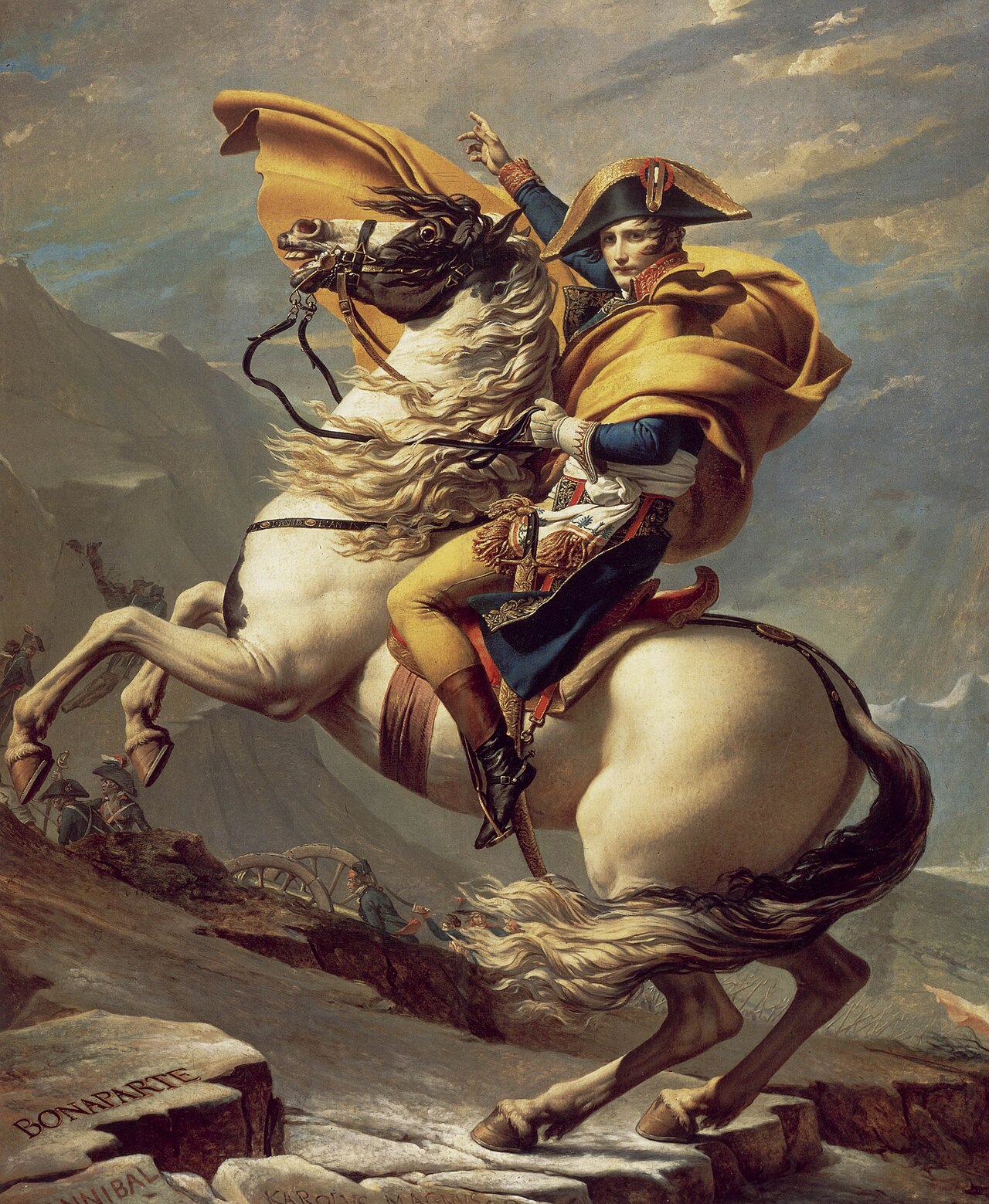
Despite the brutal conditions, losses during the crossing were surprisingly light. Contrary to the propaganda of the era, Napoleon himself made the crossing on a sure-footed mule as opposed to a charger. Lannes’ advanced guard swept aside Austrian outposts and surprised an outpost at Châtillon. However, they encountered fierce opposition by Captain Josef Stockard von Bernkopf at Fort Bard.

Conditions in besieged Genoa became desperate, with food shortages reducing troops and civilians to eating horses and other animals as famine intensified. Not only that, but General Jean-de-Dieu Soult was badly wounded and captured by Austrian Forces. At Fort Bard, a small Austrian garrison temporarily blocked the French advance. Unable to quickly storm the fort, Napoleon ordered artillery dragged past the position at night with wheels wrapped to reduce noise. Lannes attacked the enemy at Ivrea before advancing on Romana. Napoleon rapidly entered Lombardy, seized Milan, and threatened Austrian communications, forcing Melas to abandon his wider strategic position and confront the French army. Napoleon had seized the strategic initiative, but Austria’s army remained intact. The campaign’s outcome would be decided weeks later on the plains near Marengo.

We have struck here like lightning […] the enemy can hardly believe it

Napoleon to Joseph Bonaparte, 24th May, 1800
An idealised portrait of Napoleon crossing the Alps in 1800