The Cuban Revolution

By 1953, Cuba was politically unstable. When Spain first established control over the island in the early 16th century, it created a society structured around hierarchy and exploitation. At the top were Spanish-born elites, known as Peninsulares, while those of Spanish descent born on the island, Creoles, occupied a secondary position. Beneath them were enslaved Africans and their descendants, whose forced labour became central to Cuba’s plantation economy. Although the island’s indigenous population declined drastically following European arrival, Cuban society became increasingly diverse, shaped by a mixture of African, European, and mixed-race communities.

A photo of Christopher Columbus landing in Central America in 1492

By the 19th century, tensions within this system had begun to grow. Wealth and power remained concentrated in the hands of a small elite, while many Cubans, particularly in rural areas, lived in poverty. At the same time, a distinct Cuban identity was beginning to emerge, especially among Creole elites who resented both Spanish control and their exclusion from the highest levels of authority. These tensions would eventually give rise to a series of independence movements, the most significant of which was led by José Martí. Martí, a writer, political thinker, and revolutionary, envisioned an independent Cuba free not only from Spanish rule but also from foreign domination. In 1895, he helped launch a new war of independence against Spain. Although Martí was killed early in the conflict, the war continued, gradually weakening Spanish control over the island.

By the late 1890s, Spain was struggling to maintain its hold on Cuba, both militarily and economically. In 1898, the conflict took a decisive turn when the United States intervened following the explosion of the USS Maine in Havana harbour. The cause of the explosion remains disputed, but it was widely blamed on Spain in the American press, creating public pressure for war. Under President William McKinley, the United States declared war on Spain, quickly defeating Spanish forces in what became known as the Spanish-American War. Although Cuban rebels had fought for independence for years and done most of the effort, it was the American intervention that ultimately brought the war to a close.

A painting of Theodore Roosevelt, then assistant Secretary of the Navy, charging into battle in Cuba

In its aftermath, Spain relinquished control of Cuba, but full independence did not immediately follow. Instead, the United States established a military government on the island and retained significant influence over its future. This influence was formalised in 1901 through the Platt Amendment, which granted the United States the right to intervene in Cuban affairs and limited Cuba’s sovereignty in foreign policy. It also allowed the establishment of a permanent American naval base at Guantánamo Bay. While Cuba was formally independent by 1902, in practice it remained heavily dependent on and influenced by the United States.

Economic ties deepened this relationship. American businesses invested heavily in Cuba, particularly in the sugar industry, which became the backbone of the island’s economy. By the early 20th century, a significant portion of Cuba’s land, infrastructure and key industries were controlled by U.S. companies. While this brought periods of economic growth, it also created a system that was highly dependent on American markets and vulnerable to external shocks. These weaknesses became painfully clear during the Great Depression. As demand for Cuban sugar collapsed, unemployment soared and living standards declined sharply, especially in rural areas. Economic hardship quickly translated into political unrest.

A family of rural cane cutters during this period

By the early 1930s, opposition to the government of pro-American Gerardo Machado had reached a breaking point. Machado’s increasingly authoritarian rule, combined with the economic crisis, sparked widespread protests, strikes and violence across the island. In 1933, his government collapsed under mounting pressure from America, who were losing confidence in his leadership. What followed was not a stable transition, but a period of political turmoil, marked by rapidly changing governments and competing factions struggling for control. Out of this instability emerged a new and influential figure, Fulgencio Batista.

Initially rising through the ranks as a military officer during the so-called “Sergeants’ Revolt,” Batista became the dominant figure behind the scenes, exerting control over the Cuban government throughout the 1930s and 1940s. Although Cuba experimented with constitutional government during this period, political corruption, economic inequality and social unrest remained persistent problems. In 1952, Batista seized power directly in a military coup, cancelling elections and establishing a dictatorship. His regime maintained close ties with the United States and oversaw continued economic growth in some sectors, particularly in urban areas such as Havana. However, this growth was unevenly distributed. Large sections of the population, especially in rural regions, continued to live in poverty, while political repression increased.

An image of Batista in 1957

The […] most disastrous of our failures, was the decision to give stature and support to one of the most bloody and repressive dictatorships in the long history of Latin American repression. Fulgencio Batista murdered 20,000 Cubans in seven years – a greater proportion of the Cuban population than the proportion of Americans who died in both World Wars, and he turned Democratic Cuba into a complete police state – destroying every individual liberty. Yet, [the United States] publicly praised Batista – hailed him as a staunch ally and a good friend – at a time when Batista was murdering thousands, destroying the last vestiges of freedom, and stealing hundreds of millions of dollars from the Cuban people, and we failed to press for free elections.

John F. Kennedy’s speech at a Democratic Party dinner, 1960

Batista’s regime radicalised many among the Cuban populace. Confidence in democratic institutions was severely undermined and they began to believe that American foreign policy regarding anti-Communism had been prioritised over the needs of the Cuban people. One of the radicalised individuals was a young lawyer by the name of Fidel Castro. Castro, who had previously ran for political office and legally challenged Batista, had largely given up on the rule of law and believed that only an armed revolution could stop him. Castro was not originally a communist or particularly anti-American by the beginnings of his political activity, having hired multiple anti-communists in his government when he rose to power. However, these people were eventually sidelined as his regime progressed.

Castro under arrest after the 1953 Moncada Attack

In July of 1953, Castro led over 160 people in an attack on the Moncada army barracks in Santiago de Cuba, in an attempt to enact a mass popular uprising. However, this was an abject failure, with many of the rebels being captured, tortured and executed. Both Castro and his brother were arrested, but he managed to use the trial as a platform for his ideology and the platform that would build the foundations for the later revolution. The pair were released in May 1955 and founded the July 26th Movement, named after the date of the Moncada attacks, before retreating to Mexico to regroup and reorganise. Here, they met Che Guevara.

A former medical student, Ernesto “Che” Guevara de la Serna believed that much of the poverty, hunger and disease that he had witnessed was a product of a capitalist system of exploitation by the United States against Latin America, an ideology that was solidified after the CIA assisted overthrow of Guatemalan President Jacobo Árbenz. The Castro brothers, Guevara and some 80 revolutionaries crowded onto a yacht and set sail to Cuba in 1956, where they were ambushed by Cuban forces. A handful of survivors retreated into the mountains. From here, the plan for the revolution was devised, where it would be split between guerilla fighting in the mountains and an insurgency in urban areas. Eventually, a combination of military defeats, loss of public support and the backing out of elites and the US led to Batista fleeing the country in early 1959. Castro and Guevara’s forces entered Havana largely unopposed due the collapse of the Cuban government.

Castro arriving in Havana

Whilst there was a great demand for change within Cuba, the support for Castro’s movement in particular was not universal. It was undecided what was to come post-Batista amongst the Cuban populace, which Castro believed could become a breeding ground for a US-backed counter revolution, ideas which were reinforced by the CIA backed failed Bay of Pigs invasion in 1961. As a result of this belief even prior to the invasion, he suppressed the vast majority of political opposition whilst pursuing closer diplomatic and economic ties with the Soviet Union, which led to economic sanctions by the US. Using their economic backing from the USSR, Castro advanced social reforms in education and healthcare, but many of these programmes became strained following the dissolution of the USSR in 1991. Despite this, the US sanctions on Cuba have persisted, despite the near yearly declarations by the UN to lift the sanctions. Many have described the vast poverty in Cuba caused by the sanctions as a humanitarian crisis.

The Death of Stalin

By 1953, Joseph Stalin, General Secretary of the Communist Party, had been ruling the country for almost 30 years. Under his tyrannical rule, his paranoia led to him ordering the deaths of 1.2 million people in what was called The Great Purge, with a further 1.7 million dying in work camps called Gulags. It was a fearful time to be a Soviet citizen and no-one was safe from the almost nightly raids of Stalin’s Secret Police, the NKVD, who would arrest anyone even lightly suspected of having anti-Communist sentiment. However, this paranoia lead to stress and this stress soon got to Stalin.

Stalin applauding at a parade

On February 28th, members of Stalin’s Inner circle gathered for a night of drinking at one of his Dachas. The party consisted of Stalin, Lavrentiy Beria, Former Head of the NKVD, Nikita Khrushchev, Moscow Party Head, Georgy Malenkov, Deputy Premier of the Soviet Union, and Vyacheslav Molotov, Former Minister of Foreign Affairs. Once the party was over, Stalin retired to his quarters at 4am and the other 4 went home. Stalin requested to not be disturbed. By 11pm, not a sound had been heard from Stalin’s room. His housekeeper went inside, only to find Stalin unconscious on the floor in a puddle of his own urine.

Immediately, members of the Politburo, the leaders of the Central Committee of the Communist Party were called to assess the damage and to see what could be done. Whilst calling a doctor was recommended, they encountered a slight problem. The previous year, Stalin had begun to believe that Jewish doctors were plotting to poison him, which they obviously weren’t. However, he began imprisoning and executing hundreds of Jewish Doctors, which came back around to bite him. The majority of actually good and competent doctors in the Soviet Union were Jewish, meaning that only the bad ones were left. If they managed to call upon a good doctor and Stalin got better, they thought he may see the act as treasonous, so they intentionally called upon the bad doctors that Stalin hadn’t imprisoned.

They gave him a diagnosis. Stalin had suffered a stroke. Ultimately, Stalin died on March 5th of 1953, leaving the Politburo without Stalin’s guidance, while Malenkov assumed the role of acting General Secretary. Whilst many were distraught by this, some saw an opportunity. Out of those, 3 members of the Politburo emerged from the power struggle, all vying for the top job.

Georgy Malenkov – Deputy Premier of the Soviet Union

A photo of Malenkov

Malenkov was the natural choice, as he was next in the line of succession due to his position in the party. While he assumed an acting role, this ultimately meant nothing without other party members. Malenkov’s position was fragile, and only needed a little brute force to bring it crashing down.

Lavrentiy Beria – Former Head of the NKVD

A photo of Beria

During Stalin’s purges, Beria was the man largely responsible for most of the killings, overseeing many of the names on the lists. Many, including Stalin himself, say that Beria was to Stalin as Himmler was to Hitler. He was an unfiltered psychopath, who would use his old position to sexually assault and rape young women, including teenagers and young girls. He knew that in order to gain power, he must ally himself with Malenkov.

Nikita Khrushchev – Moscow Party Head

A photo of Khrushchev

Khrushchev was seen as very unambitious by many others in the party, who all believed that Stalin only kept him around because he had a good sense of humour. However, Khrushchev knew his reputation and knew that if he kept his head down, he could stay in Stalin’s good books. But, with Stalin gone, he made a quick grasp for power, fearing that he could end up dead if Beria, a long time rival of his, assumed office.

Whilst the preparations were going ahead for Stalin’s funeral, Beria began making moves. He requested of Malenkov that he become Minister of Internal Affairs, which he merged with the Ministry of State Security, an organisation that would become the KGB in 1954. He then replaced the Red Army soldiers in Moscow with his secret police he just created. Many in the committee feared that Beria was attempting to organise a coup. Beria then began releasing millions of political prisoners, reduced lengthy prison sentences and halted mass arrests. Many believe this was done as an attempt to distance himself the Stalin and increase his popularity with the Soviet people.

The straw that broke the camel’s back was an uprising in East Germany. After the uprising, Beria believed that Germany should be reunited, for American compensation. Khrushchev saw this as highly anti-communist so hatched a plot to remove Beria. He began by seeking help from the army and, at a great personal risk, began talks with Georgy Zhukov, head of the Ministry of Defence and a key figure in the Soviet victory at Stalingrad during the war. Eventually, Zhukov joined the plot, and many others in the party began to follow suit, including Malenkov.

A photo of Khrushchev (left) and Zhukov (centre)

On June 26th, 1953, 3 months after Stalin’s death, a Politburo meeting was held. At the meeting, Khrushchev proposed that Beria be dismissed from the party, due to him being anti-communist and a spy for the British. Things escalated very quickly, with Beria yelling, asking what was going on, and, before a vote could be counted, Malenkov pressed a button underneath his desk, whereupon a group of Red Army soldiers stormed the room and arrested Beria. Due to Beria’s men guarding the building, he had to be smuggled out of the Kremlin at nightfall in a truck.

On December 23rd, Beria was brought before a tribunal, where he could not defend himself. He was accused of treason, terrorism and counter-revolutionary activity. Beria, as well as his associates, were sentenced to death that same day. Beria began begging on his knees pleading for mercy, before he was shot and killed by a Red Army General. His remains were cremated and buried in the woods.

Now practically unopposed, Khrushchev ousted Malenkov as General Secretary of the Communist Party and became leader of the Soviet Union by 1956. One of the first things he did as Leader was denounce Stalin in “The Secret Speech”

A photo of Khrushchev at the Secret Speech

The negative characteristics of Stalin [which Lenin noted on] transformed themselves during the last years into a grave abuse of power by Stalin, which caused untold harm to our party.

Stalin acted not through persuasion, explanation, and patient cooperation with people, but by imposing his concepts and demanding absolute submission to his opinion. Whoever opposed this concept or tried to prove his viewpoint, and the correctness of his position was doomed to removal from the leading collective and to subsequent moral and physical annihilation.

[…]

Stalin [unlike Lenin] used extreme methods and mass repressions at a time when the revolution was already victorious.

[…]

It is clear that here Stalin showed in a whole series of cases his intolerance, his brutality, and his abuse of power. Instead of proving his political correctness and mobilising the masses, he often chose the path of repression and physical annihilation, not only against actual enemies, but also against individuals who had not committed any crimes against the party and the Soviet Government.

An excerpt from Khrushchev’s speech

Despite his speech exposing the crimes Stalin committed against his own people and the tens of millions killed under his orders, Khrushchev knew that the process of De-Stalinisation would be a long and arduous one but would ultimately be a better path for the Soviet Union than the three decades prior.

The Truman Doctrine

In the aftermath of World War 2, many of the war torn countries, such as France and Poland, began to turn to Communism in order to rebuild. Wanting to expand their influence, the Communist USSR, lead by Joseph Stalin, wanted to expand Communism all across Europe. Meanwhile, the United States opposed this, wanting more countries to embrace free market economies, capitalism and democracy. This lead to tensions rising between the two factions who were once allies against the Nazis. This divide between Western Capitalism and Eastern Communism was no clearer than in Greece.

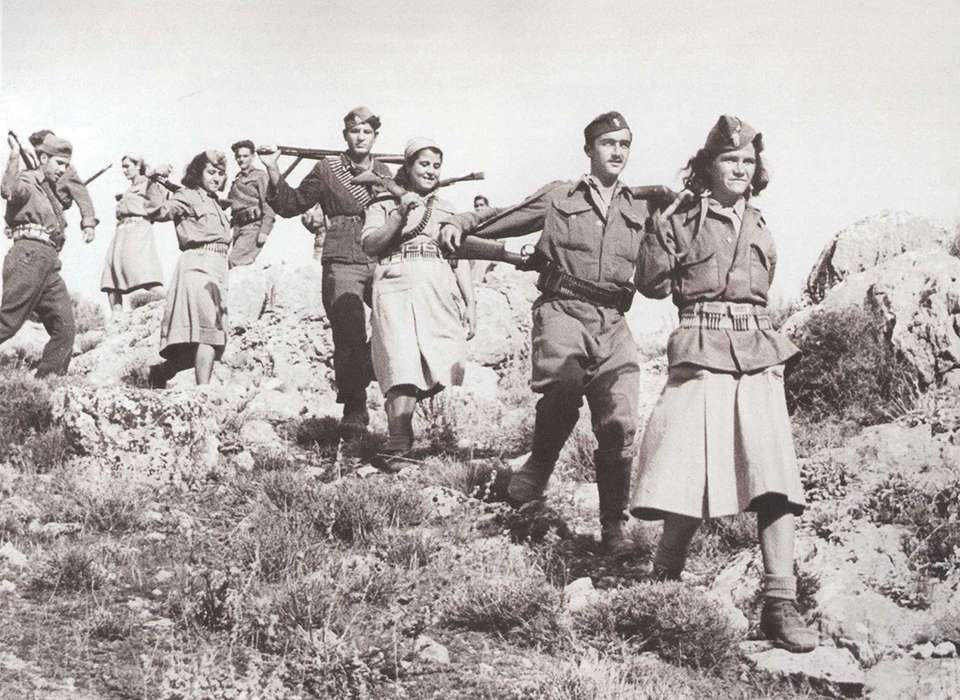
A photo of Greek Nationalist troops

From 1946-1949, Greece was in a civil war, between the Nationalists, backed by the United States, and the Communists. Whilst Harry Truman, President of the United States, feared that the Soviets may back the Greek Communists, Stalin’s focus was more on Turkey, and seeing if they would become a Communist nation, due to their oil production in Iran needing to pass through Turkish waters, requesting a military base in the country and transit rights through the Dardanelles Strait and the Sea of Marmara. Due to the economic impacts of having the water being Soviet Occupied, the United States sought a democracy in Turkey.

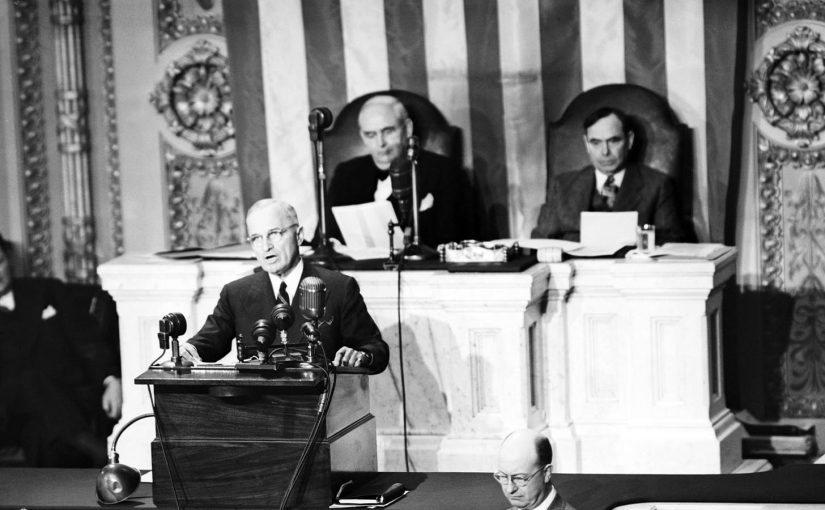
Many people feared that the Soviet Union would have a monopoly over the Mediterranean if Greece and Turkey fell to Communism. Truman chose to take action and addressed Congress with his plan on March 12th, 1947

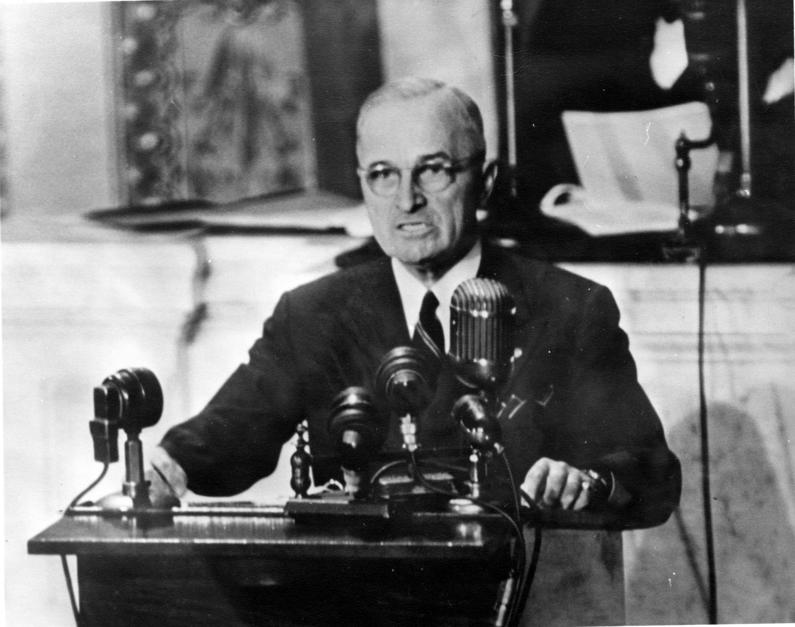
Truman addressing Congress

One way of life is based upon the will of the majority, and is distinguished by free institutions, representative government, free elections, guarantees of individual liberty, freedom of speech and religion, and freedom from political oppression.

The second way of life is based upon the will of a minority forcibly imposed upon the majority. It relies upon terror and oppression, a controlled press and radio; fixed elections, and the suppression of personal freedoms.

I believe that it must be the policy of the United States to support free peoples who are resisting attempted subjugation by armed minorities or by outside pressures. I believe that we must assist free peoples to work out their own destinies in their own way.

An excerpt from Truman’s speech to Congress

Truman was very careful to not explicitly name Communism or the USSR, but everyone knew what he was talking about. In order to truly combat communism, Truman, with the advise from Senator Arthur Vandenburg, over exaggerated the crisis, to such a degree where it would scare the American people and get them to side against Communism. Many modern historians cite the Truman Doctrine as the declaration of the Cold War.

Operation Paperclip

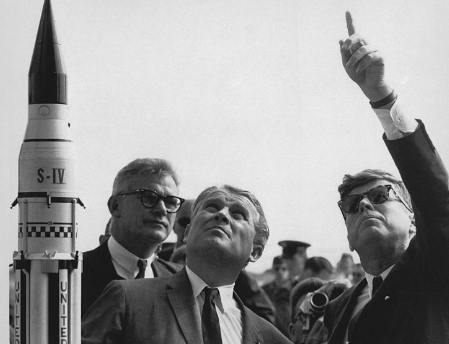
During a briefing at Blockhouse 34 of the Cape Canaveral Missile Test Annex in 1962, three of the most important men in the history of American space exploration were photographed sitting in the front row, President John F. Kennedy, who had promised that man would land on the moon by the end of the 1960s, Vice President Lyndon B. Johnson, who would later serve as President during some of the most important missions to outer space, and Kurt Debus, the first ever Director of the Kennedy Space Centre, who previously served as an Staffelrottenführer in the SS and a key architect in the Nazi V2 Rocket Project, which resulted in the deaths of thousands of people.

A photo of the three men, Johnson, Debus and Kennedy (left to right)

By May 1945, the Third Reich was in pieces. With the Führer dead, many high ranking Nazis and military officers, fearing Allied capture for their part in war crimes, including the Holocaust, either committed suicide or fled to South America. Most notably, Martin Bormann, Nazi Party Minister, Joseph Goebbels, Reichminister of Propaganda and Chancellor, and Reichsführer SS Heinrich Himmler all committed suicide in the final days of the war or in the weeks following, whilst Josef Mengele, a physician and anthropologist, specialising in human experimentation at Auschwitz, and Adolf Eichmann, a high ranking Party Member and Government Official, fled to Argentina, with the latter of the two being captured and executed in 1961 for his role in designing the Holocaust.

However, SS Sturmbannführer Wernher von Braun was less worried than most. In fact, he was bordering on confident, having approached the United States directly with his location, patiently and calmly waiting for their arrival. As a key architect behind the V2 Rocket, Braun was confident that his knowledge would be useful to the United States Government. As predicted, his captors gave him a warm welcome.

Braun (centre, civilian clothes) photographed with Wehrmacht Generals, such as Walter Dornberger, Friedrich Olbricht and Heinz Brandt in March 1941

What was more surprising, however, that this was occurring all across the collapsing Third Reich and during the years of occupation by the Allies. Whilst the Second World War had concluded, the Cold War was beginning to brew, and the Americans were determined on getting the upper hand against the Soviet Union. In all, over 1,500 Nazi Scientists were extracted from Germany between 1945 and 1962, in order to work on the American Space Programme, including Braun and the aforementioned Debus. Whilst Braun had handed himself over to the Americans, other scientists had to be found and extracted. These missing scientists were compiled in a list that, in an unsuccessful effort to dispose of evidence, was flushed down the toilet.

The operation, Operation Paperclip, was named after the paperclips that they would attach to the files, indicating they contained classified information such as Nazi affiliation or suspected war crimes and that all these should be overlooked in the name of advancing American science. For instance, Braun had overseen an SS Operation that involved forced labour at concentration camps.

A group of Rocket Scientists at Fort Bliss, Texas

The United States was not the only one involved in this practice. Whilst the British and French did not have the resources to exfiltrate German scientists without kidnapping or stealing patents, the Soviets used other more brutal methods in order to get the information they needed, such as bribery and forced relocation. The US method was the most controversial, however, offering a clean slate, the willing relocation of entire families and US citizenship.

Naturally, this massive influx of Germans into the United States raised a lot of eyebrows in the media. In response, the government did what every politician learns not to do on day 1 and told the truth. Immediately, there was mass public outcry, from influential figures such as Albert Einstein and Eleanor Roosevelt, as well as from the National Association for the Advancement of Colored People (NAACP).

The first page of a transcription of a protest telegram about Operation Paperclip sent to Harry S. Truman by the Council Against Intolerance In America

Many criticised that the victims of these mens atrocities in the Holocaust struggled greatly to get US Citizenship, ultimately to often get denied whilst the men who perpetrated the Holocaust got a fast track. In addition, there were also those who criticised the fact that former Nazis were now in Government positions, from an aspect of national security. However, as Cold War tensions grew, the argument that these scientists were necessary to combat the Soviet threat grew increasingly stronger.

Braun’s work at NASA involved getting the first American Satellite into orbit after the Soviet Sputnik, as well as the creation of the Saturn V rocket, which helped man land on the Moon. The work of other scientists involved in Paperclip ended up creating the jet engine and advanced pharmaceuticals research, but also developed chemical weapons such as Agent Orange, well known for its use in the Vietnam War.

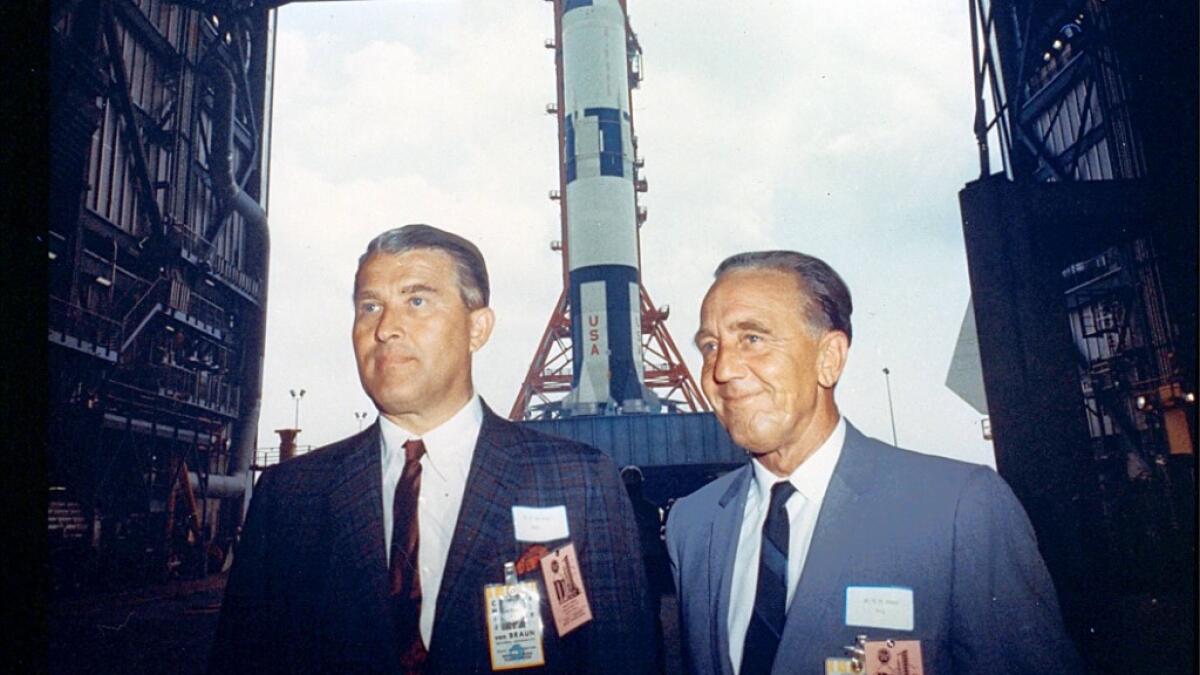
Braun and Debus in front of Saturn 500F

Whilst these advances in science allowed the US Government to brand paperclip as success, hindsight casts doubt on this judgement. Whilst many minds taken to America in Paperclip were seen as geniuses, such as Braun, many were just your average Joe, who, upon contract completion, either returned to Germany or went to normal civilian life, assimilating amongst the populous. The ethical questions about bringing in scientists from such an evil regime to work on projects of national security still do not have full conclusive answers. However, it is undeniable that these men, no matter how abhorrent and evil their past was, changed our understanding of the universe at large.