By November 1918, German morale was at an all time low. Despite Russia backing out of the war, they were now losing on the Western Front. The Kaiser had abdicated and had moved to the Netherlands, with a new democratic German government taking his place. Erich Ludendorff had resigned and was replaced by Wilhelm Groener. All of Germany’s allies had all either suffered defeat or surrendered. Everyone wanted the war to end but Germany wanted it more than anyone else.
The German government eventually requested that the allies meet to discuss the armistice. They met in Ferdinand Foch’s train carriage, located in the forest of Compiègne. Foch was French General and would be one of the main representatives of the allies.
A carriage of the same design on display in a museum. The original carriage was destroyed by the SS in 1940
They handed the Germans the terms of unconditional surrender without negotiation. They commanded that the German army leave the territories that they had occupied, including Belgium, the Netherlands, Luxembourg and Alsace-Lorraine. They also requested a demilitarisation of the Rhineland, an area of Germany that bordered France. They also had to surrender much of their munitions and other army supplies. The Germans had no choice to agree to these harsh terms and the Armistice was signed at around 5am local time on November 11th, 1918, with the Armistice not taking effect until 11am.
During those 6 hours, another 3,000 men died for nothing. The last soldier of the war to die was German, who died not long after the Armistice took affect.
RMS Titanic was the largest ship afloat by the time of her construction in 1912. The second of three in a line of Olympic-class ocean liners, she had passenger accommodation described to be “of unrivalled extent and magnificence,” especially the first-class section, which contained a Grand Staircase, Turkish baths, a pool, and high-end dining, including the luxurious À la Carte Restaurant. Even third-class, despite being less luxurious than second or first-class, was still deemed in higher quality than its contemporary counterparts. White Star Line, the company that created the Olympic-class ships, stated that the class “as far as it is possible to do so, [is] designed to be unsinkable.”
An image of the Titanic setting sail from Southampton
Whilst it was common practice for many companies to claim their ships were unsinkable, White Star Line specifically highlighted the bulkhead system, which was designed in a way that the Titanic could stay afloat with any two adjoining out of its 16 main compartments open to the sea. In addition the height of the bulkhead deck above the water line in flooded condition was well above the requirements, and the vessel would have been able to float with 3 adjoining compartments flooded in 11 of 14 possible combinations. The subdivisions could be sealed from each other with cast iron watertight doors.
The ship, under the command of Captain Edward John Smith, set off on its maiden voyage from Southampton on April 10th, 1912. Almost immediately, the ships bad luck began, when she nearly collided with the SS City of New York while departing the harbour, leading to her departure being delayed by 45 minutes. Eventually, she arrived in Cherbourg, France, to take on more passengers before once again stopping in Queenstown, Ireland, before departing to her final destination of New York City on April 11th. By the time she left the shores of Ireland, she had 892 crew members on board and 1,320 passengers. Among her passengers was Joseph Bruce Ismay, the chairman and managing director of White Star Line, and Thomas Andrews, the managing director of the company that built the Titanic in Ireland. One crew member of note was Harold Bride, one of the wireless operators. The passengers of first-class consisted of some of the richest people in the world whilst third-class consisted of many immigrants seeking a new life in the land of opportunity. Many of these people would not make it to shore.
Last image of the Titanic, taken off the coast of Ireland
Over the next few days, multiple warnings were issued regarding icebergs in the North Atlantic. The last one, on April 14th, was from the German Ship Amerika at around 13:45, and was relayed to Captain Smith by Bride, who claimed that the note was immediately discarded by the bridge without reading. Bride returned to the wireless room and began sending out messages from the passengers once more. At around 18:00, both Ismay and Andrews were in the first-class lounge and smoking rooms, where Ismay had allegedly been showing off the note regarding the iceberg warning. Ismay then retired to his quarters by 21:00 and went to bed. By 23:30, Bride was asleep and the primary operator, Jack Phillips, was operating the Marconi machine, made for radiotelegraphy. In order to receive messages from the distant Cape Race in Newfoundland, Phillips had the machine turned up to maximum volume. However, when the nearby SS Californian notified the Titanic of it stopping due to the ice fields, the high volume meant the message was received incredibly loudly by Phillips. He punched back a rude snarky message, telling the Marconi operator aboard the Californian to keep out of the signal. As most operators were in their mid-twenties, they were used to the friendly abuse they would send each other. The operator aboard the Californian, tired anyway, turned off the machine and went to bed.
Nine minutes later, with the cloudless night and a new moon, vision was limited when lookout Fredrick Fleet spotted an iceberg a mere 500 metres away from the Titanic‘s bow. Fleet cried “Iceberg, right ahead!” This message was quickly relayed to the bridge, who ordered that the Titanic change course towards the starboard side to avoid a head on collision. However, it had just managed to strike the ship below the waterline, breaching the front six compartments of the ship. One passenger is first-class described the noise as sounding “as though someone had drawn a giant finger along the side of the ship.” Around seven minutes after the collision, the crew were ordered to shut down the engines, which was standard procedure after a collision but they also feared that the cold water would combine with the high pressure steam and cause an explosion.
A diagram of the Titanic and its bulkheads. The green lines indicate the damaged areas
The stopping of the usual hum of the engines stirred many from their sleep, including Bride, Andrews and Ismay. Andrews left his quarters and went to investigate the damage sustained to the ship. He determined that at least five of the compartments had been breached by the iceberg, which was more than the ship could sustain and made him the first person to grasp the true severity of the situation. He directly reported this information to Captain Smith, who relayed this information to Bride and Phillips, telling them to send out calls for assistance upon his command. Ismay, who spoke to officers on deck, was informed that the ship had been struck but was not aware of the extent of the damage.
Meanwhile, the nearby Californian, that was closest ship to the Titanic, had its Marconi machine investigated by an officer. Whilst he knew some of morse code, he did not realise the machine was turned off so, when he didn’t hear anything from the other end, concluded that it was not worth checking again for the rest of the night. The Californian‘s Marconi machine was never checked again. When he joined the captain on deck, they observed the Titanic slow and eventually stop before the lights dimmed. When the captain raised concern, the officer explained that the lights were often dimmed on ocean liners in order to get the passengers to sleep and allow the service crew to get an early night in.
A map of the positions of ships in the vicinity of the Titanic
Meanwhile, Andrews informs Smith that the ship may sink within the next hour and a half. Smith then orders Bride and Phillips to begin sending out the distress signal, CQD. Shortly after this, Ismay spoke to Smith, who also warned him of the severity of the situation, whilst officers began to uncover the lifeboats and abandon ship. The crew began waking up passengers and ordering them to put on life jackets and come up to the deck. Many passengers, however, saw this as somewhat silly and took it as a joke to just get in the lifeboats for half an hour or so. The band came on board deck and began playing tunes to keep up spirits. Despite this, both Andrews and Ismay assisted with the evacuation process, prioritising women and children first as a part of official policy. Whilst many other ships were too far away or on the other side of the dangerous ice wall, the RMS Carpathia was 58 nautical miles south of the Titanic‘s position and received a message from Cape Race regarding the ship. The captain, Arthur Rostron, ordered the Carpathia go full steam ahead towards the Titanic‘s position. It would take them three hours to reach the Titanic
Back on board, Bride and Phillips, having switched to the newly introduced SOS signal, were informed by Smith of the true severity of the situation. Meanwhile, distress signals went up in the form of fireworks and lights flashed in morse code. However, the Californian‘s crew determined that they must have been having som kind of party and that the light was just the bobbing of the ships masthead. On deck, the situation escalated. The crew, most of them unfamiliar with emergency lifeboat procedure, did not know how much weight the boats could withstand, as they were designed to immediately ferry passengers to another nearby ship. As a result, many boats were lowered only half full. This was also partially due to some officers that interpreted “women and children first” as women and children only, and would rather launch a half full lifeboat with only women and children aboard than let any men get on. As chaos erupted on the deck, Andrews realised that, due to the company’s decision to reduce the number of lifeboats from 48 to only 16, was nowhere near enough to accommodate even a fraction of the people on board the ship.
An illustration depicting the evacuation on deck
Down below in the ship’s lower quarters, third-class passengers were promised by officers that they would be allowed onto the deck in groups of 50. However, after only three groups went up, the officers allegedly became distracted and left much of the rest of third-class down in the hold. As the radiotelegraphy system was overwhelmed with messages, the signals jammed for several minutes before Bride and Phillips returned to punching SOS messages. However, as water reached the generators, the power on the ship began cutting out and the range of the Marconi machine decreased. Eventually, their transmitter on Cape Race went out of range, meaning that they could no longer send messages on behalf of the Titanic. Whilst trying to communicate with the Carpathia, Phillips received the overpowering message from the German ship Frankfurt, which had a very powerful transmitter. The Frankfurt had been consistently asking the Titanic what was wrong. Whilst Bride and Phillips had initially joked about the stupidity of the operator, it is suggested that this was moment when Phillips lost his rag with the Frankfurt.
You are a fool, [shut up] – [shut up] – [shut up] and keep out
Phillips’ message to the Frankfurt
Phillips left the office and stood on the deck. Whilst he had only felt the ship before, he now saw it. Part of the bow was becoming submerged in the icy waters of the Atlantic. He saw Smith atop the bridge yelling out to the officers to bring the lifeboats back and take on more passengers. Near one of these boats that was about to disembark, Ismay, along side another first-class passenger, allegedly asked if there were any women and children nearby. When they got no response, the pair hopped into the lifeboat and set out to safety. Whilst the passenger who got on with Ismay, William Carter, stated that they had both checked around for any women and children, Carter’s wife described his behaviour aboard the ship as “cruel and barbarous treatment and indignities to the person,” apparently leaving her and their children to fend for themselves aboard the ship. Carter and his wife divorced only two year later.
Drawing from a book criticising Ismay by comparing his survival to a list of notable individuals who perished with the Titanic
This action from Ismay was perceived as a widely controversial one. He was ostracised from London high society life and eventually resigned his position at White Star Line. In a 1943 Nazi propaganda film about the Titanic, he was portrayed as a corrupt British business man, who ordered the Titanic to try and set a transatlantic speed record that led to the collision with the iceberg, a myth that still persists to this day. In actuality, he had briefly consulted the idea of breaking a speed record with Smith but it didn’t go much further. Lord Mersey, who led the 1912 British inquiry on the Titanic, concluded that Ismay had helped many other passengers before finding a place for himself on the last lifeboat to leave the starboard side.
At around 01:50, Smith gave up trying to call back the lifeboats and proceeded to relieve Bride and Phillips of their posts. Whilst Bride got ready, Phillips continued to punch out messages. Noticing him struggling to adjust the machine and send out messages, Bride joined his side again and the pair continued to send out messages. It was also around this time that Andrews was spotted last. The most often cited place for this sighting was in the first-class smoking lounge, with water lapping at his feet whilst in deep thought. He was never seen again.
A portrait of Andrews
After sending one last message to the Carpathia regarding its power capabilities, the ship’s lights turned a sickly red and the Marconi machine died. The ship was now alone, slowly sinking into the icy waters of the Atlantic, with the nearest help two hours away. She would sink under the waves in the next 20 minutes. The Californian had noticed that the Titanic was disappearing below the horizon and an officer attempted to notify the sleeping captain, who merely grunted and rolled over. By the time the officer returned to deck, the Titanic was gone.
Meanwhile, Phillips ordered Bride to retrieve the back-up transmitter before a crew member from the boiler room began throttling Phillips in an attempt to take his life jacket. The pair then proceeded to fight the man, before knocking him to the ground. According to Bride’s account, Phillips then grabbed the wireless key and beat the stoker over the head until the shin deep water inked with blood and the man went limp. Not knowing whether the man was dead or merely unconscious, the pair rushed out to deck. The ship, now with its stern elevated out of the water, had mere minutes left. Bride attempted to assist crewmen in lowering Lifeboat Collapsible B, and spotted Phillips running to the back of the deck. Suddenly, the oars holding the boat slipped, trapping Bride underneath it. Eventually the water lapped up, taking Bride and the boat off the deck and into the icy waters. Meanwhile, port holes created suction that pulled desperate swimmers back into the ship. The collapsing funnel caused a splash that toppled most people from the boat before they scrambled back on.
A depiction of Collapsible B from A Night to Remember
Two minutes before total submersion, the power went out. The area was plunged into total darkness, with what remained of the ship blotting out the stars in the sky. Eventually, the ship split in half, before the rest of the ship was eventually dragged down into the icy depths. In all, it took 2 hours and 40 minutes for the Titanic to sink. Reportedly, Ismay could not watch as she sank beneath the waves.
I had never seen so many shooting stars. I recalled a legend that every time there’s a shooting star, somebody dies
Jean Hippach, 1st Class Survivor
A gif depicting the sinking of the Titanic
Screams of passengers attempting to get onto lifeboats slowly went quiet as they eventually succumbed to hypothermia. On the still upside down Collapsible B, Bride clung to the side, one foot still submerged in water. He informed Charles Lightoller, a second officer, of the incoming Carpathia, who then ordered that the men attempt to balance the boat. However, as the night progressed, the boat continued to sink and the survivors were up to their knees in water. Some, not being able to handle the pain, collapsed and drifted away. Aboard the boat, Lightoller led a speaking of the Lord’s Prayer, before, eventually, the Carpathia arrived at 04:00. Some set off fireworks to signal the ship, some lit pieces of paper whilst one woman reportedly set her hat on fire. Collapsible B merely screamed for help, with Lightoller using his whistle to attract the rescue boats.
Upon being brought aboard, Bride collapsed. Ismay was in deep shock and was uncharacteristically withdrawn. He apparently ate very little and was allegedly sedated by a doctor at one point. Whilst some saw it as avoidance, others saw it as trauma. However, he assisted in compiling lists of survivors. When Bride awoke, he was given one of these lists in order to assist sending out the lists for newspapers. He was distraught to find that Phillips’ name was not on it. Eventually, public inquiries in both the US and Britain were held regarding the disaster. The Senate Inquiry, led by Senator William Alden Smith, determined that the disaster was not unavoidable and that the speed that the Titanic was going at the time should have been slowed due to the warnings that the bridge had received, implicitly blaming Ismay for this decision. It also concluded that the lifeboat provisions were beyond inadequate and that the crew were unskilled to deal with such an evacuation. It also put partial blame on the Californian, for not taking any action even when the Titanic disappeared. Meanwhile, the British Inquiry determined that the speed was standard practice at the time and assigned little personal blame. However, it still determined that evacuation procedure was not up to standards and that the lifeboats were inadequate to save even half of the passengers on board. As a result, maritime regulations were enforced, requiring lifeboats for all individuals on board, 24-hour messenger operation and an Internal Ice Patrol. Both Bride and Ismay testified at the inquiries. In all, over 1,500 died in the sinking of the Titanic. It is, by far, the most well known commercial nautical disaster of all time.
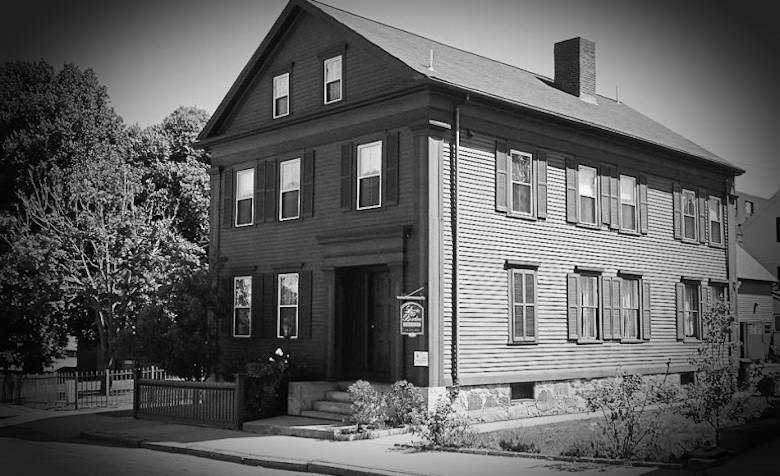
In Fall River, Massachusetts, on August 4th, 1892, around 11:10 am. Lizzie Borden heard a strange noise from her house and rushed inside. She ran into the living room to find a horrible sight. She saw her father, Andrew Borden, dead on the sofa with a disfigured face with blood pouring out the side of his head. His eye was split cleanly in two, suggesting he was asleep while he was attacked, and his nose wasn’t there. He was still bleeding, which meant the attack was recent. He had 10-11 whacks in him from a hatchet like weapon.
A censored photo of Andrew’s body found in the living room
The maid heard from her quarters in the attic from Lizzie “Come down quick! Father’s dead! Somebody’s come in and killed him!” Despite this call for help, Lizzie refused the maid, Bridget Sullivan, access to the room, thinking it too painful for her to see her father dead. Bridgette soon came back with a neighbour.
They didn’t know where the stepmother was, Abby Durfee Gray. The last they heard of her was the maid saying that she went out with friends. Lizzie said “Oh Maggie (a nickname for Bridget)! I am almost sure I heard her come in. Check upstairs and see if she is there!” The neighbour and Bridgette soon moved upstairs and saw Lizzie’s stepmother, dead. Abby Durfee Gray had 18-19 strokes with the hatchet and was face down in the bedroom.
A photo of Grey’s body in the bedroom
It is believed to be the hatchet that killed them was the same one that killed Lizzie’s pigeons a few months prior. There was nothing stolen, nor was there any sign of a break in. The timing of the murders is very peculiar. According to forensics teams, Abby was murdered at around at around 9:00 and Andrew was murdered around 11:00, since Abby’s blood was dry and, Andrew’s was fresh and wet. The maid stated that Lizzie was wearing “an unstained blue dress.” Lizzie was tried for the murder but acquitted of all charges. The strange thing is is that in such a small 3 storey house, nothing was heard by anyone until by Lizzie at 11:10
Suspect #1: Lizzie Borden – Daughter of Andrew Borden and Step-Daughter of Abby Durfee Grey
Lizzie Borden
The primary suspect is Lizzie Borden. She claimed she was in the barn looking for lead sinkers. After the murder, there was a large sum of money given to her, approximately $10 million in modern times. Her answers at the trial contradicted each other such as the fact that she said she put on her father’s slippers before his nap but according to crime scene photos he was wearing boots. A friend of Lizzie’s, Alice, saw her burning a red dress saying that “there was paint on it.” This was not the same dress Bridget described. A local pharmacist claimed she was trying to buy potassium cyanide the day before the murders. This was dismissed in the trial due to the fact that there was just some bad food in the victims on the autopsy report and nothing more. During the trial, the victim’s skulls were admitted as evidence and Lizzie fainted when she saw them. After a year of planning and prepping for the trial, the police only had circumstantial evidence so couldn’t convict her. 90 minutes and she was off scot free. This theory is so popular that there is a rhyme to go with the murders.
Lizzie Borden took an axe, And gave her mother forty whacks.
When she saw what she had done, She gave her father forty-one.
Rhyme sung about the murders
After her mother died, Lizzie apparently latched onto her father as the centre of her life, becoming a bit of a daddy’s girl before he remarried, an event she felt betrayed by. She often took to petulantly calling Abby “Mrs Borden” and would often leave early at meal times. Mending the relationship with his daughter was clearly irrelevant to Andrew, as he was incredibly strict with Lizzie. Some writers have interpreted the relationship in various ways, extending to him being abusive, and perhaps even sexually abusive, with Elizabeth Engstrom taking a very Freudian approach, with Lizzie filling the sexual desire in Andrew after the death of her mother.
Some have viewed the Borden murders as a feminist liberation from an oppressive patriarchy. Some others have interpereted her as cold, calculating and even insufferable, far from a feminist icon she is sometimes portrayed to be. However, Rafia Zakaria of The Guardian drew comparisons between the relationship with Lizzie and Andrew Borden to the relationship between Ivanka and Donald Trump, who has often been very open about sexualising his eldest daughter, calling her “voluptuous”, a “great piece of ass” and saying that if she wasn’t his daughter, he’d marry her.
The real Lizzie would likely not have recognised herself in many of the books about her, and she certainly never admitted to having committed the murders. It is too bad that recent takes on her story have veered towards the lurid, for there is plenty of contemporary relevance to be found in the feminist appraisals of the story. The same Americans who may choose to pick up a book about her, or even venture to the house on Second Street for a tour, might perceive similar paradigms being played out in the White House, where, with her own office in the West Wing, a daughter plays a similar part to the hilt, with only minor variants from the Victorian script of gentle cajoling and subordination. All while glibly sidelining a stepmother.
Rafia Zakaria “The Lizzie Borden murder industry won’t die – but its feminism has”
Suspect #2: Bridget Sullivan – Maid to the Borden Family
Bridget Sullivan
Abby was very strict and sometimes described as mean to Sullivan. She was cleaning the outside of the house and the went to bed when she was awoken by Lizzie’s screams. Where she was sleeping was above where Abby was murdered. Experiments conducted on the house prove that you would be able to hear a thud from a floor below, a sound even more likely to be heard due to the fact that she said she was only half asleep.
Suspect #3 – John Vinnicum Morse – Uncle of Lizzie Borden, Brother of Lizzie Borden’s mother
John V. Morse
The theory of Morse being behind the murders was thought of by maths teacher Richard Little who wrote a book on the case called “Cold Case to Case Closed. Lizbeth Borden. ~My Story~” John was not seen from 9:00 until noon. His alibi is that he was down the road visiting a sick relative with the town doctor. However, that very same doctor was looking at the bodies at the time. Morse was sleeping in the room that Abby was found in. Also, Morse may have known about the will. We can tell from the following transcript from Lizzie:
Q: Did you know of your father making a will?
A: No sir, except I heard somebody say once there was one several years ago. That is all I ever heard.
Q: Who did you hear say so?
A: I think it was Mr Morse.
Q: What Morse?
A: Uncle John V Morse
Transcript from the trial
Little also states there was a failing livestock business run by Mr Morse. He also said that he killed the Borden’s with a meat clever, since he was a butcher.
Suspect #4 – Were Lizzie Borden and Bridget Sullivan Lesbian Lovers?
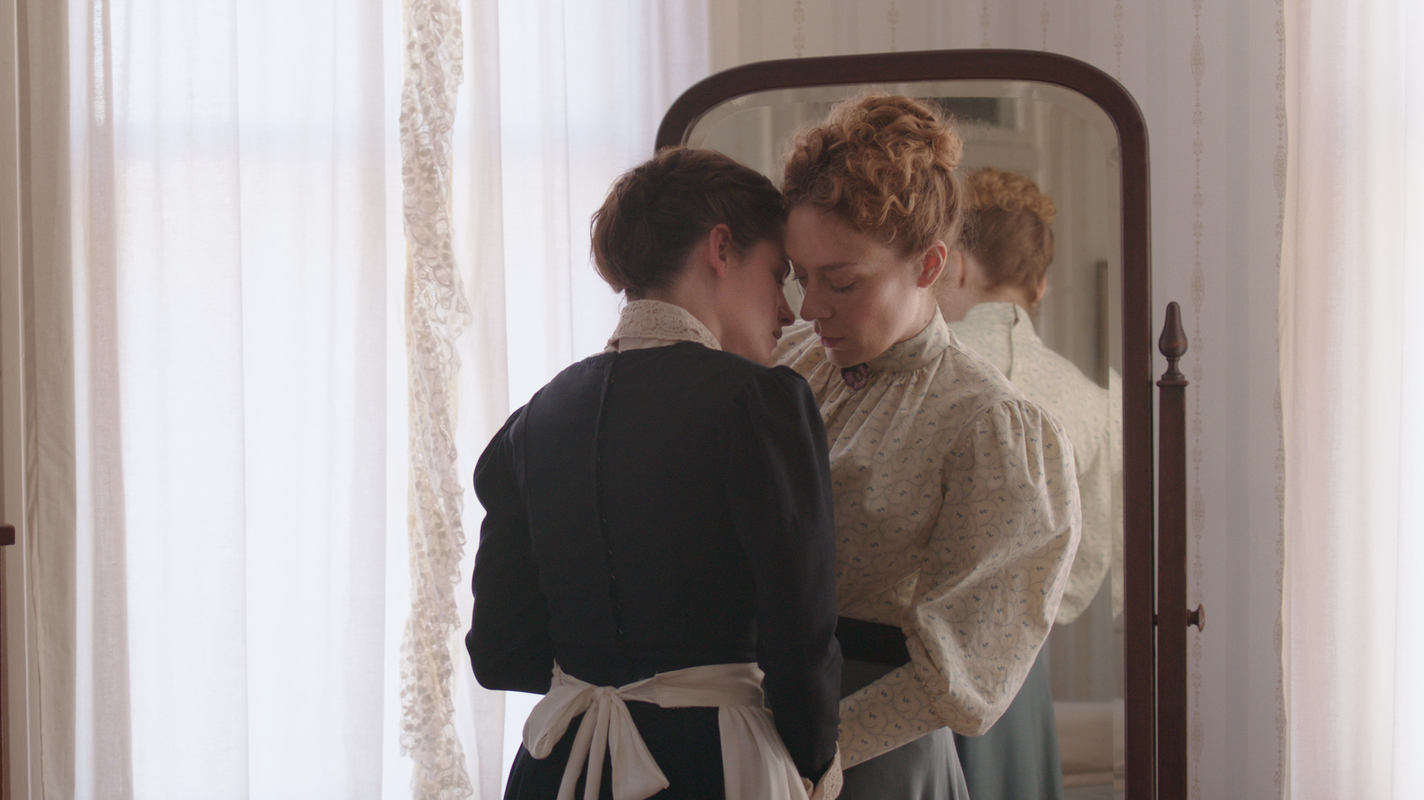
A still from “Lizzie”. Kristen Stewart is depicting Sullivan (left) and Chloe Sevigny is depicting Borden (right)
The fourth theory is 2 people at once. That is Lizzie and Bridget. Many a fan fiction claim that they had a romantic relationship and Abby discovered it. The back up for this theory is that Lizzie confessed she had a crush on a female actor later in life. However, this theory was adapted into the 2018 film “Lizzie” starring Kristen Stewart and Chloe Sevigny as Sullivan and Borden respectively, pushing the theory into the mainstream.
Ultimately, we will never know what happened that fateful day in Fall River. The Borden Murders remain unsolved to this day, but have become a defining staple of the Pre-War America.
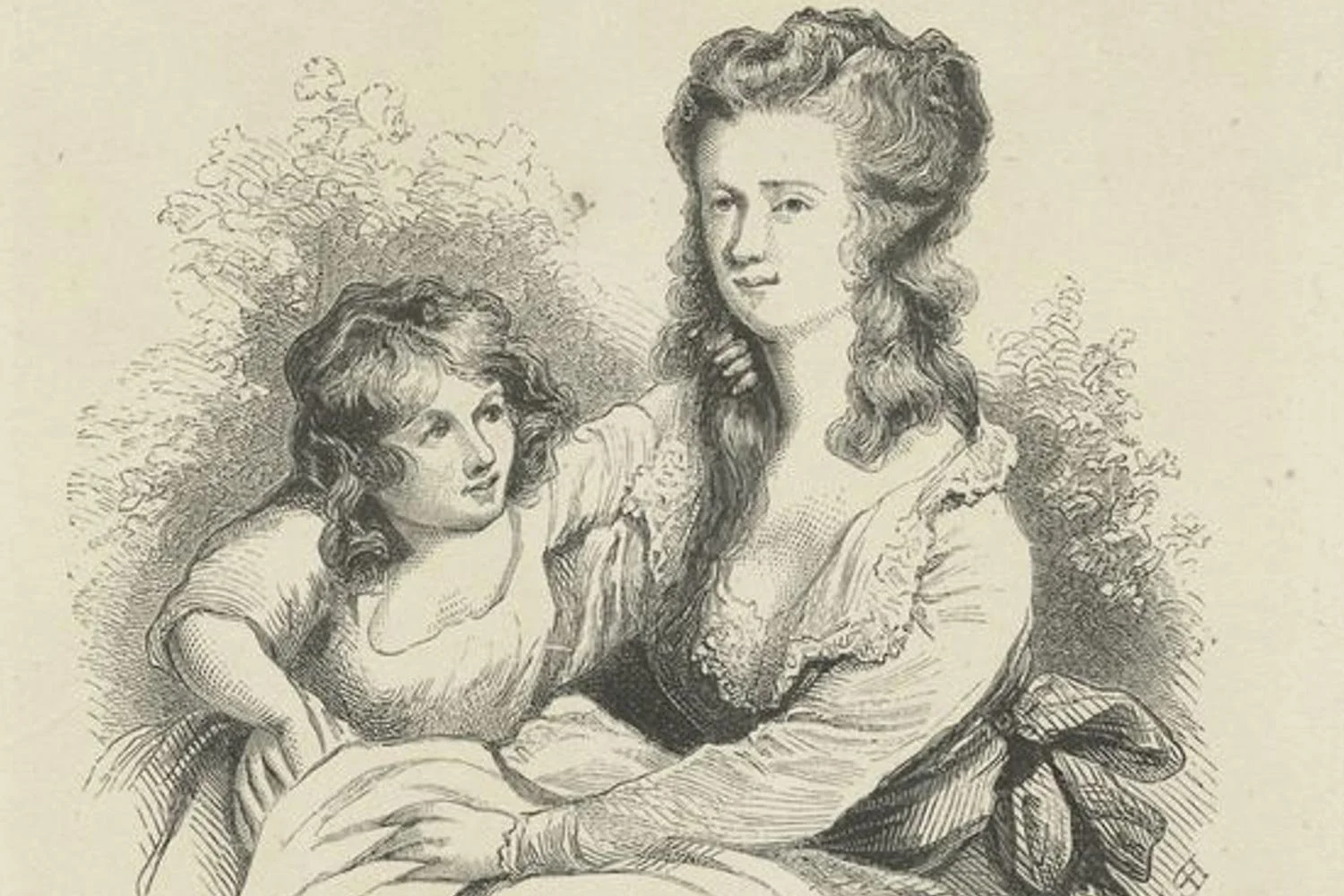
Still currently in charge of Philadelphia, Benedict Arnold had moved into Penn Mansion, which Clinton had used as his headquarters, and partied in the city with the Philadelphia Elite. He even married Peggy Shippen, a member of the Elite. However, this upper class in Philadelphia had also had parties with the British when they occupied the city. The city turned against Arnold, viewing him as a traitor. The state governor sent a letter to Washington, informing Arnold of his treasonous behaviour. Washington, who had originally saw Arnold as a “fighting general” and had supported him, denounced his behaviour. It was around this time Arnold planned to defect.
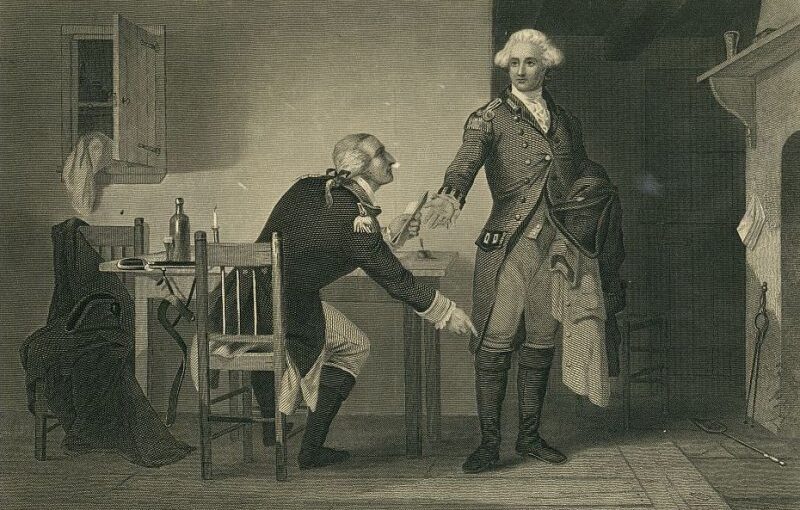
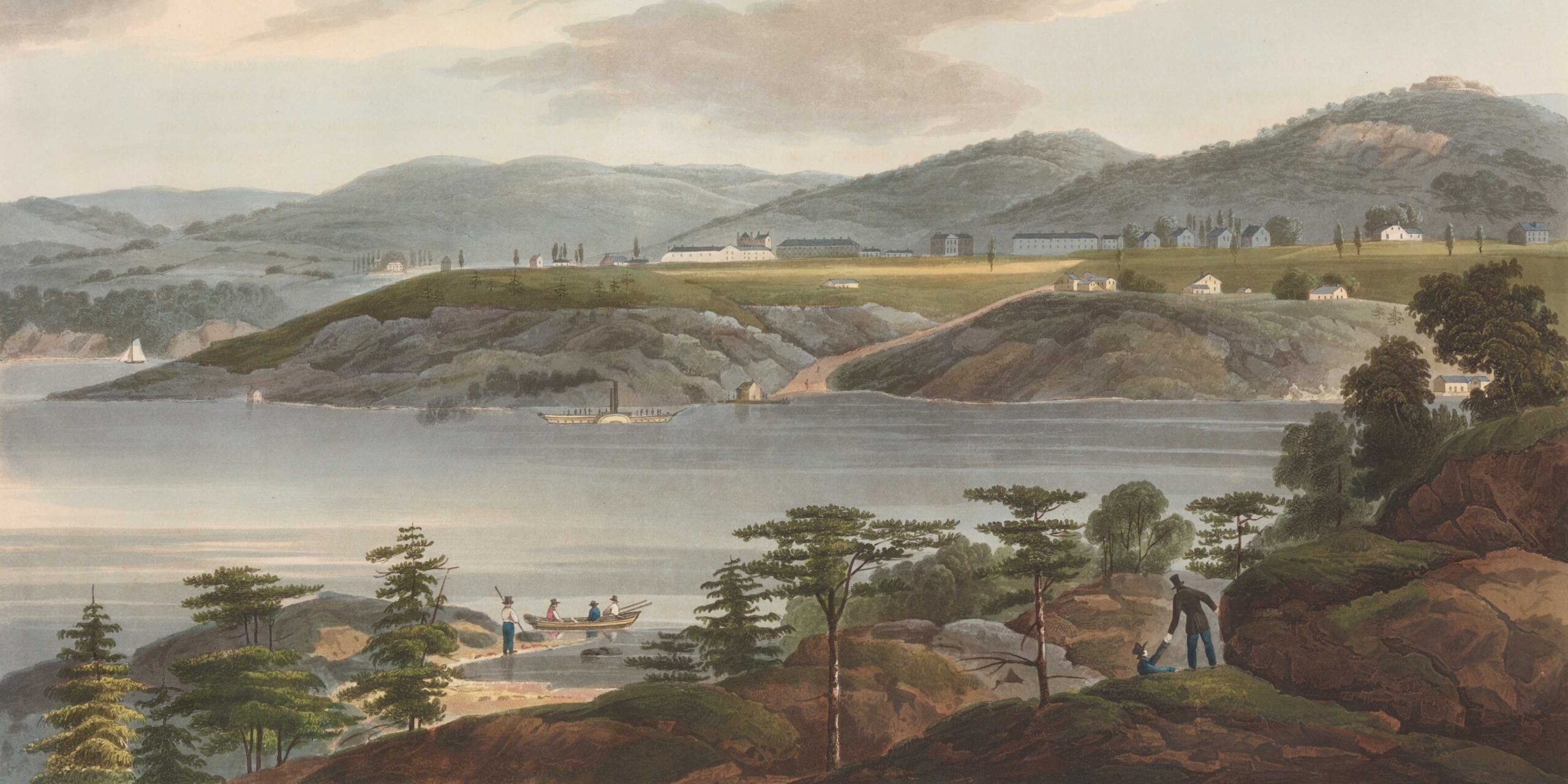
He requested that Washington put him in charge of West Point, where he would contact the British, offering the plans to the fort in exchange for a Brigadier General position in the British Army and a decent sum of cash. By the time the plans were discovered by the Americans, Arnold had already defected and set up base in the British occupied New York.
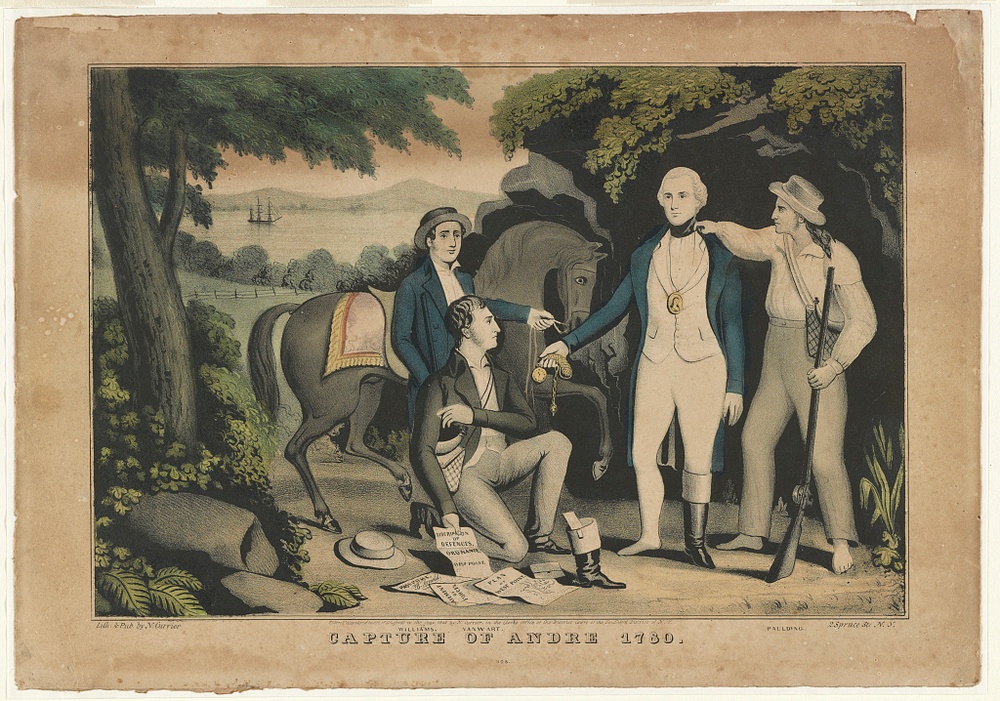
Benedict Arnold handing over the plans to the British
By 1780, the British were losing support for the war. Despite having taken parts of Massachusetts, the North had largely come to a stalemate. The British decided to switch up and focus more of their efforts on the largely British supporting South. They captured Savannah, Georgia and when the Americans and French tried to fight back, they were repelled and the British advanced to Augusta. They then captured Charleston, taking many prisoners. Now occupying the majority of Georgia and South Carolina, the pro-British Americans in the region against the people who had been harassing them for being pro-British.
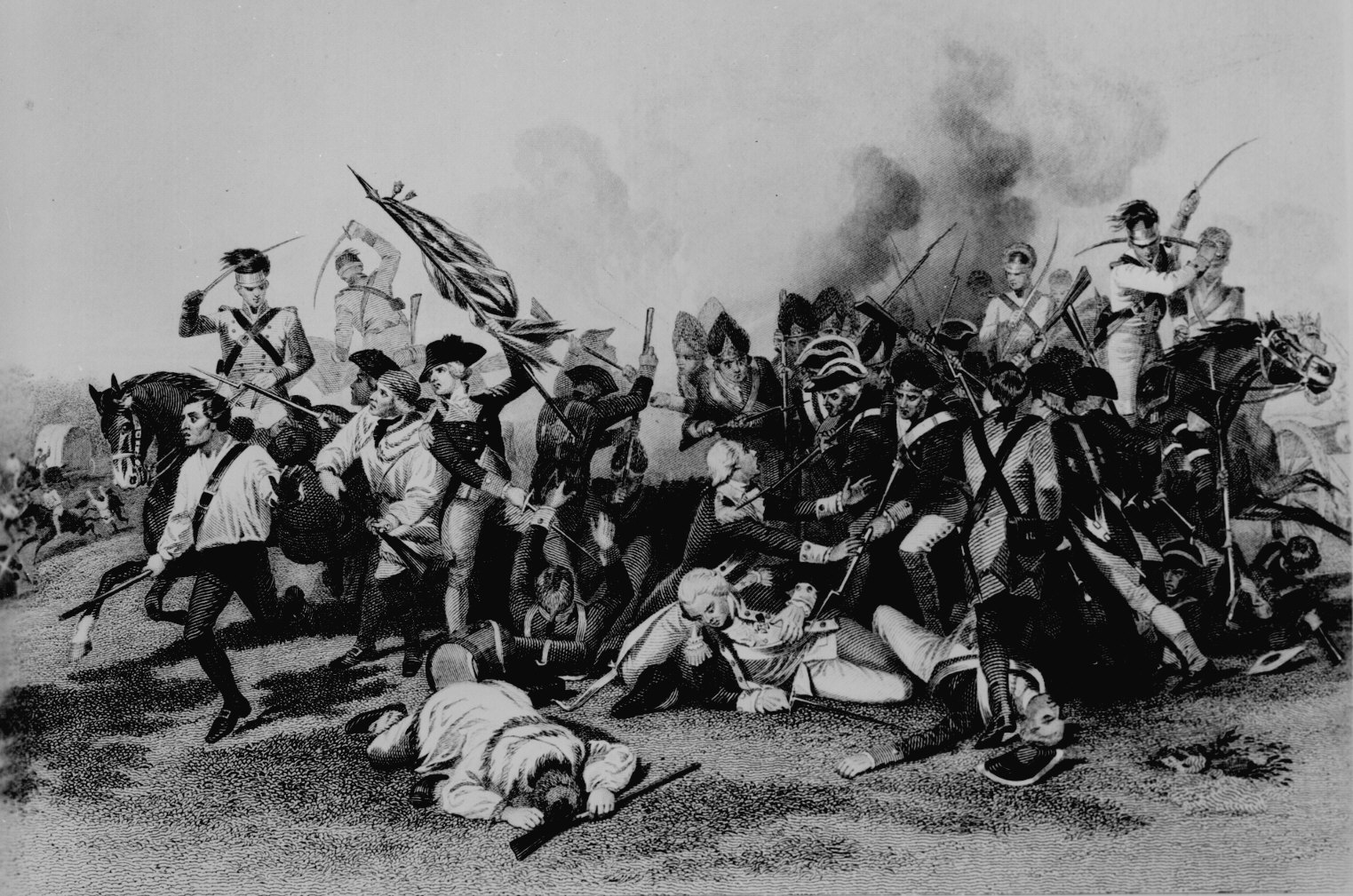
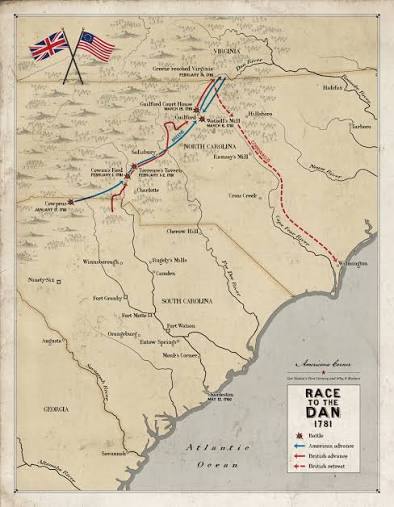
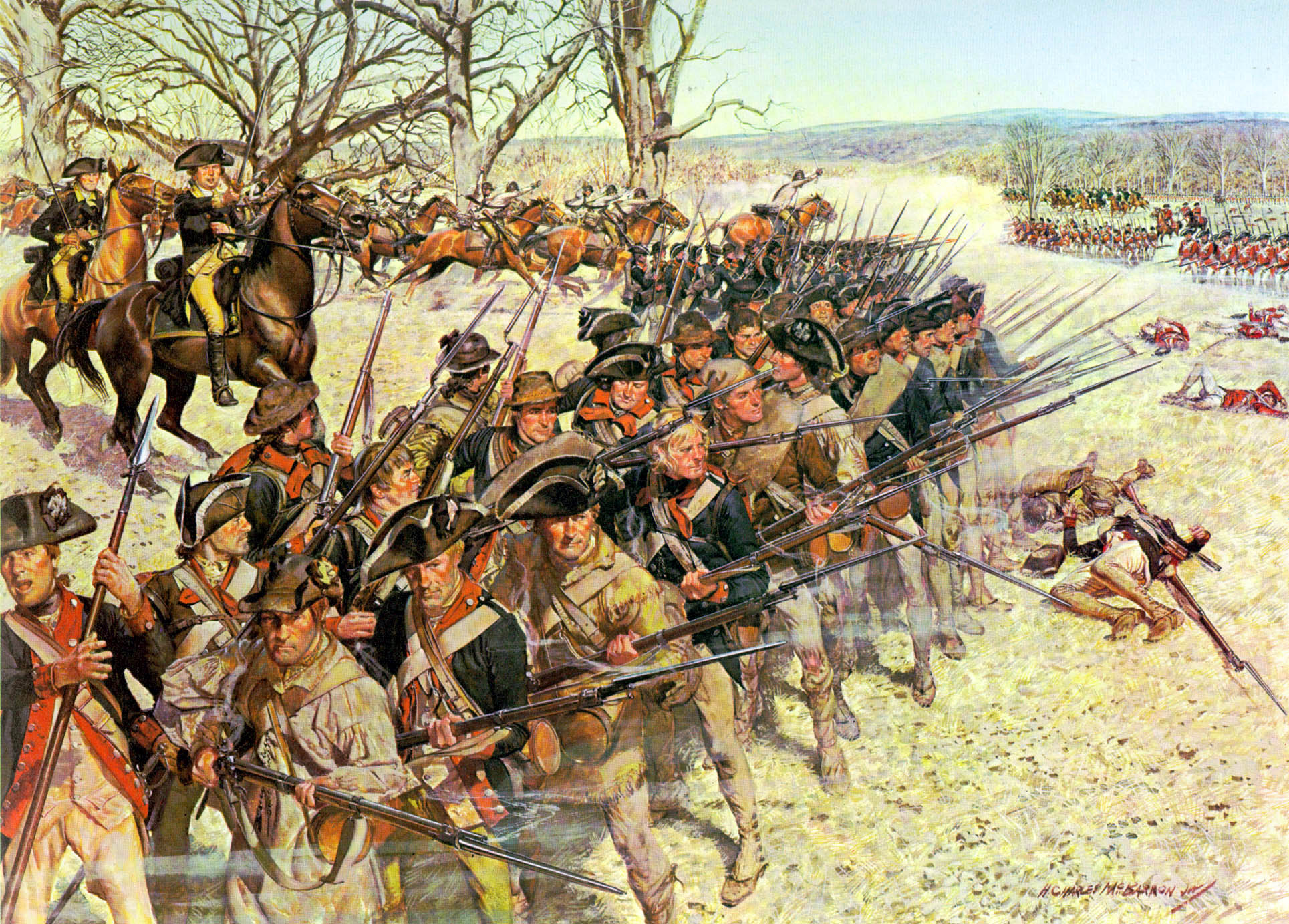
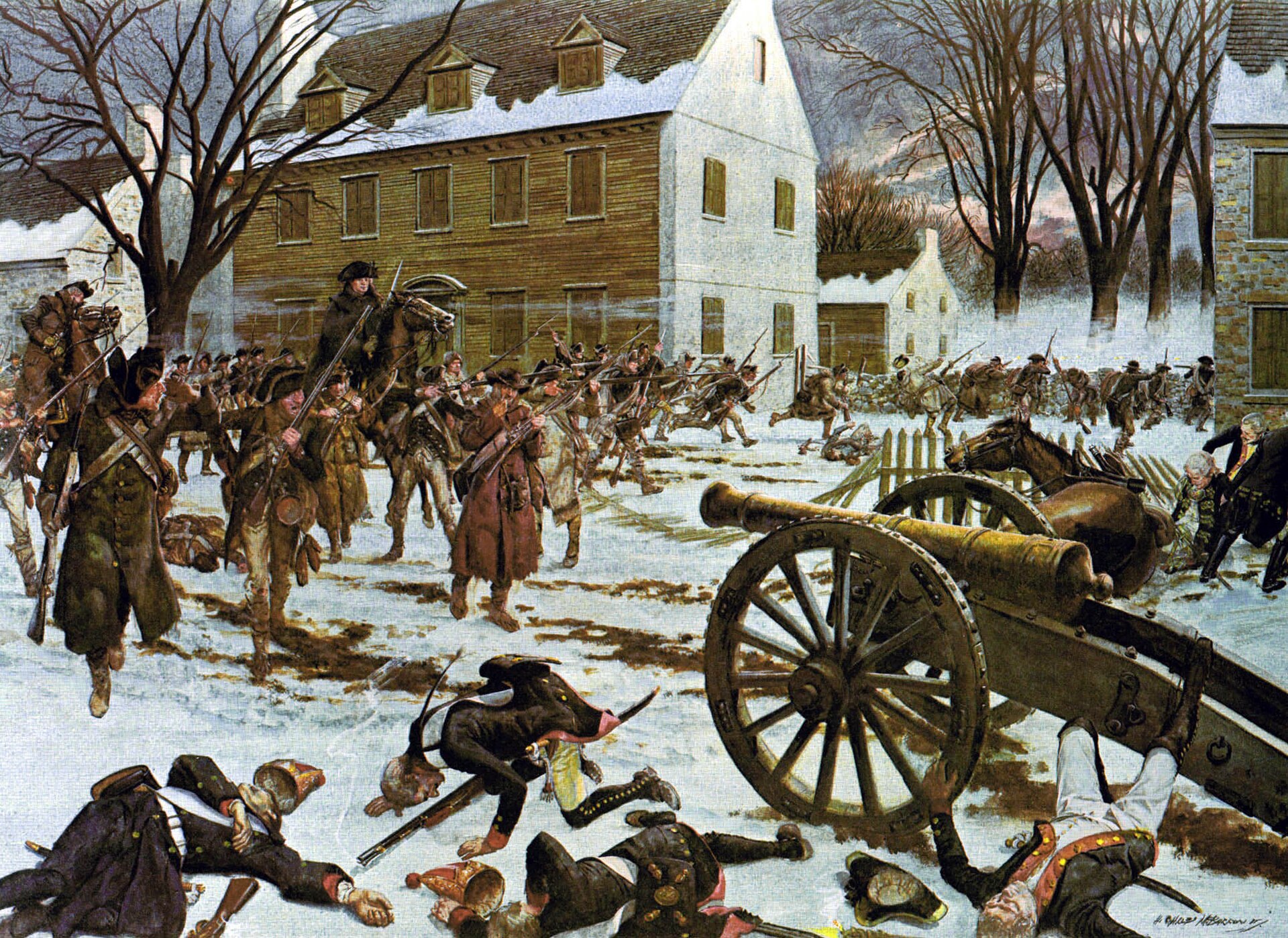
In order to deal with the Southern offensive, James Madison sent down Horatio Gates, who they believed was the one responsible for the successful offensive at Saratoga, to Camden. Gates got in one battle at Camden and was absolutely annihilated. Washington then sent down the much more capable Nathaniel Greene. He split his army into two, distracting General Tarleton, and defeating them with ease. He then pulled up Cornwallis’ men through North Carolina, straining their supply line. Greene then crossed the Virginia border, gathered reinforcements and faced down the British at Guilford Courthouse, who were tired from having to slug around their heavy equipment. Eventually, the two sides clashed in close-quarters combat. Fearing loss, Cornwallis fired cannons into the struggle, many of which cut down his own men. The American forces retreated but the British, just like Bunker Hill, sustained significantly more losses.
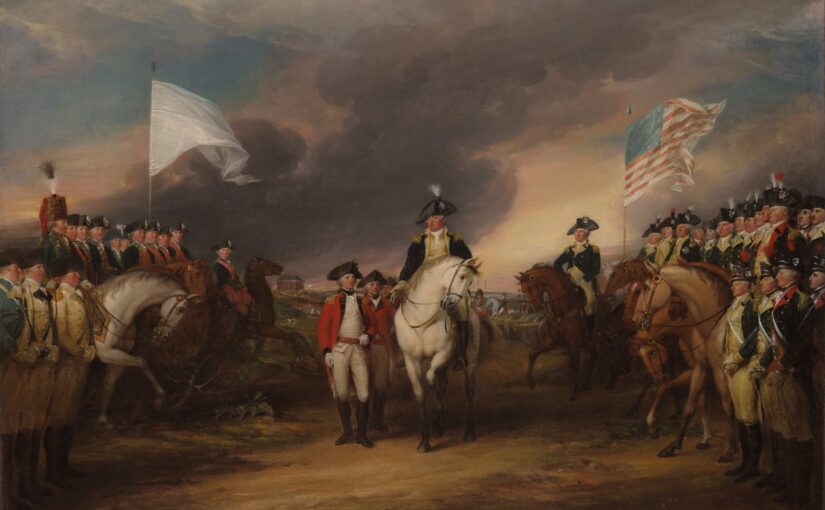
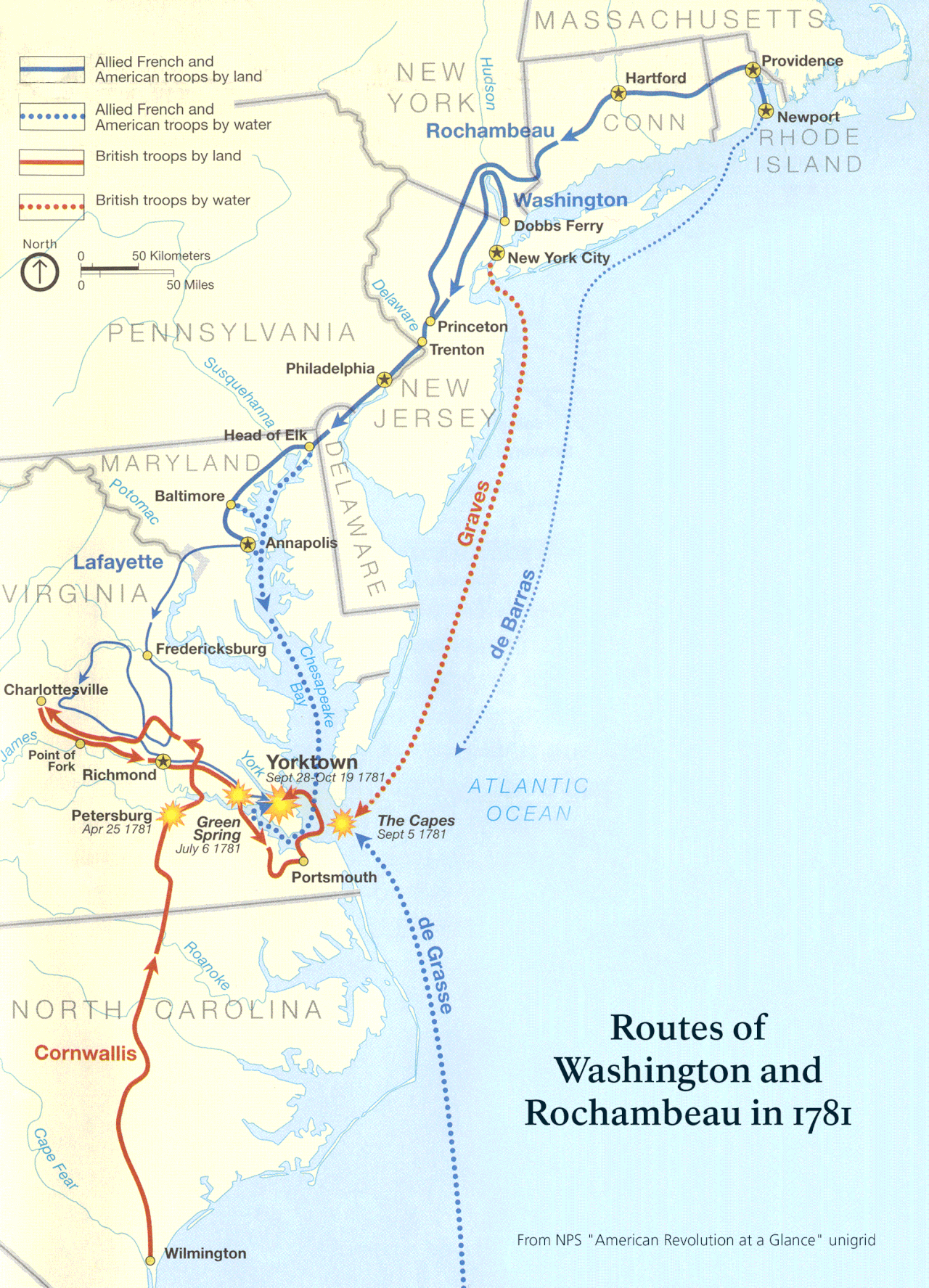
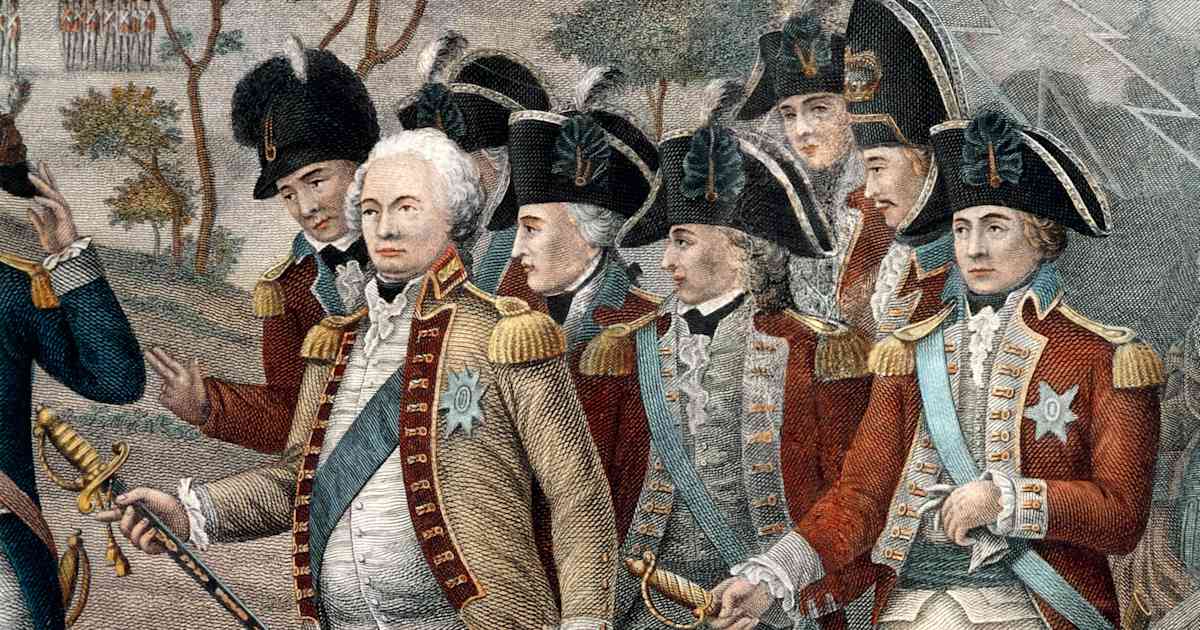
Eventually, both sides were becoming tired of the war. With mutinies occurring in the American Army and the British running out of money, the French arrival was the fresh air that they needed to end the war. Cornwallis decided to consolidate his men in Yorktown, with the intention to take Virginia, which was the American’s main supply hub. Meanwhile, Clinton’s forces in New York received intercepted messages saying that Washington intended to do a frontal assault of New York. However, Washington and the French, Commanded by Rochambeau, were secretly moving their troops down to Yorktown. The French navy made quick work of the British ships in the area whilst the ground troops tightened their grip on the city, firing artillery at Cornwallis’ men. Cornwallis asked Clinton for assistance but it never came. After holding out for a month, Cornwallis surrendered, with 7,000 British troops captured.
A painting of Cornwallis’ surrender
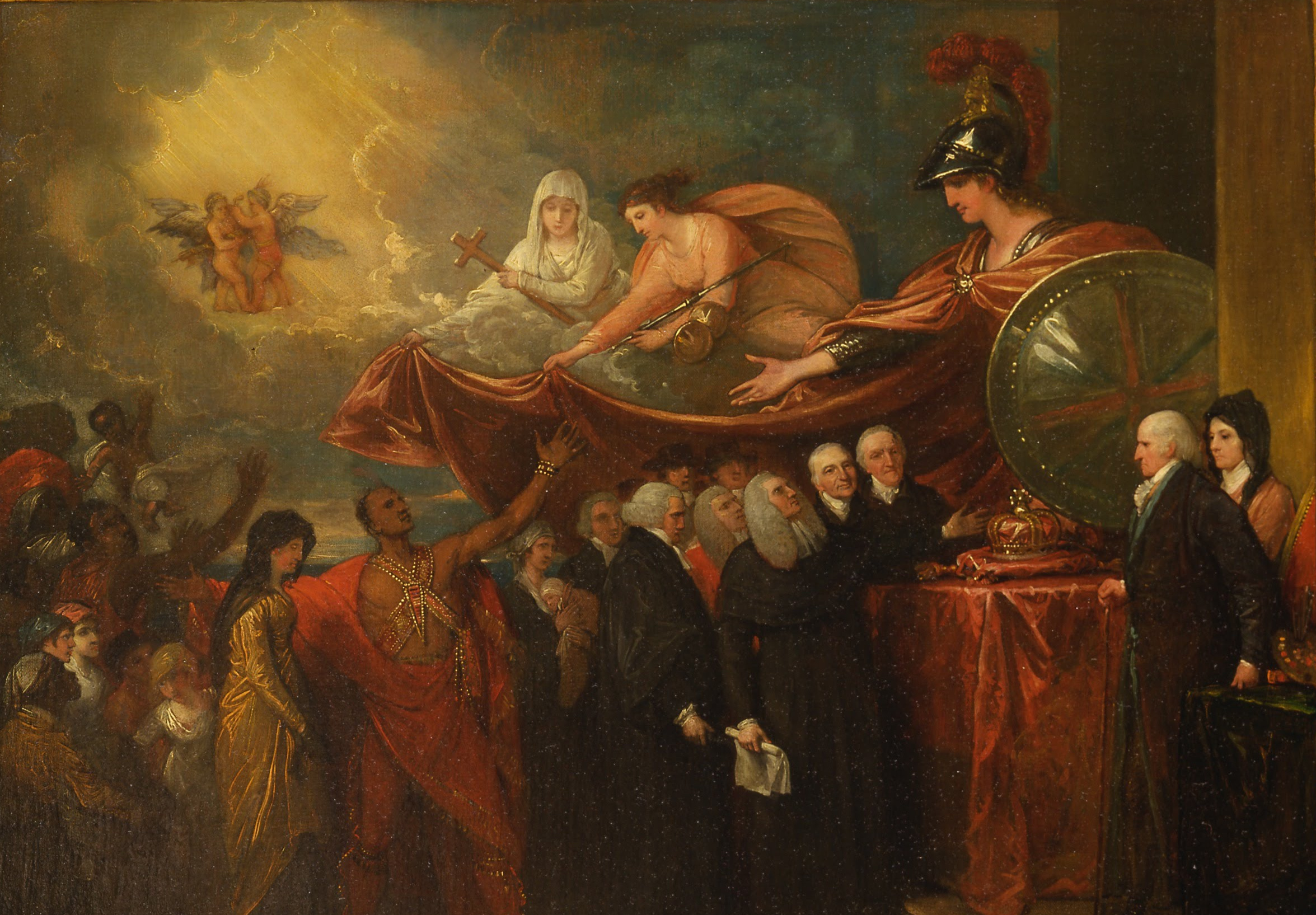
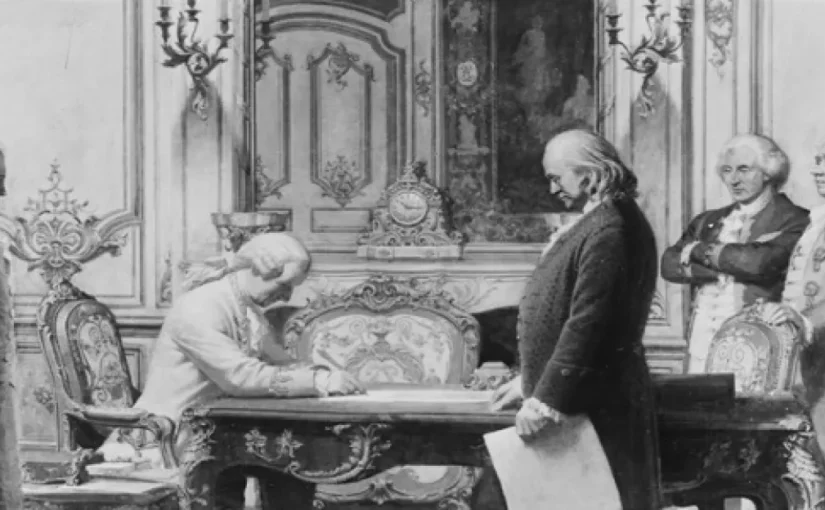
Parliament had enough of the war. Whilst Britain still did hold New York, Charleston and Savannah, they decided that they must sue for peace. The Treaty of Paris was signed, which dictated that British troops must leave the 13 colonies, recognise US independence and give them territory up to the Mississippi River, whilst America agreed to pay any debts to Britain and stop discrimination against any American Royalists. The Spanish took Florida.
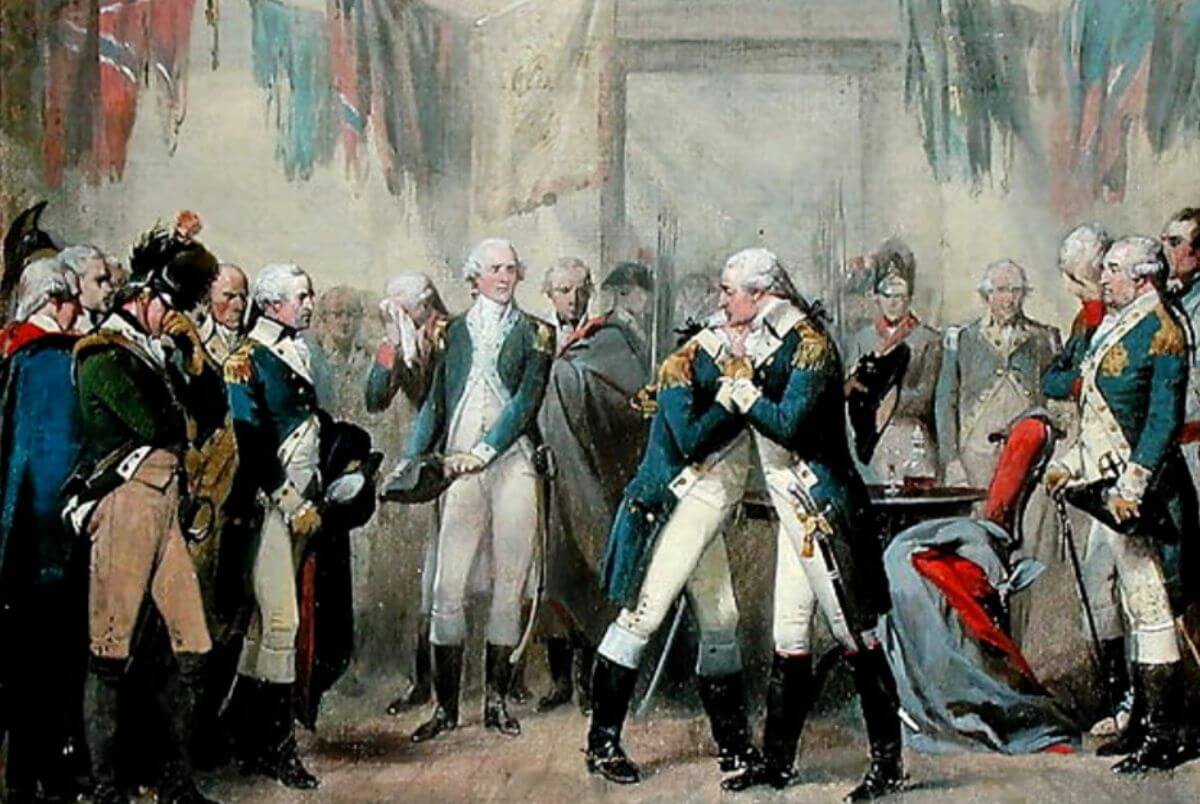
Washington retired, wishing his men a farewell, saying:
With a heart full of love and gratitude, I now take leave of you. I most devoutly wish that your latter days may be as prosperous and happy, as your former ones have been glorious and honorable.
Washington speaking to his officers, 1783
A painting of Washington bidding farewell to his officers
Eventually, the ever modest Washington was forced by the other founding fathers to take the role of leader of the country, deciding to name the office the humble title of President. Ultimately, Washington could have made the office into anything he wanted, whether it be a fascist dictatorship or an absolute monarchy. He instead decided to make the office a fairly elected, with a cabinet of advisors, as he knew that one man could not know everything. He would give annual speeches, talking about the state of the Nation. He claimed that the US should remain neutral in foreign politics and resigned the office after two 4 year long terms, knowing someone else had to eventually take the rains. Due to Washington’s carefulness, he made the office of President of the United States one of the most respected in the world.
Winter had fallen upon the war. Due to the severe losses, troop morale was low, so low that many ended up abandoning the army. British forces had spread throughout the New Jersey area and, while they partied, hired some German mercenaries to guard the Delaware River. However, due to their defences being low, Washington decided that now was the time to strike.
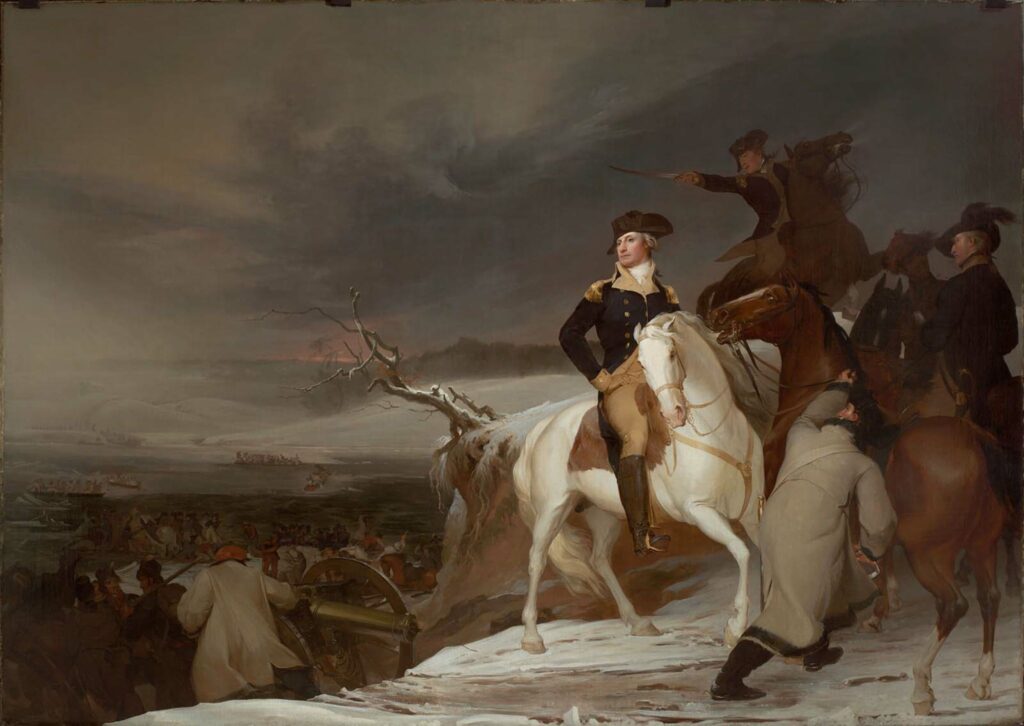
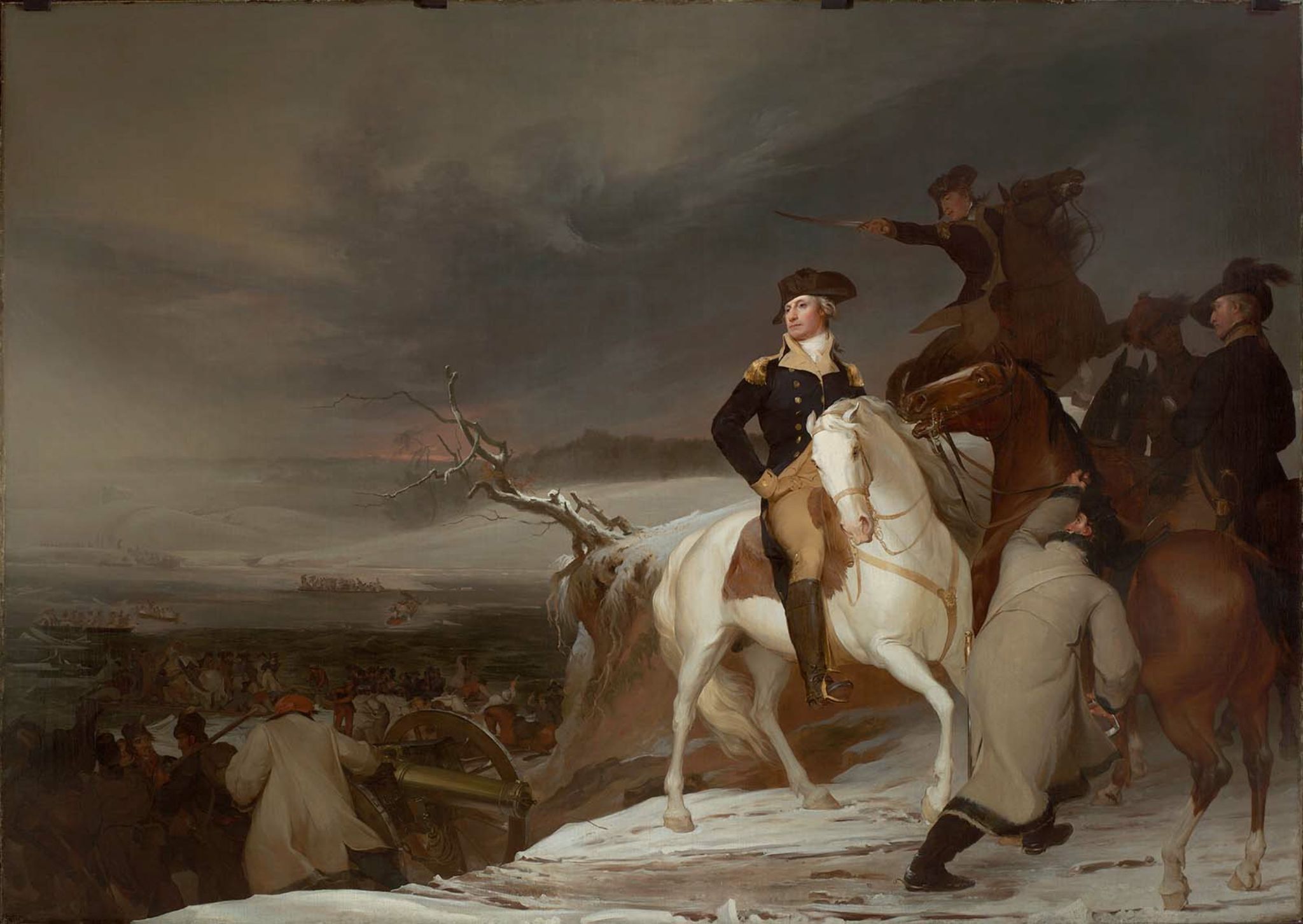
On Christmas, 1776, Washington made a dangerous crossing across the icy Delaware River. It was considered of upmost importance that the river be crossed so every soldier was armed, including officers and musicians who were given muskets. He marched down to Trenton the next morning and took out the mercenaries with ease. This victory sent a message of American power and that the war was far from lost for the Colonies.
A famous painting of Washington crossing the Delaware
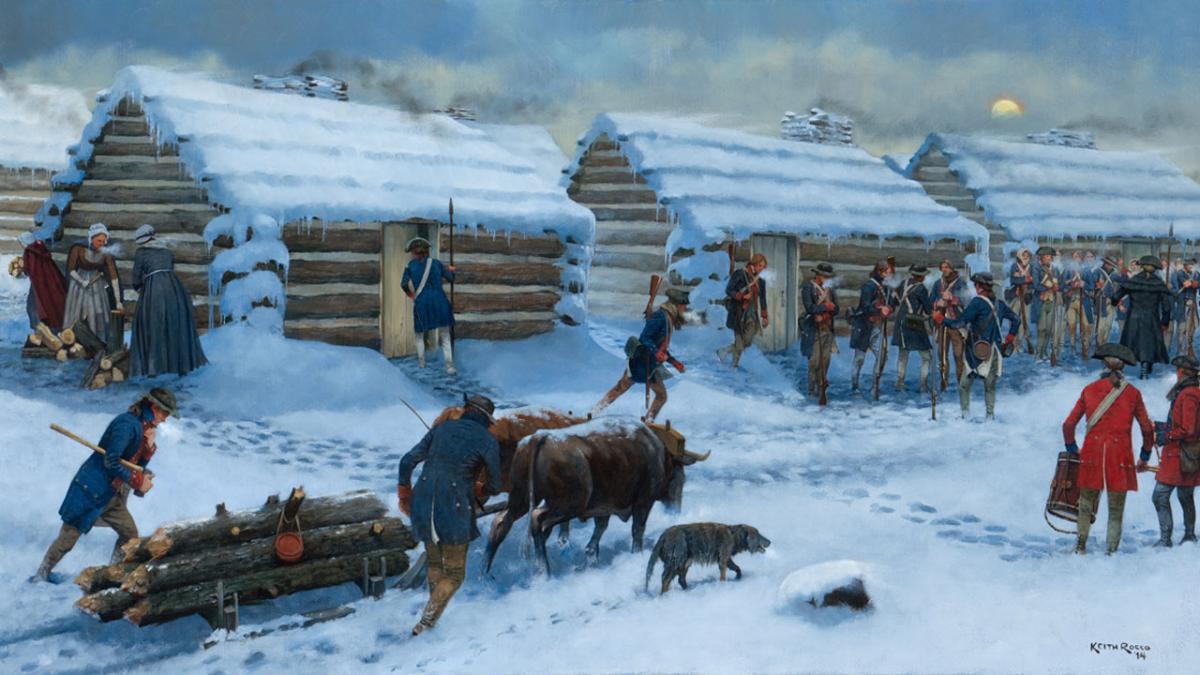
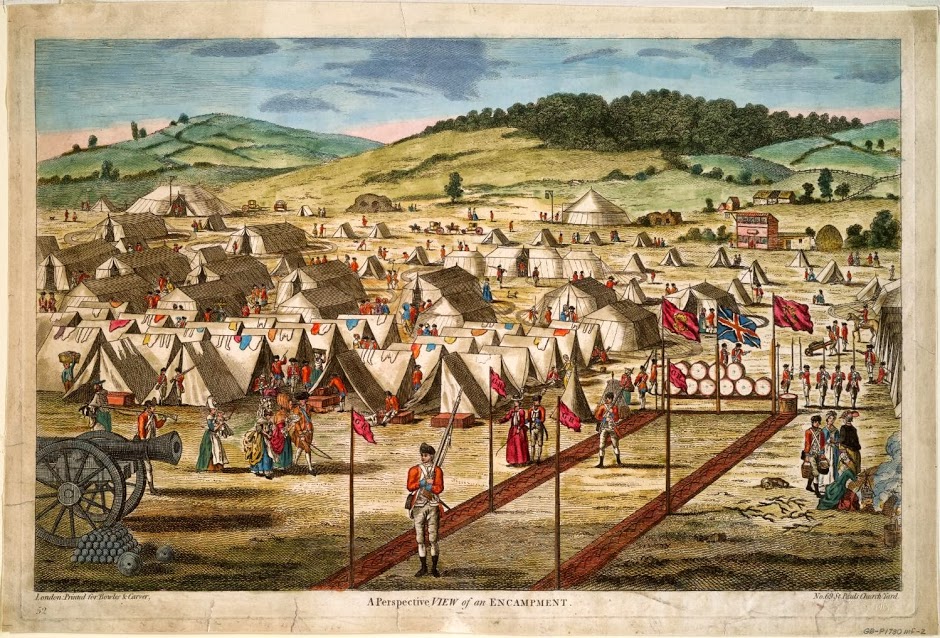
British forces were sent south to deal with the armies but were quickly taken care of by Washington’s army, forcing Britain to back out of Southern New Jersey. The Americans set up camp in Morristown and waited out the winter.
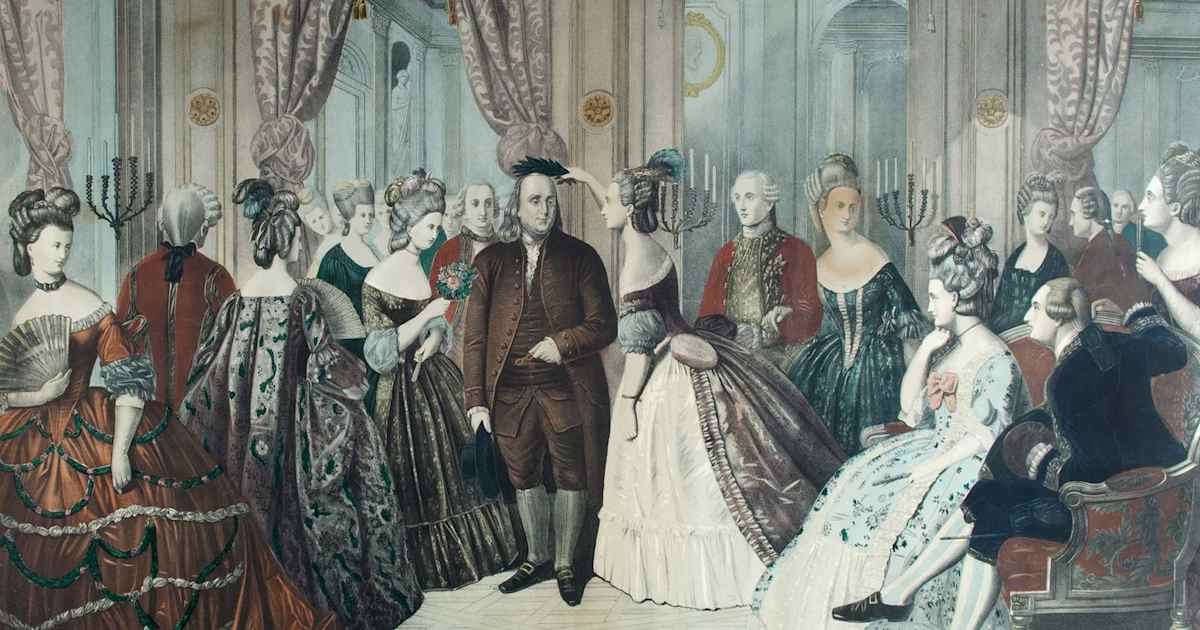
The British had managed to capture the northern naval base of New Port, Rhode Island, and attempted to capturing Charleston, South Carolina. Because of this, Congress sent Benjamin Franklin to Paris, to convince the French to join the fight. Whilst the French were deciding, Franklin allegedly starting getting in casual relationships with Parisian women.
Furious that the Colonies had not been crushed, the British came up with a plan, to meet up Burgoyne’s army in Canada with Howe’s army in New York, splitting the Colonies in half down the Hudson Valley. Burgoyne managed to make it to Bennington but Howe had not joined the fight. He had instead gone down to Philadelphia, capturing the capital and forcing Congress to move to York. This left Burgoyne to deal with the ever increasing American force at Saratoga.
Once again, we encounter Benedict Arnold. He was in a dispute with Horatio Gates. Gates wanted to set up defensive positions and push back from there. Arnold wanted to lead an offensive charge against the British. Gates eventually vetoed the plan but Arnold went against his orders and sent a large force against the British, pushing them back to Canada. Horatio took all the credit and Arnold did not get a single mention.
Burgoyne and Howe were both pulled out of the country, leaving General Henry Clinton in New Jersey. In addition, the victory at Saratoga meant the French could finally join the war against the British. Despite this ally, American forces were once again beginning to lose hope in Washington’s leadership, as winter had once again set in. Soon, a Prussian General called Friedrich Stueben came along and fixed everything, properly training the American army in shooting, marching and other such things that the army desperately needed. Those who did not comply would be punished. After the winter of 1778, Washington was ready to take back the capital. But before he could, Clinton was ordered to move all his forces to New Jersey, due to the new threat from France, and allowed Philadelphia to fall back into American hands. Washington assigned Arnold to hold down Philadelphia and chased the British all the way back to New York.
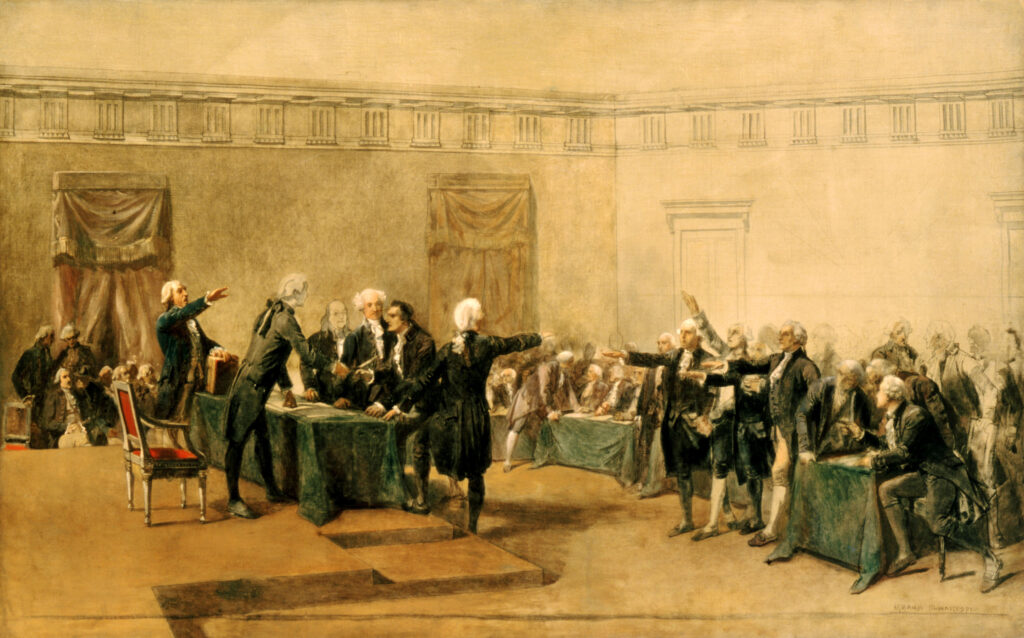
After forcing the British troops out of Boston, Washington decided to move his troops down the New York, believing that if the British were to return, they would come for there. Meanwhile, Thomas Paine, a political philosopher, wrote a pamphlet called “Common Sense”, wherein he advocated for independence from Britain. It spread across the nation and became one of the best selling American titles. This pamphlet brought the idea of independence into the mainstream, meaning that congress began considering it seriously. Thomas Jefferson wrote an official Declaration of Independence. On July 2nd, Congress voted unanimously in favour of independence, with the independence taking effect on July 4th. The United States of America was born.
A painting of the signing of the Declaration of Indpendence
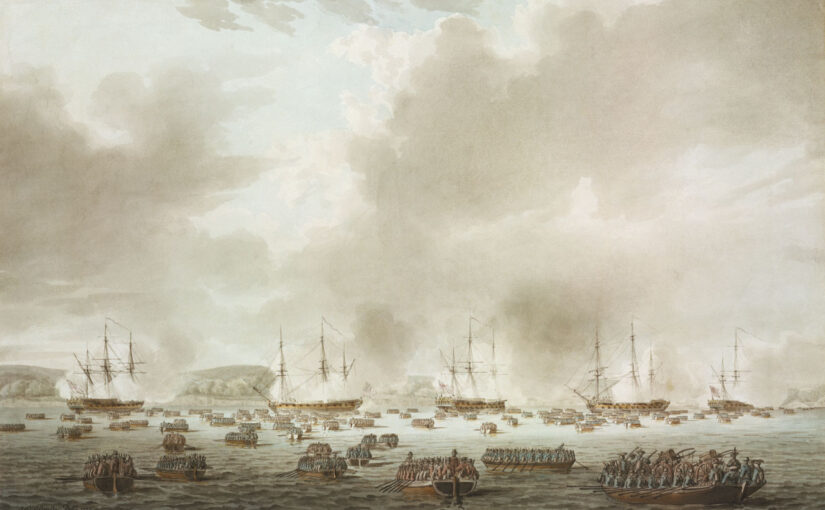
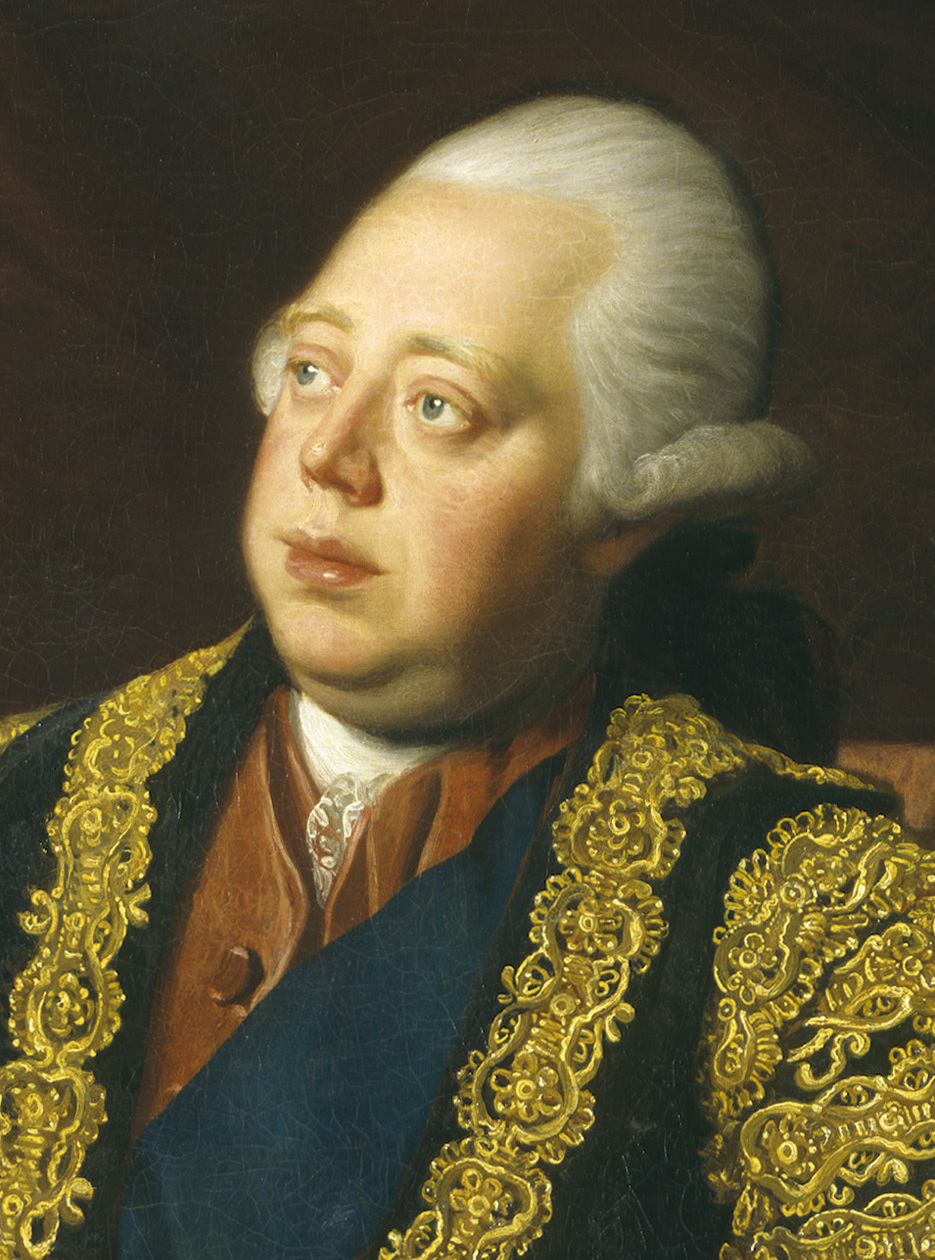
Due to viewing this declaration of independence as treason, King George sent 130 warships down to New York with 25,000 soldiers for a ground invasion. They set up camp on Staten Island whilst the Americans set up on Brooklyn Heights. However, the British did not attack, instead allowing the American’s nerves to wear down. After an artillery barrage, the British hit hard, having one half of their army attack Washington’s men from the front, while the other half looped from the back and flanked them. The American forces ended up being pushed back to the East River.
Between a rock and a hard place, Americans began to believe that the war was already lost. However, the British decided to entrench themselves around the Continental Army as a thick fog set in, allowing the Americans to cross the river undetected. However, they were chased by the British, suffering defeat after defeat. Washington’s leadership began being called into question as they were pushed all the way back the the New Jersey-Pennsylvania border. Never in human history was an army so badly beat but yet was still around to fight another day.
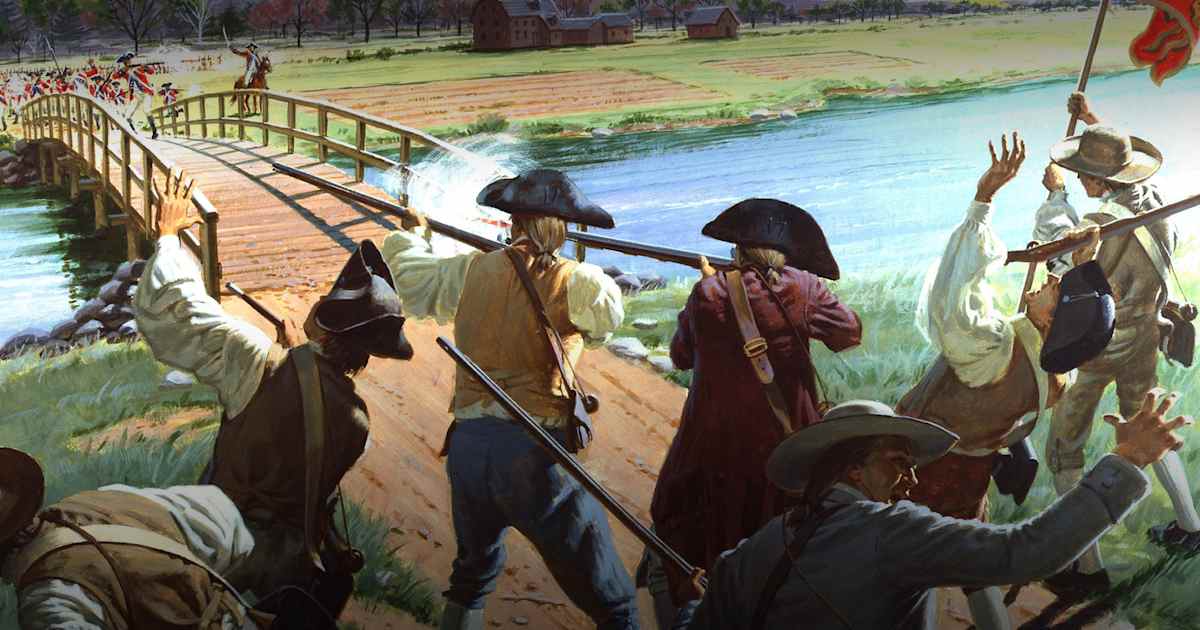
Once someone shot first at Lexington, the much more powerful British army pushed the Americans back to Concord. However, reinforcements arrived for the Americans and, despite being one of the most heavily trained armies on Earth, they were pushed back to Boston, being ambushed by the inexperienced militia forces. Once the British troops were in Boston, the Americans surrounded the position.
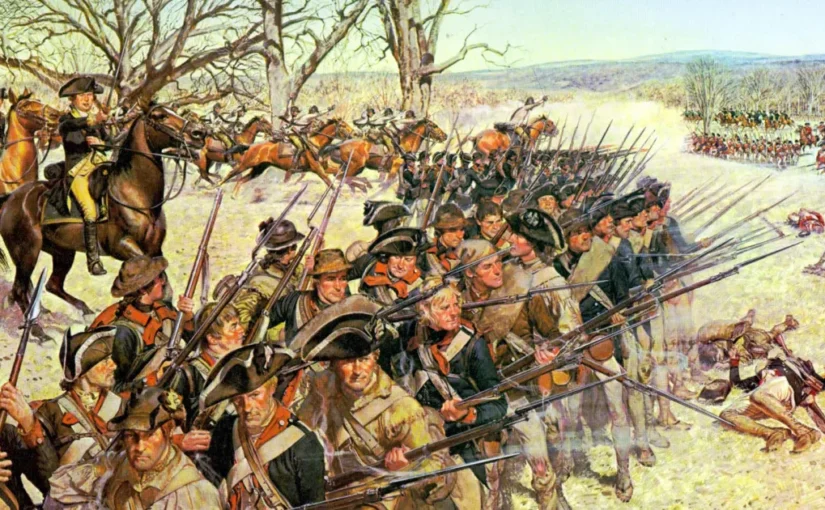
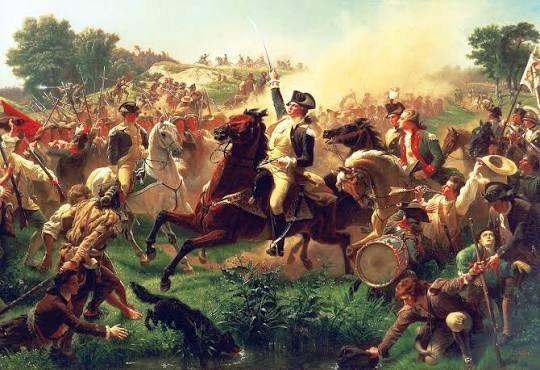
Eventually the founding fathers realised that militia forces would not be enough to crush the British so had to organise an army, assigning George Washington to command. George headed north from Philadelphia whilst the British attempted to break the siege, planning to attack the northernly Bunker Hill. Spies warned the newly formed Continental Army of their plans so fortified Bunker Hill and the neighbouring Breeds Hill. The British began the offensive and, after two unsuccessful attempts, the Americans ran out of ammunition and were forced to retreat. The Battle of Bunker Hill was technically a British victory, despite having almost 3 times the casualties of the Continental Army.
A painting of the British charge up Bunker Hill.
However, many Americans were still not decided on what they were fighting for. Some radicals began throwing around independence, whilst others wanted to maintain relations with the British. The latter camp sent a letter to London, requesting the removal of the taxes and an ally ship. George III denied the request. Britain burnt down the towns of Falmouth, MA and Norfolk, VA, which the Americans used to show how brutal the British were. France and Spain, seeing this, sent supplies over to the colonies.
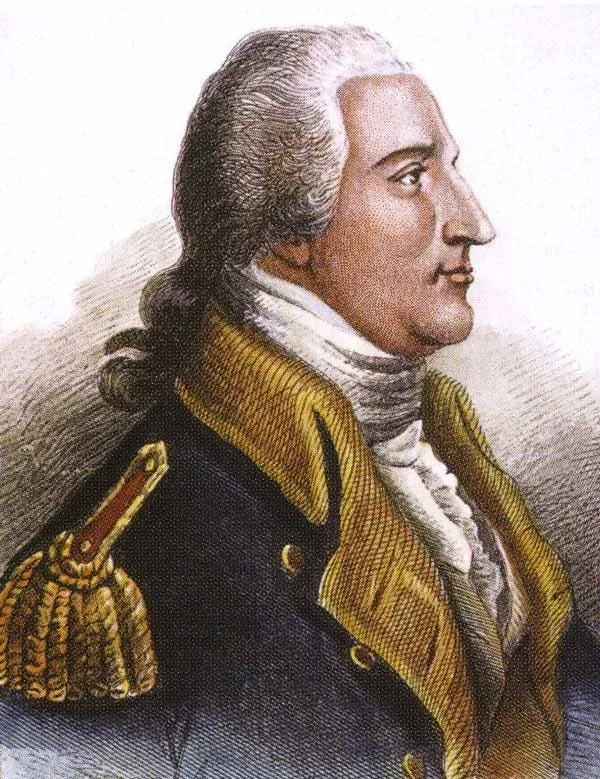
A drawing of Benedict Arnold
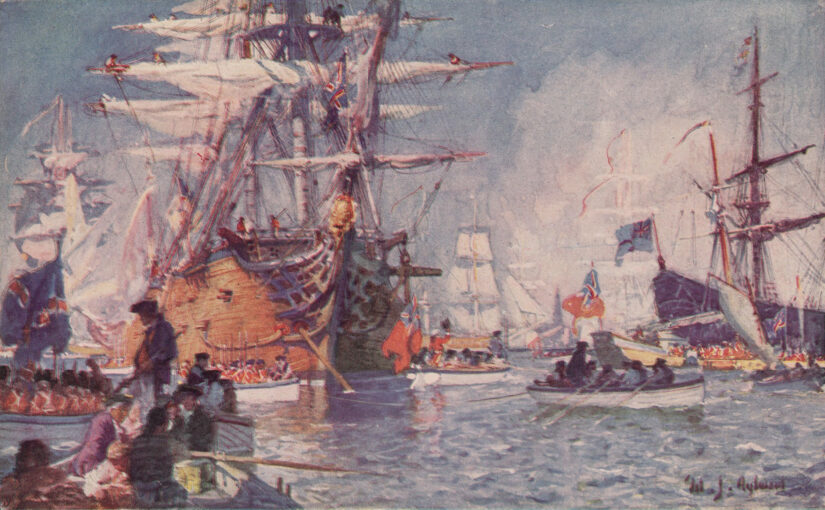
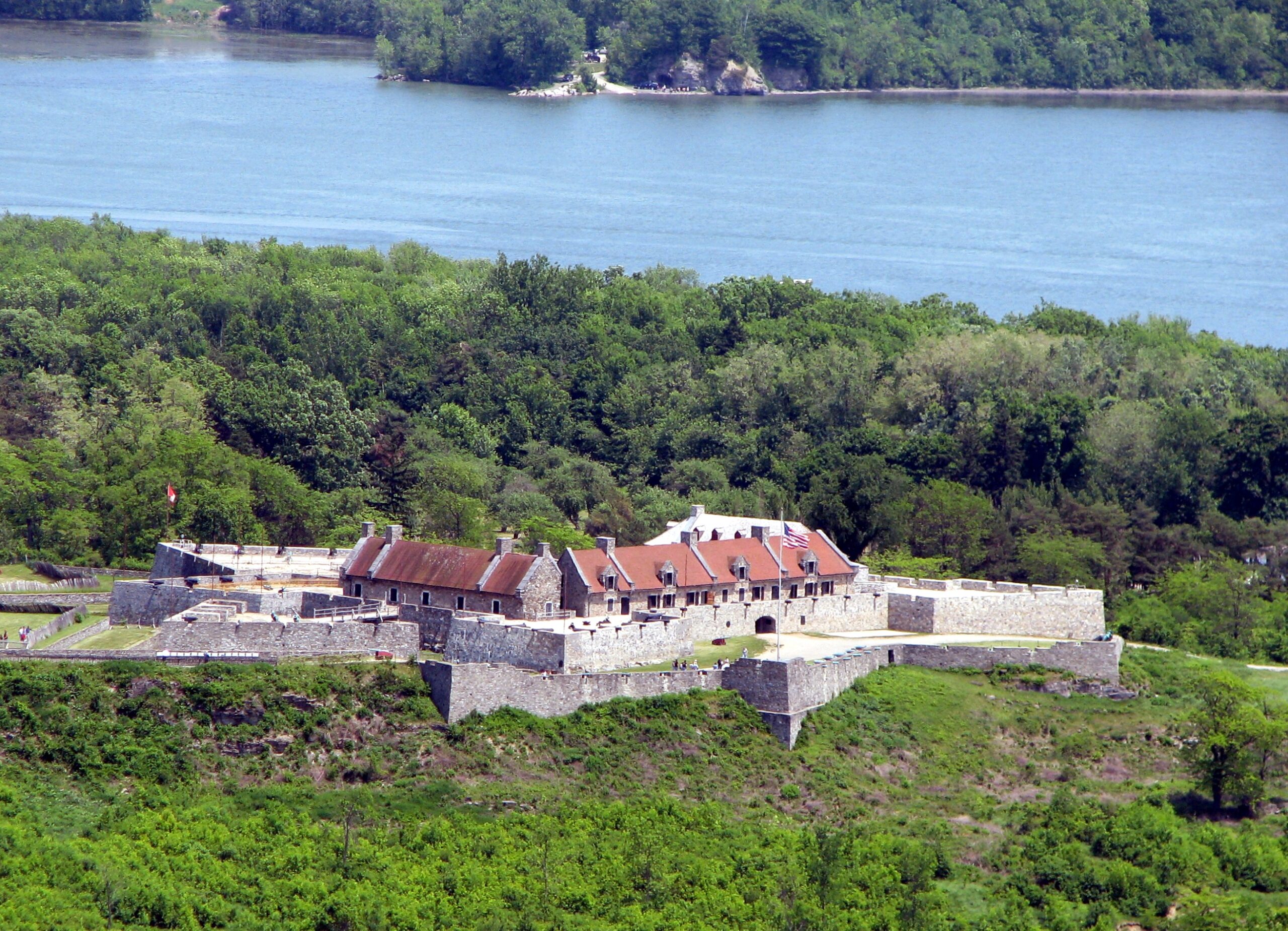
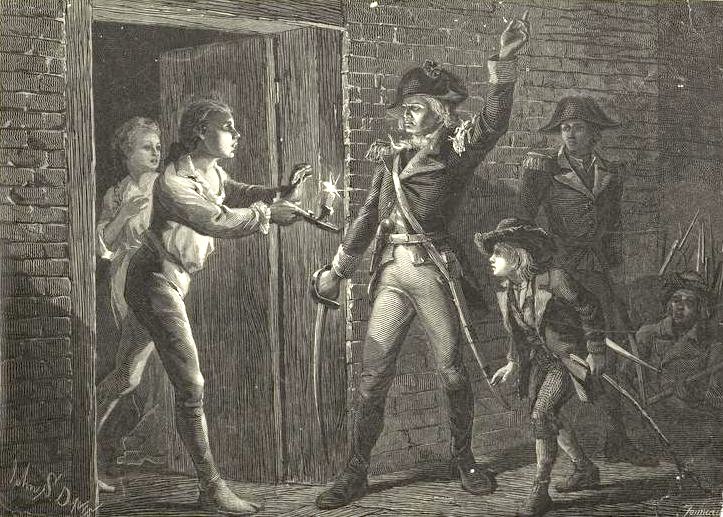
Meanwhile, we meet a man called Benedict Arnold. Arnold conducted a plan to take the British fort, Fort Ticonderoga, which had a lot of weapons and ammunition that he believed could be useful for the colony’s war effort. He set off to Ticonderoga by himself, wanting to recruit soldiers along the way. He eventually met the Green Mountain Boys, led by Ethan Allen, who had the same idea as Arnold. After a dispute of who should lead the capture of Ticonderoga, Allen was assigned to lead. Whilst the British were asleep, they took the British by supplies and managed to capture the fort and take the ammunition with little resistance. However, Allen took all the credit of the capture for himself, not even mentioning Arnold. He then attempted to stage an invasion of Canada. The Continental Army had managed to capture Montreal but were pushed back at Quebec, all the way to Fort Ticonderoga.
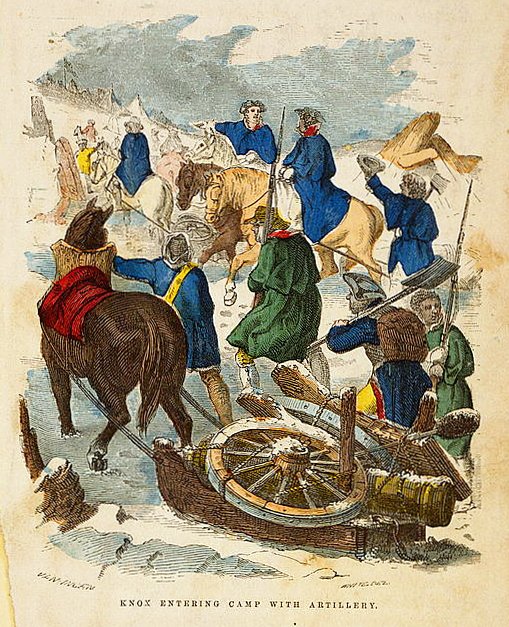
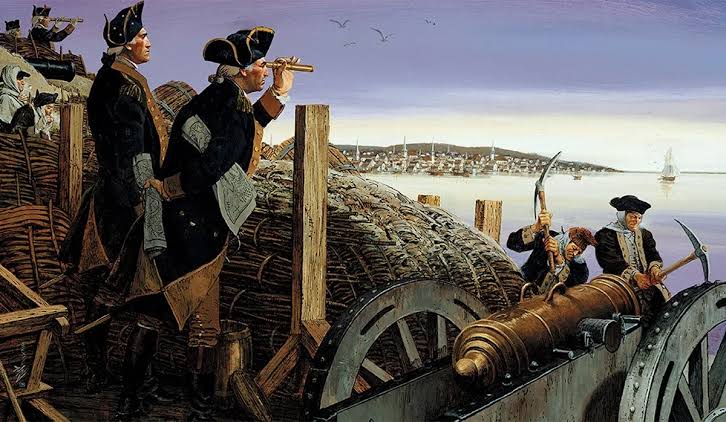
Henry Knox had an idea of what to do with all the guns and ammo they seized from the British at Ticonderoga. He grabbed some bison and got them to pull the guns and ammo through the harsh winter to Washington’s army in Boston, who very much needed the morale boost. Washington believed that a frontal assault would be necessary to end the siege, but junior officers believed that it would be too risky as they believed the British would be heavily fortified in their position. Thankfully, Washington listened and set up cannons on Dorchester Heights, overlooking the city overnight. Once morning came, the British knew they had no choice but to abandon the city, pulling 9000 soldiers out of the city. Washington had his first victory of the war.
A painting of the cannons being set up at Dorchester Heights
In 1492, Christopher Columbus, unknowingly, discovered the New World. This New World was rather notorious for having a lot of gold, leading many European countries to set up shop. After many years of waring with each other and the natives, the European powers had gained quite a decent amount of land.
A small strip between Britain and France’s land in the region was disputed by the two sides, until the British sent up-and-comer, George Washington to the region to sort things out. This eventually lead to the Seven Years War between Britain and France.
Britain came out as the victor but at a great monetary cost. In order to get their money back, they decided to tax the American colonies to hell and back. Think of any random every day object and there was probably a tax for it. Stamps? Paper? Sugar? Tea? All taxed
Not only this but the colonies had no representatives in Parliament, despite them being taxed. This is called “Taxation without Representation”, which was drilled into my brain by my Year 11 History teacher.
The Americans ended up boycotting all British goods, meaning Britain was still poor. Eventually, King George had to concede and removed all taxes except for the one on tea and sent 1000 British troops to Boston, forcing the colonists to pay.
On March 5th, 1770, a large group of Colonists came to protest against the soldiers. As back-up arrived for the soldiers, more Colonists arrived and began to throw things at the soldiers, from snowballs to rocks. Eventually, the soldiers had enough, took aim and fired.
A drawing of the Boston Massacre
5 civilians were killed in the massacre. Many Colonial newspapers claimed this was a brutal attack against the colonists and a war crime.
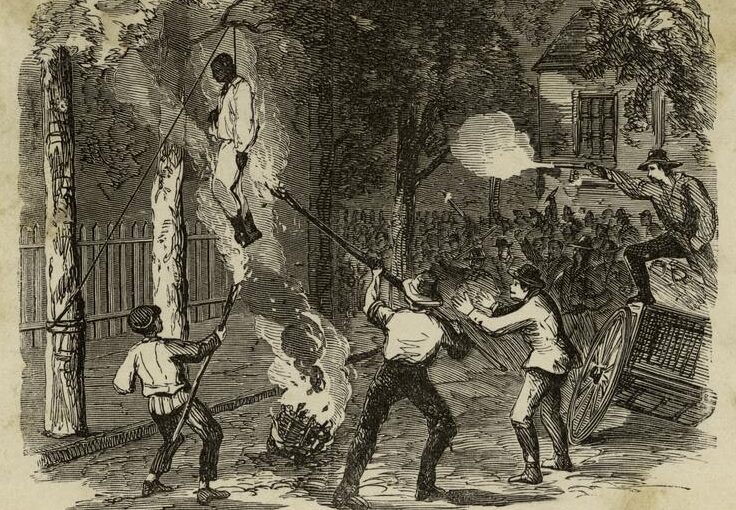
The people were incredibly angered and the violence escalated. Schooners that ran aground would be raided, pro-British politicians would have their houses burnt down and on December 16th, 1773, a group of colonists would disguise themselves as Native Americans, jump onto a shipment of tea and pour it all into the Boston Harbour.
A drawing of the Boston Tea party
In response, the British dissolved their assembly, revoked their charter and sent 3000 more troops to Boston. Boston was now a directly British Occupied City. And the people were angry. Fearing they may be next, other colonies gathered to discuss what to do next
The First Continental Congress. George Washington is depicted central and Benjamin Franklin is in the brown jacket on the left
They decided to politely ask Britain to stop and after they (obviously) said no, they decided to set up groups of soldiers across the 13 colonies, to be ready at a minute’s notice. Hearing this, the British sent out 700 troops into the American Occupied Massachusetts. After setting off to concord in the middle of the night, many Americans were heard to be in the streets yelling “The British are Coming!” The two sides encountered in Lexington. After minutes of yelling, one side shot first. This is considered to be the start of the Revolutionary War.