
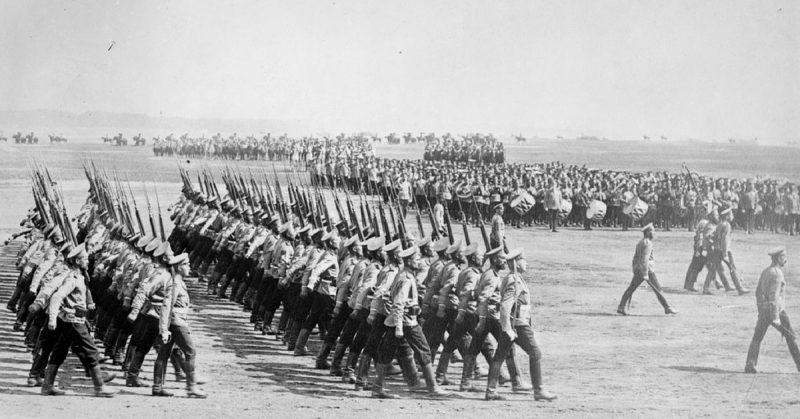
Many Russians had grown disillusioned with the Tsarist government due to political and economic strife throughout the 1900s and 1910s, but the outbreak of the World War I initially brought a wave of patriotism. A defeat at the hands of Germany was widely feared because it could expose the weakness of the regime and potentially lead to its collapse. As part of the war effort, even the capital, Saint Petersburg, was renamed Petrograd in 1914 to sound less German.
Not everyone supported the war. Vladimir Lenin, a communist revolutionary living in exile, condemned it as an imperialist conflict between rival powers. He argued that workers should not fight for their rulers, but instead turn the war into a revolution against them, a position that was highly controversial at the time.
On the battlefield, Russia struggled. Poor leadership, weak logistics, and outdated equipment led to a series of defeats. In 1915, Tsar Nicholas II made a critical decision: he took personal command of the army. While intended to boost morale, this move had serious consequences. It tied the Tsar directly to Russia’s military failures and left the government in Petrograd under the authority of his wife, Alexandra Feodorovna. This is where one of the most controversial figures in Russian history comes into play: Grigori Rasputin.
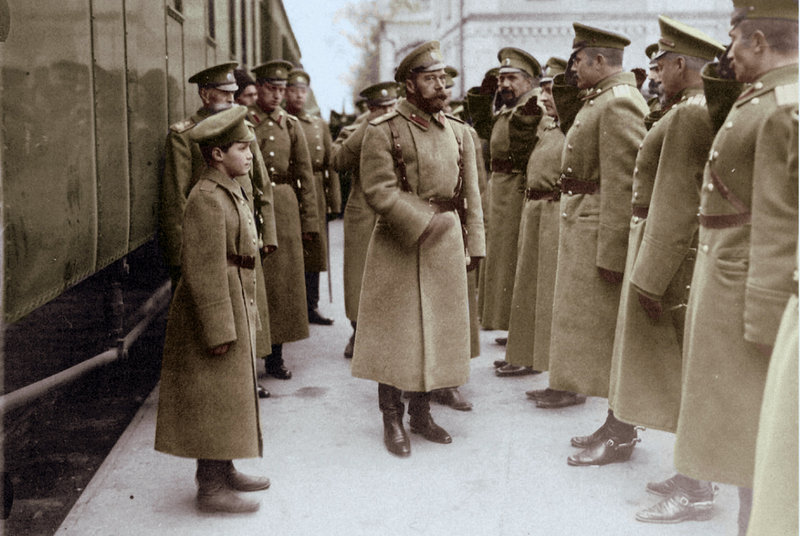
Rasputin was not a “wizard” in the literal sense, nor simply a madman. He was a Siberian peasant and self-proclaimed holy man who had gained a reputation as a spiritual healer. His rise to influence came through the royal family’s private crisis: the Tsarevich, Alexei, suffered from haemophilia, a life-threatening condition that caused uncontrolled bleeding. On several occasions, Rasputin appeared to ease the boy’s suffering, possibly by calming him, advising doctors to stop certain treatments, or through sheer coincidence. To the Tsarina Alexandra, however, this seemed like a miracle. She came to believe that Rasputin was sent by God to protect her son and, by extension, the monarchy itself. Because of this, Alexandra trusted Rasputin deeply and began to rely on his advice, even in political matters.
While there is little evidence that Rasputin directly controlled government policy, his influence over the Tsarina, combined with her influence over the absent Tsar, created the perception that he was effectively running the country. This perception proved disastrous. Rasputin’s behaviour, which included heavy drinking and alleged affairs, scandalised the aristocracy and damaged the reputation of the monarchy. Even more damaging was the fact that Alexandra was German-born during a war against Germany, leading to rumours that she, and by extension Rasputin, were undermining Russia from within.

By late 1916, a group of nobles had decided that Rasputin had to be removed. Among them were Felix Yusupov and Grand Duke Dmitri Pavlovich, both closely connected to the royal family. On the night of December 30th, 1916 (December 17th in the old Russian calendar), they lured Rasputin to Yusupov’s palace in Petrograd. What happened next is partly known and partly myth.
According to Yusupov’s later account, Rasputin was offered cakes and wine supposedly laced with cyanide, yet appeared unaffected. However, historians widely doubt this version, as the poison may never have been used or may have been ineffective. What is more certain is that Rasputin was eventually shot. When he did not immediately die, he was shot again, likely multiple times, and finally killed. His body was then taken and thrown into the Neva River. Later reports claimed that water was found in his lungs, suggesting he may have still been alive when thrown into the river, but this remains disputed. Much of the dramatic story of his death, involving poison, survival, and near-supernatural endurance, comes from unreliable or exaggerated accounts, which helped fuel the legend of Rasputin as an almost indestructible figure.

When the conspiracy was uncovered, the punishments were relatively mild. Yusupov was exiled to his family estate, while Dmitri Pavlovich was sent away to serve in Persia (modern-day Iran). The leniency reflected both their noble status and the widespread belief among the elite that Rasputin’s removal had been necessary. However, Rasputin’s death came too late to save the monarchy. By this point, the damage to the Tsarist regime’s reputation was already severe. The association of the royal family with such a controversial figure had eroded public trust and contributed to the growing sense that the government was incompetent, corrupt, and out of touch.