The Revolution had transformed France politically, but for ordinary people, one problem remained largely unchanged: food. Bread was the foundation of the French diet, and its price had risen dramatically following years of poor harvests and economic disruption. Paris was particularly vulnerable. Thousands of workers and labourers depended upon cheap bread to survive, and rumours that the aristocracy was hoarding grain or deliberately allowing prices to rise were widespread.

Many Parisians therefore began to see the political crisis and the food crisis as inseparable. The National Assembly might have been debating constitutional reform, but ordinary people wanted something much more immediate: bread. Increasingly, they also believed that King Louis XVI did not fully understand their suffering. He lived at the Palace of Versailles, surrounded by courtiers and aristocrats, almost twenty kilometres from the centre of Paris. To many Parisians, Versailles represented everything that was wrong with the old regime: enormous wealth, political privilege and royal isolation from the people.
Tensions became even worse in early October 1789. On October 1st, royal soldiers held a banquet at Versailles to welcome a newly arrived regiment. According to reports circulating in Paris, the soldiers had trampled on the revolutionary tricolour cockade, a symbol of the Revolution, while royal white cockades were supposedly worn in its place. Whether the event was quite as provocative as later revolutionary propaganda suggested remains debated, but the story spread rapidly through Paris. To an already angry population, it appeared that the King and his soldiers were openly mocking the Revolution while ordinary people struggled to feed themselves.
.jpg)
On the morning of October 5th, thousands of Parisian women gathered at the Hôtel de Ville. Women played a particularly prominent role in the protest because they were often responsible for purchasing food for their families and therefore experienced the effects of rising bread prices directly. What began as a protest over food quickly developed into something much larger. The women demanded bread and political action. They also demanded that the King approve the Declaration of the Rights of Man and of the Citizen and accept the decrees passed by the National Assembly. The crowd began marching towards Versailles. As the procession travelled westwards, its numbers grew. Thousands of men eventually joined the march as well, many carrying weapons taken from Parisian arsenals. By the time the protesters reached Versailles, the crowd numbered in the tens of thousands. The National Assembly was already meeting at Versailles, meaning that the demonstrators had effectively brought the Revolution directly to the King and his government.
Louis XVI initially attempted to calm the situation. He agreed to approve several of the National Assembly’s decrees, including the abolition of feudal privileges. But this did not satisfy the crowd. The fundamental problem remained: the King was still at Versailles, while the people of Paris were still hungry. The situation became increasingly dangerous during the night. In the early hours of October 6th, protesters broke into the Palace of Versailles. They fought their way through the palace’s security and attempted to reach the royal family’s apartments. Several members of the Swiss Guards and royal bodyguards were killed. Some of the guards were decapitated and their heads displayed on pikes, a grim practice that had already become associated with revolutionary violence.
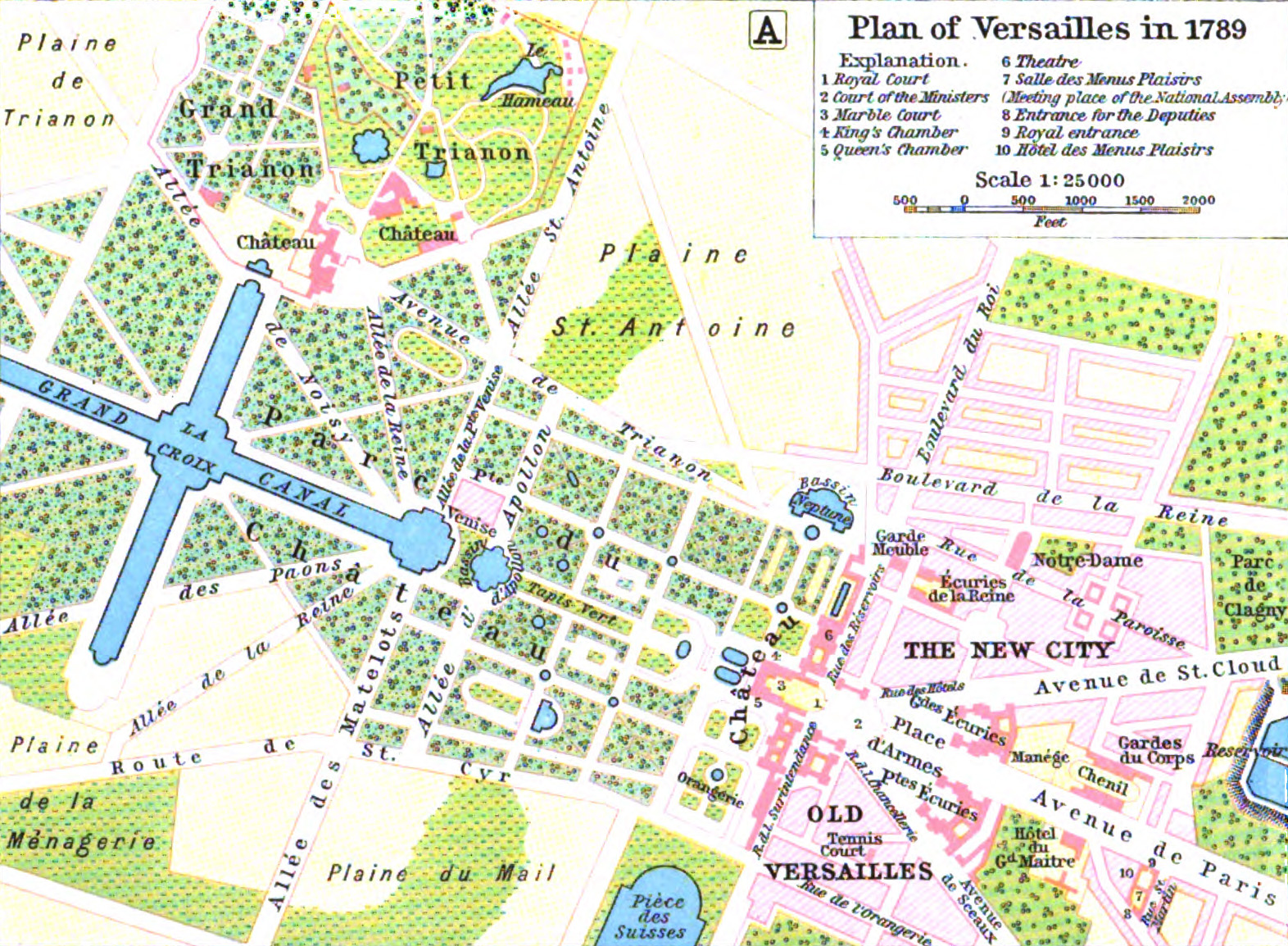
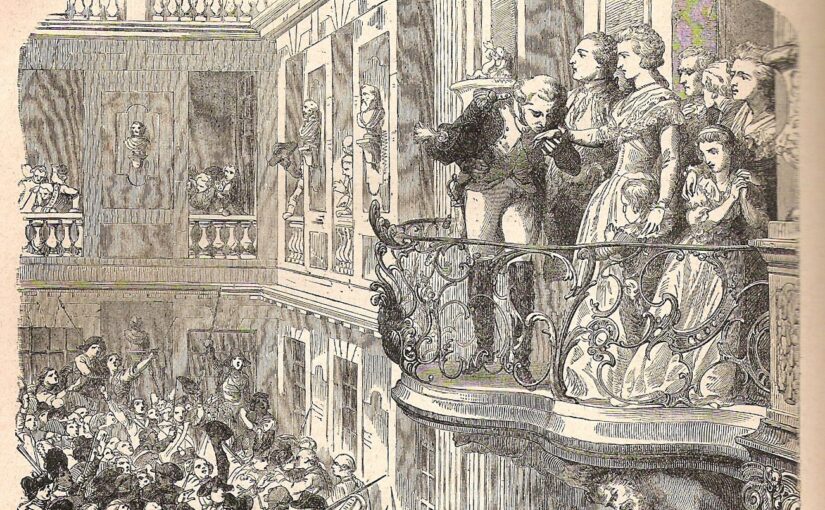
Marie Antoinette was one of the principal targets of the mob. The Queen was sleeping when the attackers entered the palace and was forced to flee through a private passageway connecting her apartments to those of the King. She narrowly escaped the crowd and was reunited with Louis. The situation had become so dangerous that the royal family could no longer remain at Versailles. Louis eventually appeared before the crowd on the palace balcony. He agreed to move to Paris and accept the protection of the people. The crowd responded enthusiastically, reportedly calling for the King and Queen to return with them. The royal family therefore left Versailles later that day.
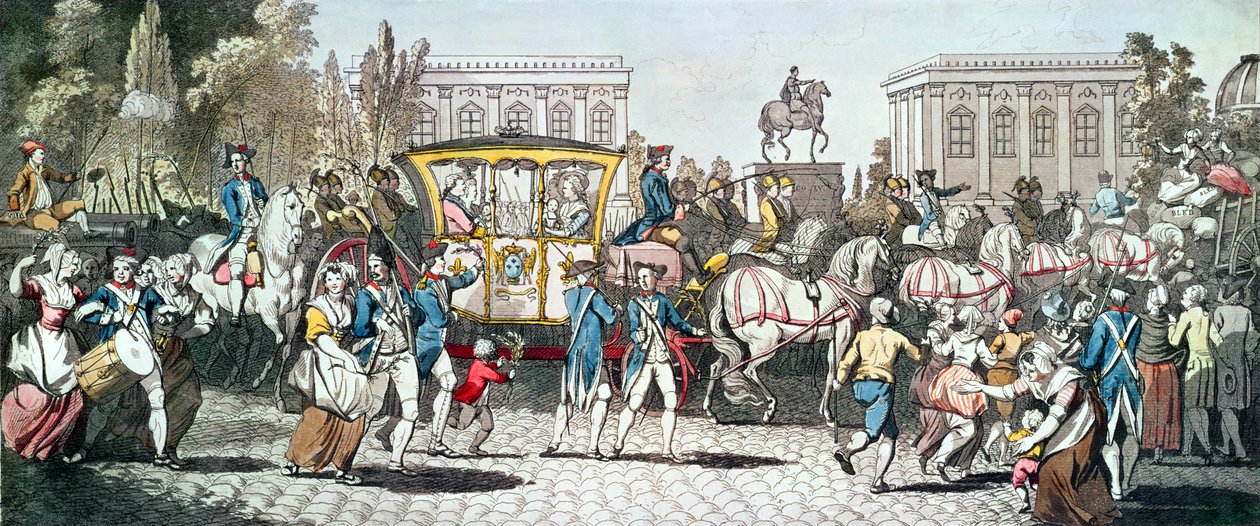
The procession back to Paris was enormous. Thousands of people accompanied the King, Queen and their children, while the National Guard under Marquis de Lafayette escorted them. The atmosphere was simultaneously celebratory and threatening. One contemporary description famously characterised the procession as the people bringing the King back to Paris with the cry that they had finally found “the baker, the baker’s wife and the baker’s boy” – a reference to the belief that the monarchy could now be forced to provide bread. For Louis XVI, however, the consequences were enormous. The King was no longer living at the centre of the old royal court. He was now effectively under the supervision of revolutionary Paris. Versailles had represented royal independence from the political population of the capital. Paris represented the opposite. From this point onwards, Louis was increasingly constrained by the National Assembly, the Paris Commune and the National Guard. The March on Versailles therefore represented a fundamental shift in the balance of power. The King had not formally lost his throne, but he had lost much of his freedom.
For the next two years, Louis attempted to operate within the new constitutional system. The Constitution of 1791 transformed France from an absolute monarchy into a constitutional one. Louis retained the title of King and certain important powers, but sovereignty was increasingly understood to belong to the nation rather than the monarch. For revolutionary moderates, this represented the ideal outcome: France would retain a monarchy while becoming a constitutional state. For Louis himself, however, the situation was increasingly unbearable. He had accepted the Revolution publicly, but privately he remained deeply opposed to many of its fundamental changes. His religious beliefs also put him at odds with the revolutionary government, particularly after the Civil Constitution of the Clergy attempted to bring the Catholic Church under state control. The royal family eventually decided that remaining in Paris was too dangerous.
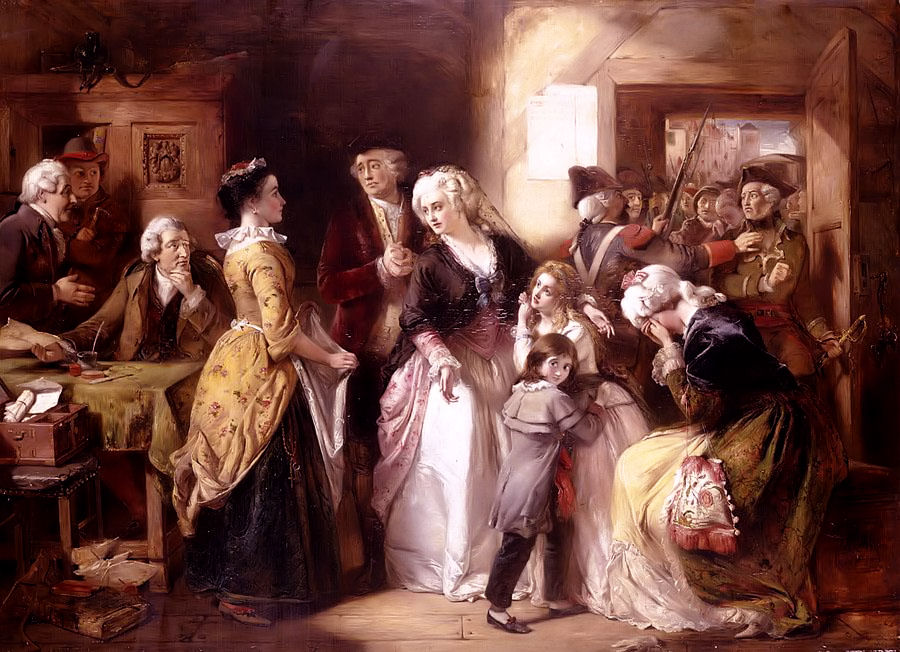
In June 1791, Louis, Marie Antoinette and their immediate family attempted to escape France. Their destination was the eastern frontier, where they hoped to reach territory controlled by royalist forces and potentially obtain protection from Austria and other European monarchies. The escape was carefully planned, and the family travelled under assumed identities. The plan might have succeeded had Louis not been recognised at Varennes. According to the traditional account, the local postmaster Jean-Baptiste Drouet recognised the King from his resemblance to the image on an assignat, the revolutionary paper currency that carried Louis’s portrait. He alerted the authorities, and the royal family’s carriage was stopped. Louis was forced to return to Paris.
The political consequences were devastating. Until Varennes, many revolutionaries could still argue that the King was genuinely willing to accept the constitutional settlement. His attempted escape appeared to prove the opposite. To his critics, Louis had not merely attempted to flee Paris – he had attempted to abandon the country and seek assistance from France’s enemies. The King now faced a profound crisis of legitimacy. Moderate revolutionaries attempted to preserve the monarchy, arguing that Louis had effectively been kidnapped or coerced into leaving. Radicals rejected this explanation entirely. To them, the Flight to Varennes demonstrated that the monarchy could never coexist peacefully with the Revolution.
The division became increasingly visible in Paris. On July 17th 1791, thousands gathered on the Champ de Mars to demand the King’s removal. The demonstration was organised by radical political groups, including members of the Cordeliers Club, and became an important moment in the development of revolutionary republicanism. The authorities declared the demonstration illegal. Lafayette and the National Guard arrived to disperse the crowd. When stones were thrown at the soldiers, the National Guard opened fire. The resulting Champ de Mars Massacre killed and wounded numerous protesters.

The massacre exposed a growing fracture within the Revolution. The people who had initially united against the old absolute monarchy were now divided over what should replace it. On one side were constitutional monarchists, who wanted France to remain a monarchy with the King reduced to a largely constitutional role. On the other were increasingly radical republicans, including the Jacobins and Cordeliers, who believed that the Revolution could not succeed while Louis remained on the throne. The March on Versailles had therefore achieved something far more significant than simply bringing the royal family to Paris. It demonstrated that popular pressure could force the monarchy to surrender to the Revolution. The Flight to Varennes then destroyed much of the remaining trust between King and people. Within a year, the constitutional monarchy would collapse entirely. Louis XVI would be arrested, the monarchy abolished and France declared a republic. And the Revolution would enter its most violent phase.