
Despite the fall of Tsar Nicholas II in early 1917, the problems that had brought down the monarchy did not disappear. The Russian Empire remained locked in the World War I, the economy was still collapsing, and food shortages continued to plague the cities. What had become increasingly clear was that the crisis ran deeper than the Tsar himself. Russia’s uneven industrialisation lagged behind much of Western Europe, its political system remained rigid and unresponsive, and its vast population had little faith that the state could meet their needs. The war had simply exposed these weaknesses. Many Russians no longer saw the old system as merely flawed, but as incapable of surviving in the modern world.
In the months that followed the February Revolution, power rested uneasily between two rival institutions in Petrograd. On one side stood the Provisional Government, formed by members of the State Duma. It aimed to guide Russia toward a democratic future, continuing the war alongside its allies while preparing elections for a new political system. Figures such as Alexander Kerensky believed that Russia could become a modern republic, similar to those developing elsewhere in Europe. On the other side was the Petrograd Soviet, representing workers and soldiers. Dominated by socialist parties such as the Mensheviks and Socialist Revolutionaries, it held real influence on the streets and within the army. This uneasy arrangement, often described as “dual power,” left authority divided and uncertain. The Provisional Government could issue orders, but the Soviet could decide whether those orders were followed.

Into this unstable situation returned Vladimir Lenin. With the assistance of Germany, which hoped to weaken Russia’s war effort, Lenin travelled from exile in Switzerland to Petrograd in April 1917. His arrival marked a decisive shift. While many socialists were willing to cooperate with the Provisional Government, Lenin rejected it outright. Drawing on the ideas of Karl Marx and Friedrich Engels, Lenin argued that the existing system, based on private ownership, profit, and inequality, could not be reformed and had to be replaced. In its place, he envisioned a society in which workers would collectively control industry and resources, eliminating the divide between rich and poor and reorganising society around need rather than profit. To many, this was a radical and uncertain vision, but to workers facing hunger, and soldiers facing endless war, it was a powerful promise.
[There should be no] support for the Provisional Government; the utter falsity of all its promises should be made clear. [This government is] a government of capitalists, [and] should cease to be an imperialist government.
Lenin’s writings about the Government in his April Theses
Lenin’s slogans were simple: “Peace, Land, and Bread,” and “All power to the soviets.” In contrast to the cautious reforms of the Provisional Government, they offered immediate solutions to the crises people were living through. Meanwhile, the government struggled to maintain control. It introduced reforms, expanding civil liberties, removing old restrictions, and dismantling the Tsarist secret police, but these changes did little to address the most urgent problems. Most importantly, it chose to continue fighting in the war. In the summer of 1917, Alexander Kerensky, now Minister of War, launched a major military campaign known as the Kerensky Offensive. The aim was to restore morale and prove that Russia could still fight effectively. Instead, the offensive collapsed within days. Soldiers deserted in large numbers, discipline broke down, and the army’s confidence was shattered. The failure deepened the sense that the government was incapable of solving the country’s problems.
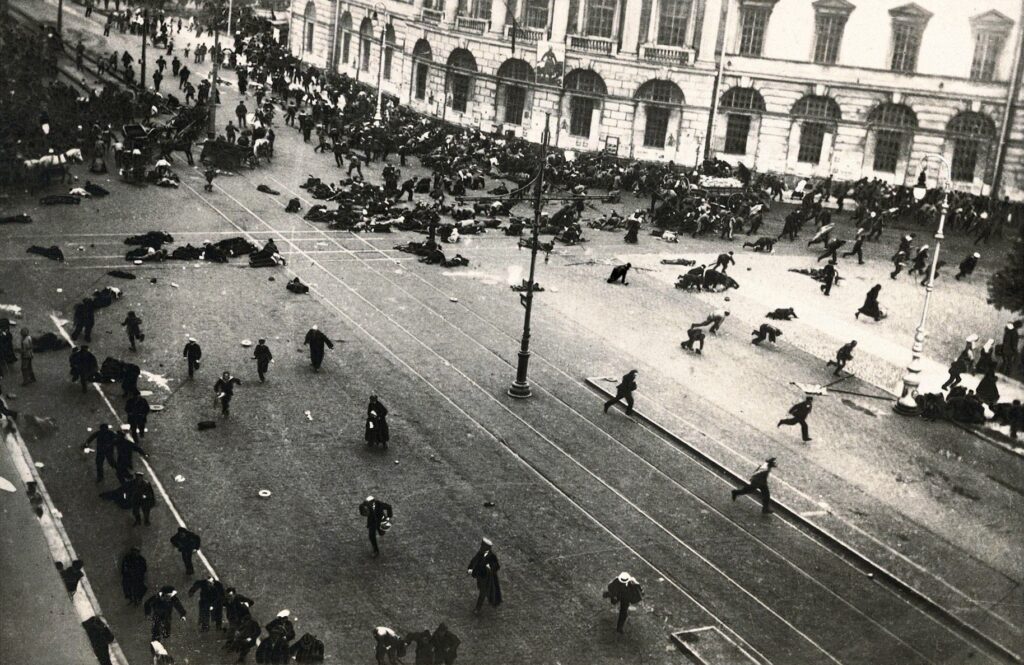
By July, unrest in Petrograd erupted into armed demonstrations. Workers and soldiers took to the streets, calling for power to be handed to the soviets. The uprising was chaotic and lacked clear leadership, and although the Bolshevik Party had encouraged such demands, they were not fully prepared to take power. The government responded with force, restoring order and arresting Bolshevik leaders. Lenin fled into hiding, accused of being a German agent. For a brief moment, it seemed as though the Provisional Government had regained control. But its position remained fragile.
In August, a new crisis emerged when General Lavr Kornilov, the army’s commander-in-chief, moved troops toward Petrograd. Whether this was an attempted coup or a miscommunication remains debated, but it was widely seen as a threat to the revolution itself. Faced with this danger, Kerensky turned to the very groups he had recently suppressed. Bolsheviks were released from prison, and workers were armed to defend the capital. Under the leadership of figures such as Leon Trotsky, they organised resistance, disrupted railway lines, and persuaded many of Kornilov’s troops to abandon their advance. The crisis collapsed without major fighting.
The outcome was transformative. The Bolsheviks, once seen as extremists, now appeared as defenders of the revolution. Their influence grew rapidly, particularly within the Petrograd Soviet, where they gained a majority. At the same time, the Provisional Government was left weakened, increasingly isolated, and unable to command either the army or the streets. By the autumn of 1917, the balance of power had shifted. Lenin, now returned from hiding, argued that the moment for a second revolution had arrived. Unlike the spontaneous uprising that had overthrown the Tsar, this would be carefully organised and directed.
In early November (late October in the Russian calendar), Bolshevik forces moved across Petrograd, seizing key points in the city. Bridges, railway stations, and communication centres were taken with little resistance. The operation was swift and largely bloodless, reflecting the extent to which the Provisional Government had already lost control. Attention soon turned to the Winter Palace, where members of the government remained. On the night of November 7th, Bolshevik forces entered the building and arrested those inside. Alexander Kerensky had already fled the city. The Provisional Government had fallen.

In the aftermath, Lenin and the Bolsheviks moved quickly to consolidate power. They declared that authority now rested with the soviets and issued decrees promising peace and land reform. Yet their position was far from secure. When elections were held for a national assembly, the Bolsheviks failed to win a majority. Rather than accept this result, they dissolved the assembly and sidelined rival parties. What had begun as a revolution promising power to the people was rapidly becoming more centralised. Opposition was suppressed, and a new political order began to take shape, one dominated by a single party. Later in 1918, Lenin survived an assassination attempt by Fanny Kaplan, an event that intensified repression by the new regime. The Bolsheviks expanded their security apparatus and moved decisively against perceived enemies. The events of 1917 did not end with the seizure of power in Petrograd. Instead, they marked the beginning of a far longer and more violent struggle over Russia’s future. What had begun with the collapse of Tsarist rule had led, within the space of a single year, to the rise of a radically different system, one built not on monarchy or liberal reform, but on revolutionary ideals that would shape the course of the 20th century.
