
The Treaty of Versailles had radically redrawn the map of Europe after the First World War. One of the newly recreated states was Poland, which had not existed as an independent country for over a century after being partitioned between Prussia, Austria and Russia. To give the new nation access to the Baltic Sea, the Allies created the so-called Polish Corridor, a strip of land that separated mainland Germany from the province of East Prussia. The predominantly German city of Danzig (modern-day Gdańsk) was also detached from Germany and declared a Free City under the supervision of the League of Nations. To many Germans these arrangements were a national humiliation. To Adolf Hitler, they represented an injustice that had to be reversed.

But Hitler’s ambitions stretched far beyond simply reclaiming lost territory. Central to Nazi ideology was the belief that the German people needed Lebensraum—”living space” – to expand. Hitler envisioned conquering Eastern Europe, particularly Poland and the Soviet Union, clearing much of the local population from the land and replacing them with German settlers. Poland therefore stood directly in the way of his long-term plans. Yet there was one major obstacle. Invading Poland risked provoking both Britain and France into war while simultaneously leaving Germany vulnerable to an attack from the Soviet Union in the east. Hitler was determined to avoid the two-front war that had doomed Germany during the First World War.
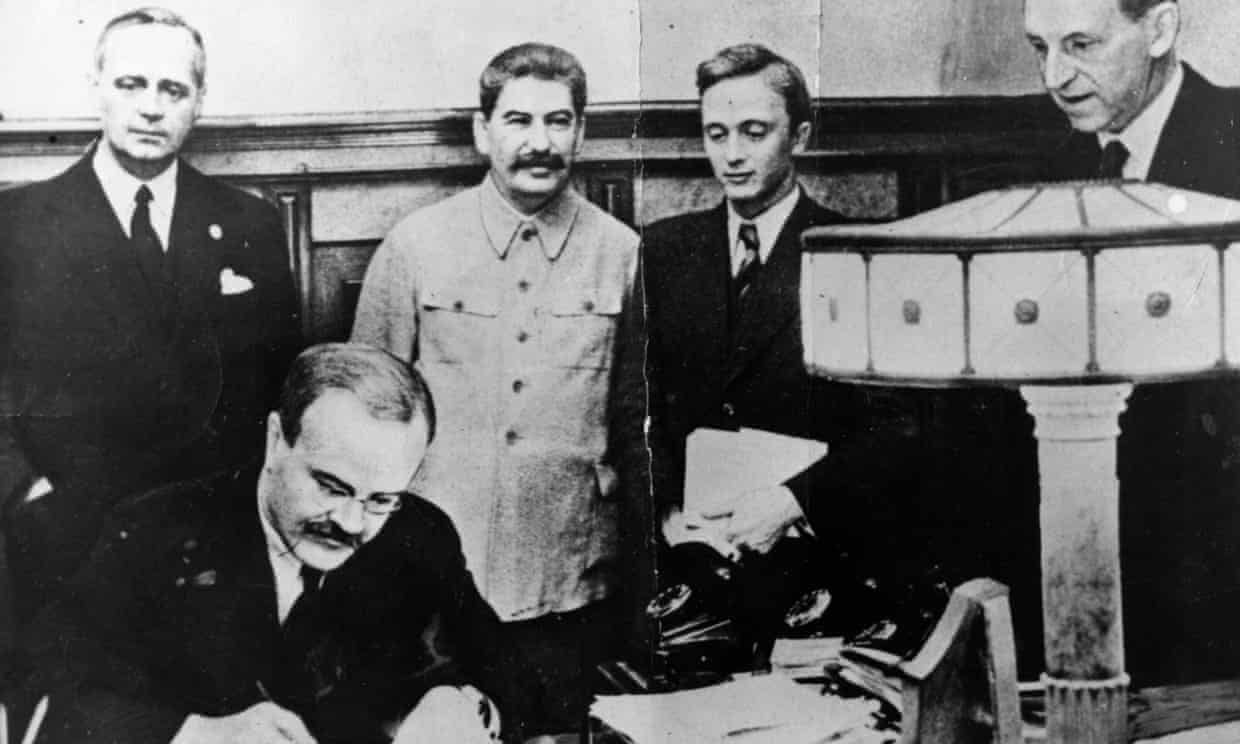
To remove that danger, Hitler made one of the most shocking diplomatic moves of the twentieth century. On 23 August 1939, Germany and the Soviet Union signed the Molotov-Ribbentrop Pact, named after their respective foreign ministers. Publicly, it was presented as a simple non-aggression agreement, with both countries promising not to attack one another. Secretly, however, the treaty contained a hidden protocol dividing Eastern Europe into German and Soviet spheres of influence. Poland would be partitioned between them, while the Soviet Union would also receive a free hand in Estonia, Latvia, Finland and parts of Romania. The agreement stunned the world. Hitler had built his political career around destroying communism, while Joseph Stalin had spent years denouncing fascism. Yet both dictators believed they could benefit from temporarily cooperating with one another.
Hitler still needed a justification for war. On the night of 31 August 1939, members of the SS disguised themselves as Polish soldiers and seized the radio station at Gleiwitz, just inside Germany near the Polish border. They broadcast a brief anti-German message in Polish before abandoning the station. To complete the deception, the Germans left behind the body of Franciszek Honiok, a Polish civilian who had been arrested by the Gestapo, murdered and dressed in a Polish military uniform. Nazi newspapers immediately presented the incident as proof that Poland had attacked Germany first. It was entirely fabricated.
At dawn on 1 September 1939, Germany launched its invasion. Along a front stretching hundreds of miles, over one and a half million German soldiers crossed the Polish frontier. Battleships bombarded the Polish garrison at Westerplatte near Danzig while the Luftwaffe struck airfields, railway junctions, bridges and communication centres in an attempt to paralyse the Polish response before it could fully mobilise.
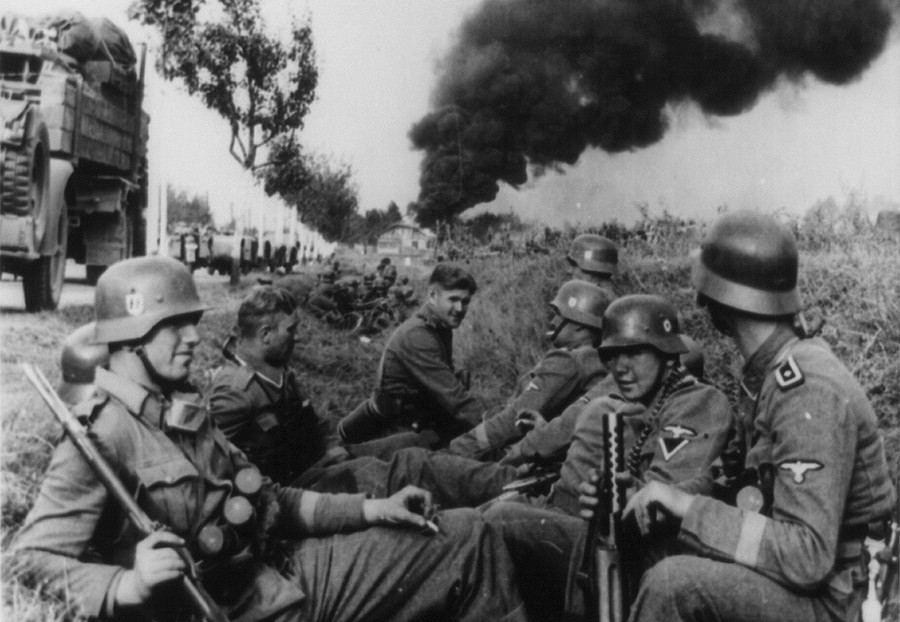
The invasion showcased Germany’s new method of warfare. Although the term Blitzkrieg, or “lightning war”, was popularised later, the campaign demonstrated its central principles: concentrating tanks, aircraft and motorised infantry at a single point to smash through enemy lines before rapidly advancing deep into their rear. Rather than attacking evenly across the front, German Panzer divisions punched holes in the Polish defences, bypassing isolated pockets of resistance and leaving slower infantry to surround them. Above, Junkers Ju 87 Stuka dive bombers attacked troop concentrations, artillery positions and roads, while their terrifying sirens became one of the defining sounds of the campaign. Contrary to popular myth, Polish cavalry did not charge German tanks with sabres. Instead, cavalry units fought primarily as highly mobile infantry, though they occasionally launched successful charges against German infantry before being forced back by armoured vehicles and aircraft.
Britain and France declared war on Germany on 3 September, but little immediate military assistance reached Poland. The decisive blow came from the east. On 17 September, with much of the Polish Army already engaged against Germany, the Soviet Union invaded in accordance with the secret terms of the Molotov-Ribbentrop Pact. Poland now faced two of Europe’s largest armies simultaneously. With no realistic prospect of continued resistance, organised Polish defence gradually collapsed. Warsaw surrendered on 28 September after weeks of bombardment, while the last organised Polish units laid down their arms on 6 October 1939.
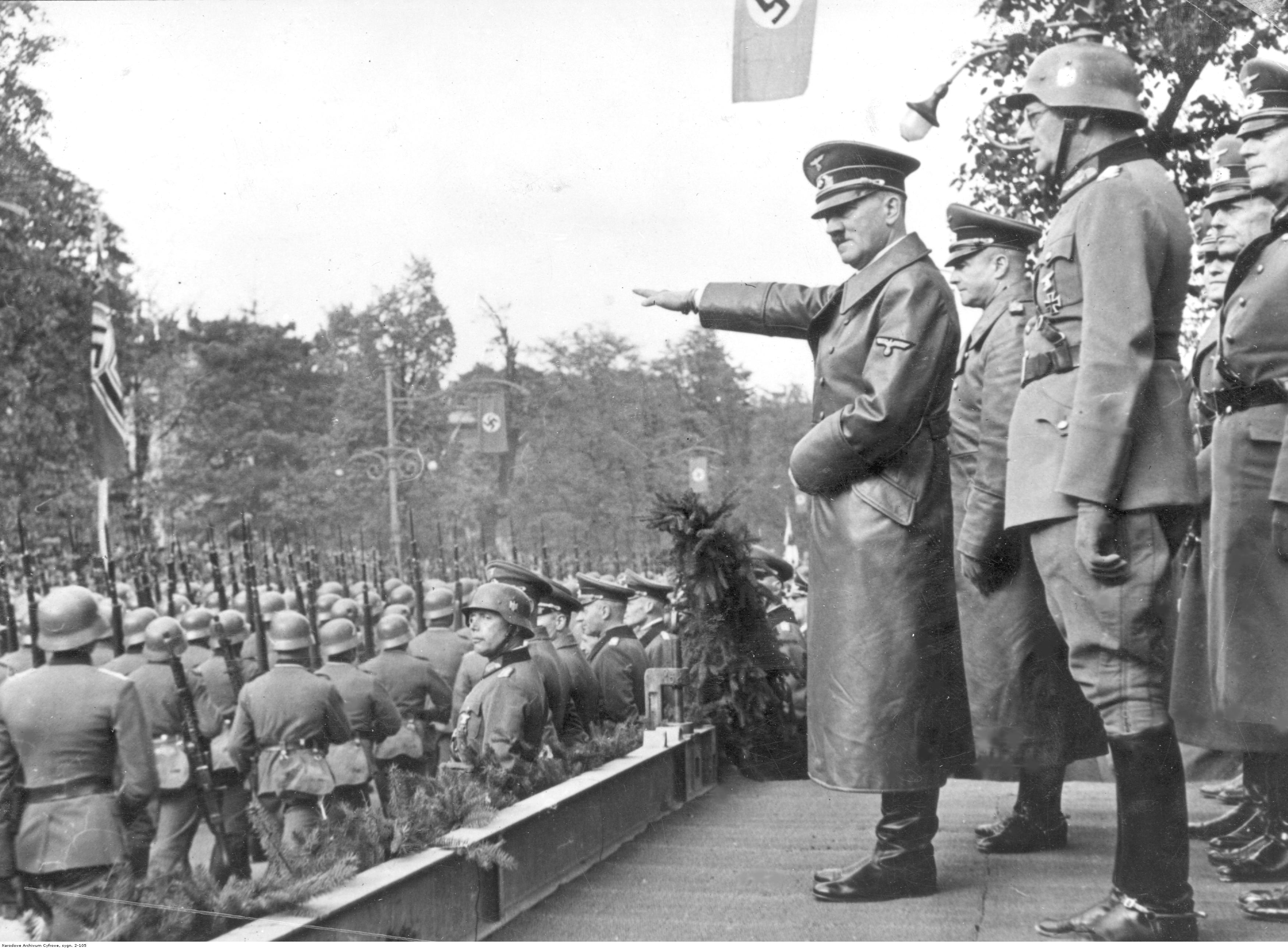
The campaign had lasted just over a month. Germany annexed western Poland directly into the Reich and established the General Government in the country’s centre under brutal military occupation. The Soviet Union annexed eastern Poland, arresting, deporting and executing hundreds of thousands of Polish citizens in the years that followed. Although the invasion had been swift, its consequences would be anything but. Hitler’s attack on Poland transformed what had begun as another territorial dispute into the Second World War, a conflict that would soon engulf the entire globe.
This morning, the British ambassador in Berlin handed the German government a final note stating that unless we heard from them by 11 o’clock that they were prepared at once to withdraw their troops from Poland, a state of war would exist between us. I have to tell you now that no such undertaking has been received, and that consequently this country is at war with Germany.
Neville Chamberlain’s radio broadcast to Britain, September 3rd, 1939