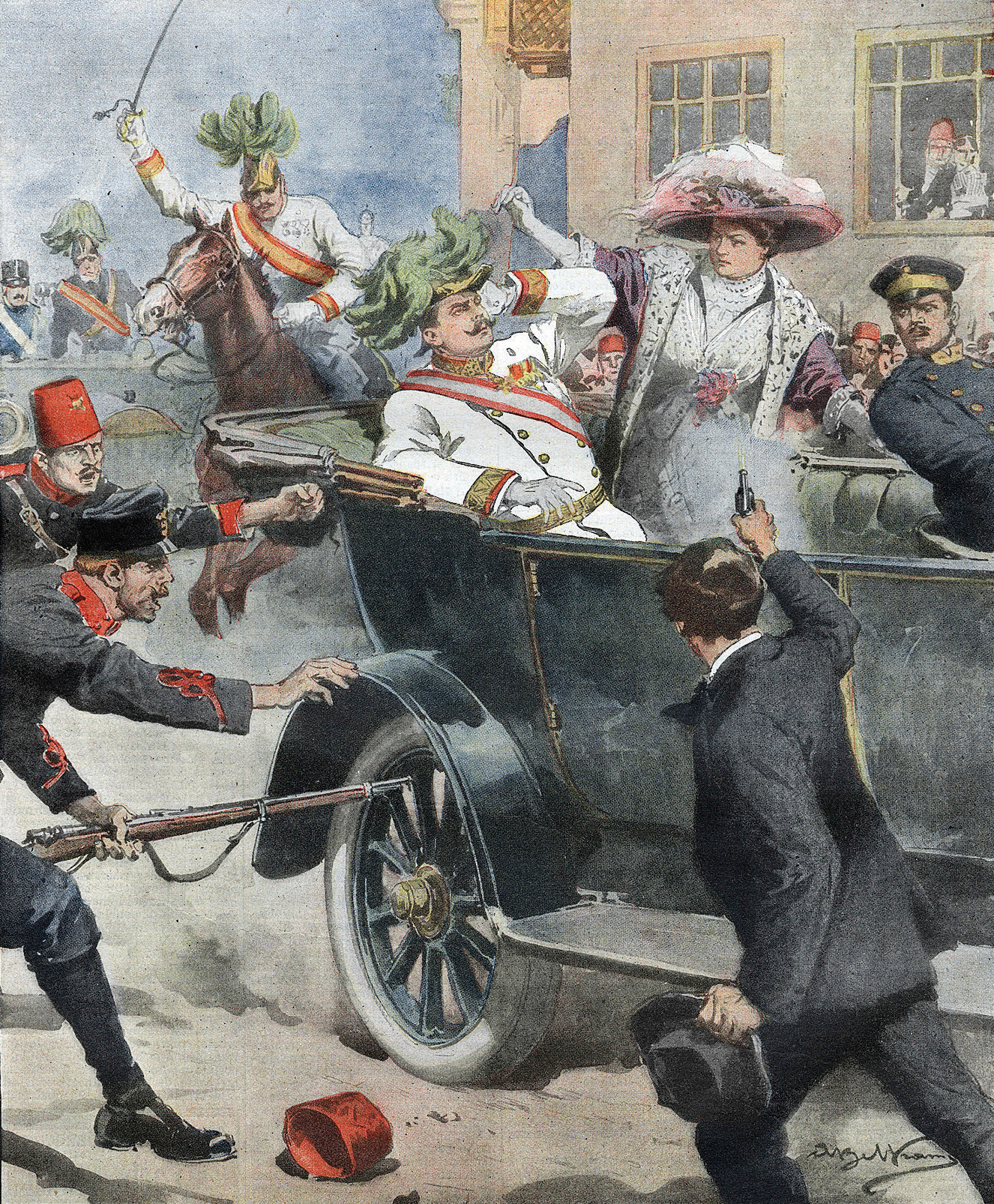
On 28th of July 1914, Gavrilo Princip, member of the Serbian organisation “The Black Hand” shot Archduke Franz Ferdinand, heir to the throne of the Austro-Hungarian Empire, and his wife in Bosnia, killing them both. Austria-Hungary blamed Serbia for the assassination, so declared war. Russia had an alliance with Serbia, so declared war on Austria-Hungary. Germany had an alliance with Austria-Hungary, so declared war on Russia, thus bringing both Germany and Hitler into World War 1.
He was attached to the Bavarian Reserve Infantry Regiment 16 and was a runner on the Western Front in East Belgium. He was awarded an Iron Cross (2nd class) for his bravery, one of the highest awards given to soldiers in the German Army, similar to the Victoria Cross or Medal of Honour.
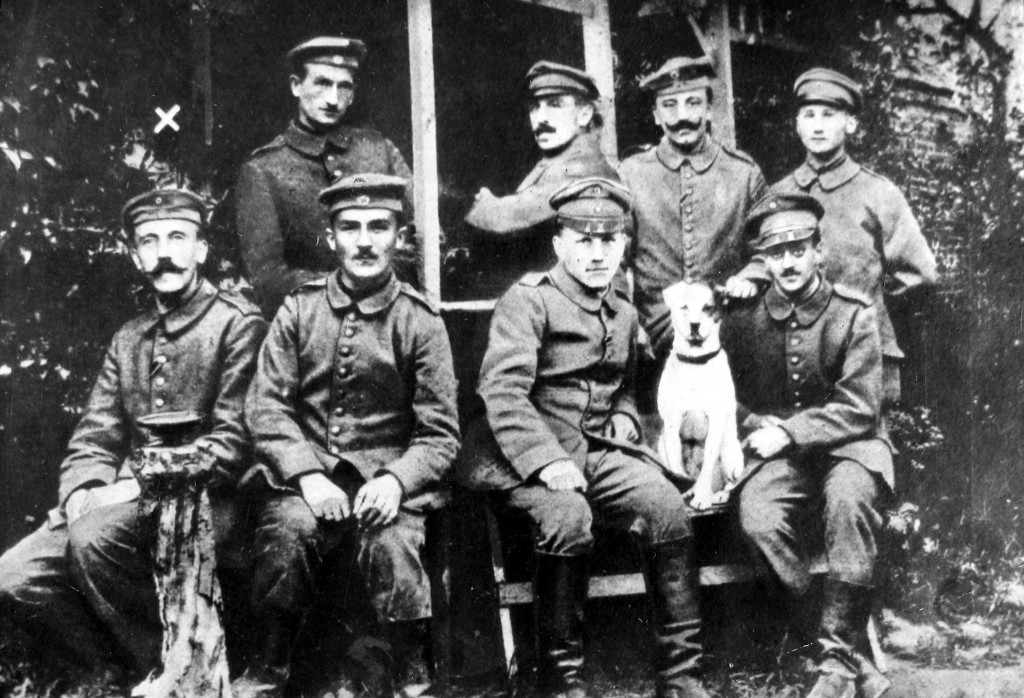
Hitler in a dugout in the war. He is furthest left.
During the Battle of the Somme in 1916, he suffered an injury from an artillery shell which wounded his left thigh. He was sent to hospital and returned in March 1917.
In September 1918, Hitler claimed that in a battle was unarmed and a rifle was pointed at him by Private Henry Tandey, one of the most highly decorated privates of the war, having gained a Victoria cross for his bravery at the fifth Battle of Ypres. He held his gun on Hitler but then told him to go. Hitler told this tale to Former Prime Minister Neville Chamberlain when he visited his house in Bavaria, saying “That man came so near to killing me that I thought I should never see Germany again,”. When first hearing this Tandey denied all claims but later on he says he remembers doing something like this and if it was Hitler he should’ve pulled the trigger, saying, “If only I had known what he would turn out to be […] When I saw all the people and women and children he had killed and wounded I was sorry to God I let him go.” when an interviewer went to his house in Coventry. The paper wrote “Nothing Henry did that night could ease his sickening sense of guilt. […] It was a stigma that Tandey lived with until his death […] He could have stopped this. He could have changed the course of history.” Tandey passed away in 1977 at his home in Coventry.
This is a painting at Hitler’s home in Bavaria which he showed to Prime Minister Chamberlain. Hitler claimed that the injured man being carried at the front of the line is him and the man carrying him is Tandey.
A month after he was nearly killed, Hitler was partially blinded by a mustard gas attack and was sent to hospital. It was during this time when he learnt of Germany’s defeat. Hitler said that when he learnt this he had a second wave of blindness. Hitler and many others believed that Germany had been stabbed in the back from the home front and Hitler blamed it on the Jews and Marxists. The terms of the Treaty of Versailles didn’t help matters, making the German people hate the countries that made them sign the Treaty even more than they already did.
By the early twentieth century, Europe had become increasingly divided into two rival alliance systems. On one side stood the Triple Entente, an informal partnership between Britain, France and Russia. On the other stood the Triple Alliance of Germany, Austria-Hungary and Italy. The origins of these alliances lay in growing geopolitical tensions. France had never accepted the loss of Alsace-Lorraine to Germany following the Franco-Prussian War of 1870–71 and sought an opportunity to regain the territory. Britain became increasingly concerned by Germany’s rapid naval expansion under Kaiser Wilhelm II, fearing that the German fleet might one day challenge the Royal Navy’s dominance of the seas. Russia, meanwhile, saw itself as the protector of the Slavic peoples of Eastern Europe and increasingly found itself at odds with Austria-Hungary in the Balkans.
A map of Europe in 1914
Germany’s leaders feared that their country was becoming strategically encircled by hostile powers. To counter this threat, Berlin strengthened its alliance with Austria-Hungary, Germany’s only major and dependable continental ally. Although Italy was formally part of the Triple Alliance, its commitment to the partnership was often uncertain and its interests frequently diverged from those of Germany and Austria-Hungary. The growing rivalry between the great powers was exposed during a series of international crises before 1914. In 1905 and again in 1911, Germany challenged French influence in Morocco, hoping to weaken the Entente between Britain and France. Instead, the crises had the opposite effect. Britain backed France, diplomatic relations between the Entente powers strengthened, and Germany increasingly felt isolated on the international stage.
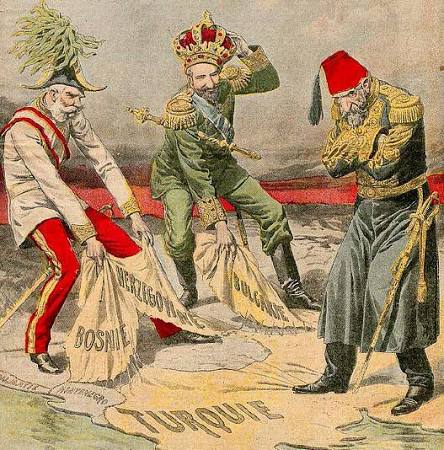
Even more dangerous were the tensions in the Balkans. The declining Ottoman Empire had left a power vacuum across south-eastern Europe, leading to competing nationalist movements and territorial disputes. Austria-Hungary, a vast multinational empire containing millions of Slavic subjects, feared that rising Serbian nationalism could inspire its own minorities to seek independence. Serbia, by contrast, dreamed of creating a larger South Slav state that would unite Serbs living under Austrian rule with those already living in Serbia. These tensions escalated during the Bosnian Crisis of 1908, when Austria-Hungary formally annexed Bosnia-Herzegovina, a territory populated by many Slavs. Serbia was outraged and Russia backed Serbian objections, but both were forced to back down when Germany supported Austria-Hungary. The humiliation left both countries determined not to retreat again in a future crisis.
A politican cartoon depicting the Bosnian Crisis of 1908
The situation became even more volatile after the Balkan Wars of 1912–13. Serbia emerged significantly larger and more powerful, alarming Austrian leaders who increasingly viewed the country as an existential threat to the stability of their empire. At the same time, nationalist groups within Serbia began advocating more aggressively for the liberation of Slavs living under Austrian rule. By 1914, Europe had become a continent of competing empires, military alliances, nationalist movements and unresolved diplomatic crises. The great powers had spent years preparing for a major war, building vast armies and drawing up detailed mobilisation plans. What they lacked was a trigger.
June 28th, 1914. Heir to the Austro-Hungarian Empire, Archduke Franz Ferdinand was coming to visit Sarajevo in Bosnia with his pregnant wife, Sophie, Duchess of Hohenberg. A Bosnian terrorist organisation backed by the Serbian Government called the Black Hand decided to act. There were 6 people assigned to assassinate the Archduke as he drove on his motorcade to Sarajevo City Hall.
Muhamed Mehmedbašić
Vaso Čubrilović
Nedeljko Čabrinović
Cvjetko Popović
Trifko Grabež
Gavrilo Princip
These six men were coordinated by Danilo Ilić. Every assassin would be armed with a pistol, a bomb and a cyanide pill. Before the Archduke even got into town, things began to go awry. They were worried the weapons would not get there in time, as they were being smuggled in a sugar shipment to the city. However, the problem was they thought they sent the sugar to the wrong place. Eventually, the weapons did arrive in time.
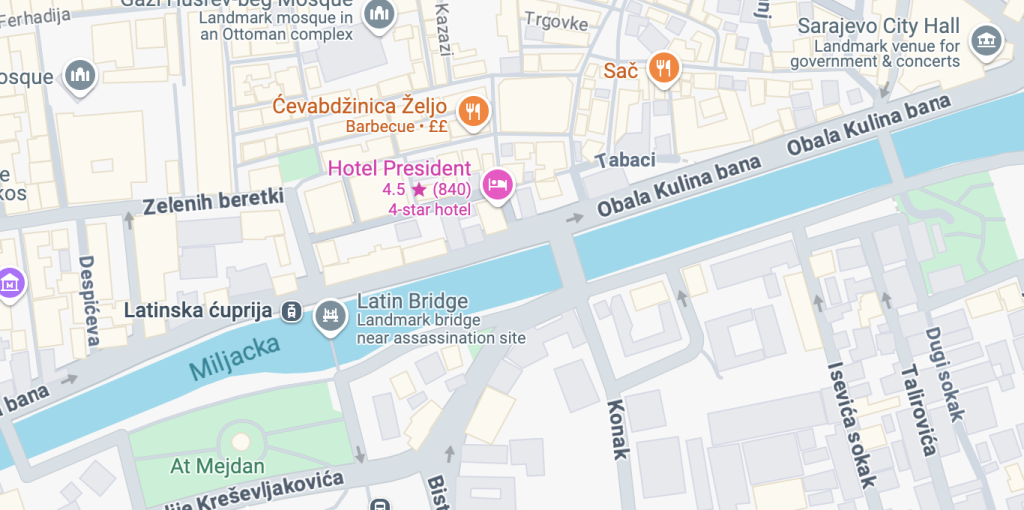
A modern day map of the river in Sarajevo (Google Maps)
Eventually, the Archduke arrived in the town in an open top car. As he drove down Obala Kulina bana, the street leading up to the City Hall in the third car of a six car motorcade, two of the assassins, Muhamed and Vaso, were stationed next to each other on the side of the street furthest from the Milijacka River and Nedeljko was on the river side of the street. The Archduke passes Muhamed and Vaso. For some unkown reason, Muhamed, who the Archduke is first to pass, does nothing. Many historians suspect it was due to nerves. Vaso, possibly because Muhamed didn’t act, also does nothing.
Eventually, Nedeljko, steps out into the street, throwing a bomb at the Archduke’s car. However, the bomb bounced off the car, rolled into the street and exploded the car behind the Archduke, injuring the guards inside. Realising the plan had failed, Nedeljko takes the cyanide pill and leaps into the river in an effort to drown himself. However, not only was the cyanide pill out of date, the river was also in a dry season. So Nedeljko was now vomiting in knee deep water having just broken his legs from jumping off the bridge. The crowd, mad at the attempt on the Archduke’s life, swarmed him and nearly beat this vomiting crippled man to death, before the police stepped in.
The other 3 assassins, whose whereabouts were unknown during all this, scrammed. Gavrilo decided to make a stop at a local sandwich shop on the corner of Obala Kulina bana and Zelenih berekti. Meanwhile, the motorcade races down to the City Hall, where the Archduke was supposed to make a speech. He burst in, halfway through the mayor’s speech, interrupting him saying:
Mr Mayor, I came here to visit and I am greeted with bombs. It is outrageous.
Archduke Franz Ferdinand upon walking into City Hall
When he wanted to give his speech, he discovered that the speech had been left in the car that had just blown up, so someone was sent back to retrieve the speech, now covered in blood, and hand it to the Archduke. After the speech, the Archduke and a security team decided what to do next, who eventually decided to go back the way they came towards the hospital to see if the guards were doing alright. They all agreed upon this plan, got in their cars and drove away.
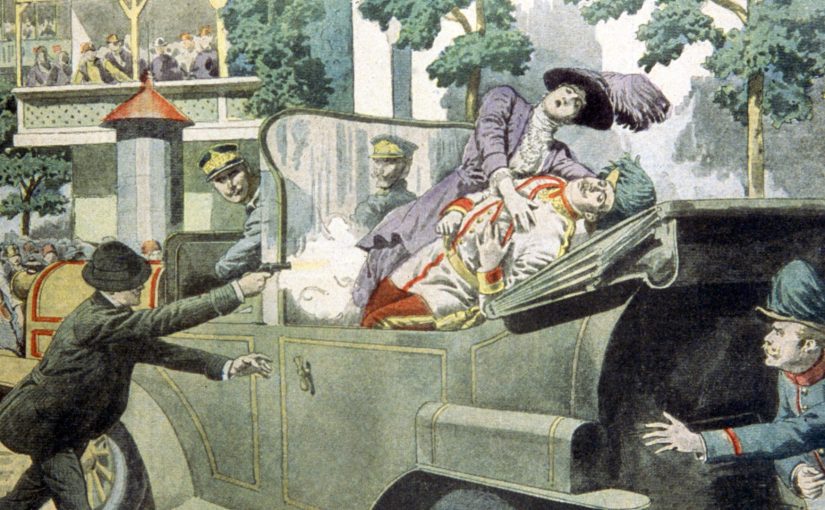
The Archduke was now sat in the back right seat of his car, with Sophie on the back left seat and a guard hanging onto the left side. However, for some unholy reason, everyone neglected to tell the drivers, so they continued on the scheduled route up to the museum, which would involve a right turn onto Zelenih berekti. Just outside the sandwich shop, the guard noticed that they had made a wrong turn. Back in these days, there was no reverse on cars so the driver had to get out of the car and push. Around this time, Gavrilo left the shop and noticed his target stopped right in front of him, with his only guard on the other side of the car. Gavrilo took his chance and, with his pistol, shot the Archduke dead. The guard prepped to return fire and Gavrilo shot at him. However, Sophie, who was tending to her husband, got in the way and was shot instead.
A painting of the Archduke’s assassination
Gavrilo Princip, who was only 19 at the time, was arrested and put on trial. He was too young to be executed so was sentenced to solitary confinement in the Small Fortress, a prison complex in Terezin. He spoke to a psychiatrist, to whom he said that World War 1 would’ve started with or without the assassination. He did not feel responsible for the starting of the war but he did feel awful for killing Sophie. Princip died of tuberculosis on April 28th, 1918, weighing only 40kg (88lb) due to malnutrition inside the prison.
This one event set off a chain reaction. Austria-Hungary, believing Serbia to be behind the attack, declared war on them. Serbia was allies with Russia, so they declared war on Austria-Hungary. Germany joined in on the fighting against the two nations, with France joining the fight not long after that, beginning World War 1. The UK decided to stay out of it for the meantime. However, that was to change very soon.