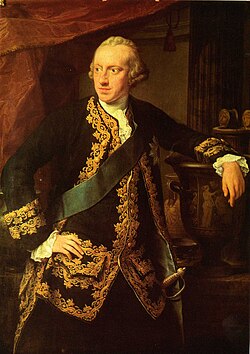
The fall of the monarchy did not bring peace to revolutionary France. Instead, it created a political vacuum at precisely the moment when the country was facing its greatest crisis yet. France was at war with the European monarchies, the government was increasingly divided between competing revolutionary factions, and Paris was filled with rumours of treason and counter-revolution. The danger appeared to be coming from outside as well as within. On July 25th 1792, Charles William Ferdinand, Duke of Brunswick, commander of the Prussian forces invading France, issued a declaration on behalf of the allied Austrian and Prussian armies. The Brunswick Manifesto warned that if the royal family were harmed, Paris would face severe reprisals. The city would, it threatened, be subjected to military punishment.
Rather than frightening the revolutionaries into submission, the manifesto had almost the opposite effect. To many Parisians, it appeared to confirm their suspicion that Louis XVI was conspiring with France’s enemies. If foreign monarchies were threatening to destroy Paris in order to protect the King, then the King himself increasingly appeared to be an enemy of the Revolution. The result was the insurrection of August 10th 1792. Thousands of revolutionaries, including the radical Paris Commune and fédérés who had arrived from the provinces, marched on the Tuileries Palace. The Swiss Guards defending the palace opened fire, and a bloody battle followed. Hundreds of insurgents were killed, while the Swiss Guards were eventually overwhelmed. Louis XVI, recognising that the palace could not be held, fled with his family to the Legislative Assembly.
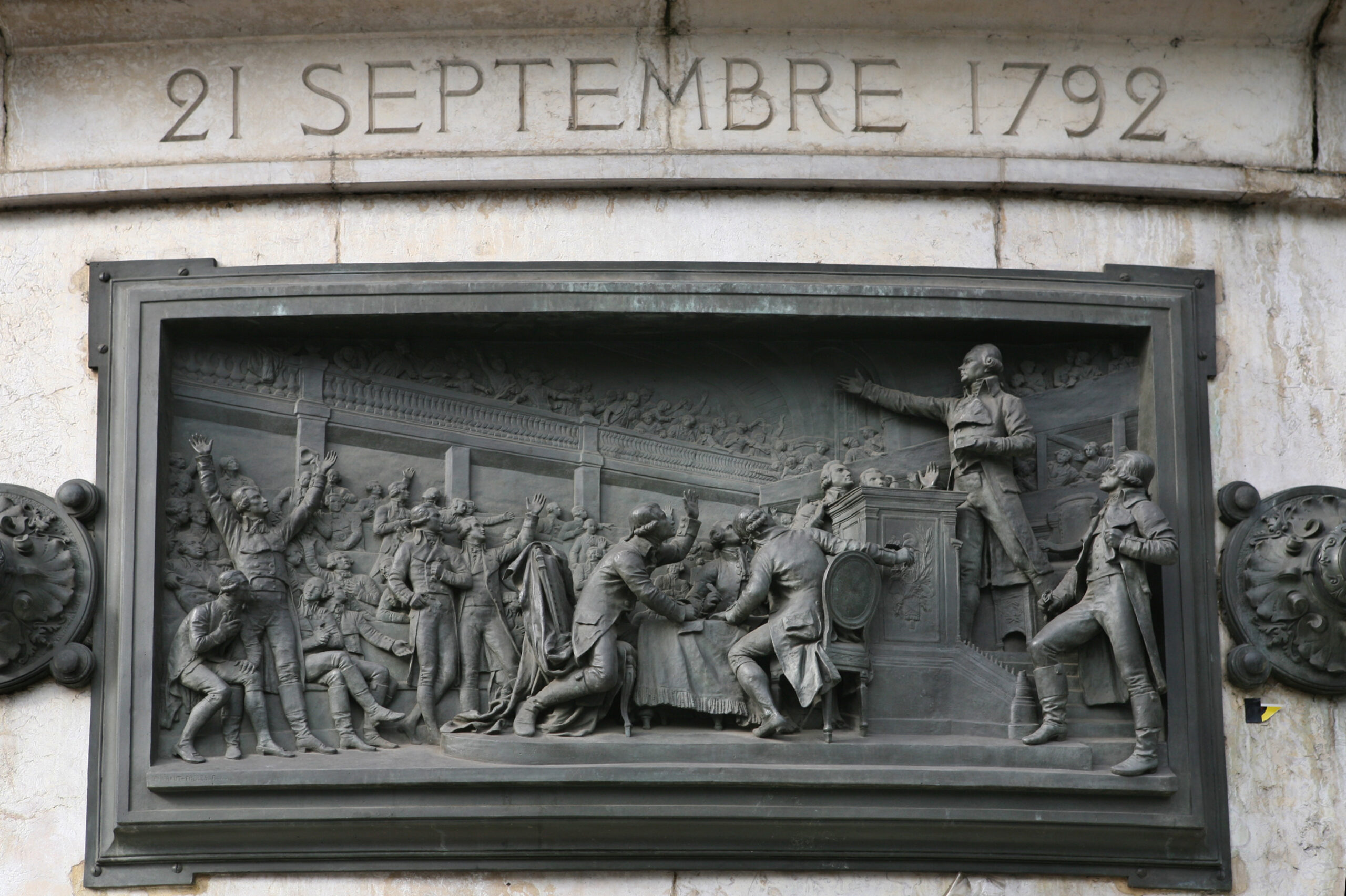
The Assembly suspended the King’s constitutional powers. Louis was no longer effectively the ruler of France. He and Marie Antoinette were placed under guard and eventually imprisoned in the Temple. The monarchy was finished. But the Republic that replaced it was born into an atmosphere of fear. The Legislative Assembly was replaced by a newly elected National Convention, which met for the first time on 20 September. On 21 September, it formally abolished the monarchy. The following day, September 22nd 1792, the Convention declared the French Republic. For revolutionaries, this represented the fulfilment of a remarkable transformation. France was no longer to be a kingdom ruled by a hereditary monarch. The old political order had been overturned in the name of popular sovereignty, citizenship and equality.
Yet outside Paris, the armies of Austria and Prussia were advancing. The revolutionary government feared that France might collapse from within before it could defeat its enemies from without. The fortress of Longwy had fallen on August 23rd, and Verdun was under threat. On September 2nd, news reached Paris that Verdun had fallen. The road to the capital appeared open. This was the environment in which paranoia became explosive. Thousands of men were being called upon to leave Paris and fight at the front. If the city’s defenders departed, what would prevent royalists and counter-revolutionaries from rising behind them? Rumours spread that aristocrats and refractory priests imprisoned in Paris were preparing to escape, seize weapons and massacre the families of revolutionaries while the city’s men were away fighting. There was little evidence for such a conspiracy. But revolutionary politics had increasingly developed a language in which political opponents could be portrayed not merely as people with different opinions, but as enemies of the nation. Jean-Paul Marat was particularly influential in this atmosphere. Through his newspaper, L’Ami du peuple, Marat repeatedly warned that enemies of the Revolution were hiding within France and called for decisive action against them. The question was no longer simply whether the Revolution could defeat its enemies. It was whether the enemies of the Revolution were already inside Paris.
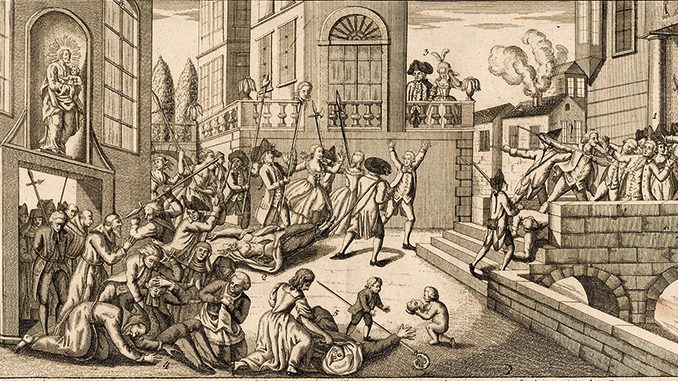
On September 2nd, as volunteers prepared to leave Paris for the front, crowds gathered outside the city’s prisons. The first killings began at the Abbaye prison. Prisoners were dragged out and subjected to improvised tribunals. Those judged to be dangerous counter-revolutionaries were killed. But the violence quickly spread. Over the following several days, groups of armed Parisians moved between the city’s prisons. Clergy, aristocrats, suspected royalists and ordinary criminals were brought before makeshift courts. Some were released. Others were condemned and killed. The distinction between political vengeance and indiscriminate violence rapidly began to disappear. Among the victims was Princess Marie-Louise de Lamballe, a close friend of Marie Antoinette. She was murdered after being brought before the killers, and her death became one of the most notorious episodes of the massacres. Her body was mutilated and her head was reportedly displayed before the Temple prison where the royal family was being held.

The violence was not limited to aristocrats. Priests who had refused to accept the revolutionary state’s religious reforms were among the principal targets, while ordinary prisoners were also killed. Men, women and some children were caught up in the violence. By the time the massacres subsided around 6 September, approximately 1,100 to 1,400 prisoners had been killed. The September Massacres were not formally ordered by the National Convention. They were carried out largely by crowds and militants in Paris. Yet the revolutionary authorities did remarkably little to stop them. Figures such as Georges Danton have consequently been the subject of considerable historical debate over their responsibility, with historians disagreeing about how much the revolutionary leadership encouraged, tolerated or simply failed to prevent the killings.
What is clear is that the massacres demonstrated how far revolutionary politics had changed. Only three years earlier, the Revolution had proclaimed the Declaration of the Rights of Man and of the Citizen, declaring that men were born free and equal in rights. Now prisoners were being condemned and executed by crowds without anything resembling a normal judicial process. The contradiction was noticed almost immediately outside France. The British press followed events in Paris with horror. The Times of London reported the killings on 10 September 1792, describing the streets as being filled with the bodies of victims and asking:
Are these “the Rights of Man”? Is this the liberty of Human Nature?
The London Times, Sept 10, 1792
The quotation captured one of the great questions raised by the Revolution. Could a movement founded upon liberty and human rights justify violence against those it considered enemies of liberty? The September Massacres were not yet the Reign of Terror. That came later, particularly after the creation of the Revolutionary Tribunal, the Committee of Public Safety and the Law of Suspects in 1793. Nor did the massacres represent the inevitable consequence of republicanism or democracy. They emerged from a very specific combination of circumstances: foreign invasion, the collapse of the monarchy, political instability, fear of counter-revolution, rumours of conspiracy and the radicalisation of popular politics. Nevertheless, they marked a profound psychological turning point.
The Revolution had begun by attacking the privileges of the old order. It was now beginning to define itself through the identification and destruction of its enemies. That distinction would become increasingly important. A political opponent could be described as a royalist. A royalist could be described as a counter-revolutionary. A counter-revolutionary could be described as a traitor. And a traitor, in the logic of revolutionary emergency, could be treated as someone who had forfeited the protections normally afforded to a citizen. The language of universal rights therefore existed alongside a new language of revolutionary necessity.
The Republic itself would soon become radically more secular. The dechristianisation campaigns of 1793–94 would see churches closed or transformed, religious symbols destroyed and the revolutionary Cult of Reason promoted by some of the most radical revolutionaries. Notre-Dame de Paris was converted into a Temple of Reason in November 1793. The revolutionary government would also introduce the Republican Calendar, beginning retrospectively on September 22nd 1792, the first day of the Republic. These developments belonged to a later phase of the Revolution, but they reflected the same desire to break decisively with the institutions, symbols and traditions of the ancien régime.
The September Massacres therefore occupy an important place in the story of the Revolution. They were not simply a particularly bloody riot. They demonstrated the extent to which fear could transform a political movement. France had overthrown its king. It had proclaimed a republic. It had declared the equality of its citizens. But now, faced with war and internal conspiracy, the Revolution had begun to ask a darker question: Who deserved to be a citizen at all?