
By the beginning of 1917, the Russian Empire was no longer simply under strain, it was beginning to break. Years of involvement in the World War I had taken a devastating toll. Millions of soldiers had been killed, wounded, or captured, and those still fighting often lacked even the most basic equipment. Back home, the war effort placed enormous pressure on an already fragile economy. Food supplies struggled to reach the cities, prices rose sharply, and long queues for bread became a daily reality in Petrograd. Much of the blame fell upon Tsar Nicholas II. His decision in 1915 to take personal command of the army had tied him directly to Russia’s failures at the front, while political authority in the capital had been left in the hands of Tsarina Alexandra. Her reliance on the controversial mystic Grigori Rasputin only deepened the sense that the government was out of touch and increasingly unstable.

By the winter of 1916–17, confidence in the monarchy had eroded to a dangerous degree. The crisis finally broke in early March. On the 8th of March 1917, known in Russia at the time as February 23rd, thousands of women workers took to the streets of Petrograd. They marched not for ideology, but for bread. Years of shortages had pushed them to the limit, and what began as a protest over food quickly gathered momentum. The following day, more workers joined them. Factories began to close as strikes spread across the city, and within days the crowds had grown into the tens of thousands.
At first, the demands were simple, that being food and relief from rationing, but they rapidly escalated. Cries for an end to the war were soon joined by calls for political change, and then, increasingly, for the removal of the Tsar himself. What had begun as a protest was becoming a mass uprising against the entire system. As the crowds swelled, the authorities responded in the only way they knew how. Troops were ordered onto the streets to restore order. In previous crises, this had been enough. This time, it was not. Some soldiers did fire on the demonstrators, and casualties mounted, but others hesitated. Many had come from the same backgrounds as the protesters, and after years of war, hunger, and exhaustion, their willingness to enforce the Tsar’s authority was fading.

Within days, that hesitation turned into open defiance. Soldiers began to refuse orders. Then they began to mutiny. Weapons were handed out to the crowds, and entire regiments abandoned their officers to join the protests. The balance of power in Petrograd shifted almost overnight. Without the support of the army, the Tsar’s government had no real means of control. As order in the capital collapsed, attention turned to the State Duma. For years, it had existed in a limited and often frustrated role, repeatedly dismissed by the Tsar whenever it challenged his authority.
Now, faced with the breakdown of the state, its members refused to stand aside. Instead, they formed a provisional committee, stepping into the vacuum of power that was opening in the capital. At the same time, workers and soldiers began organising themselves once more, reviving the Petrograd Soviet. This body, representing the interests of those on the streets, quickly became a powerful force in its own right. Two centres of authority now existed side by side, one rooted in the old political system, the other emerging from the revolution itself. Neither fully controlled the situation, but together they marked the end of the Tsar’s monopoly on power.
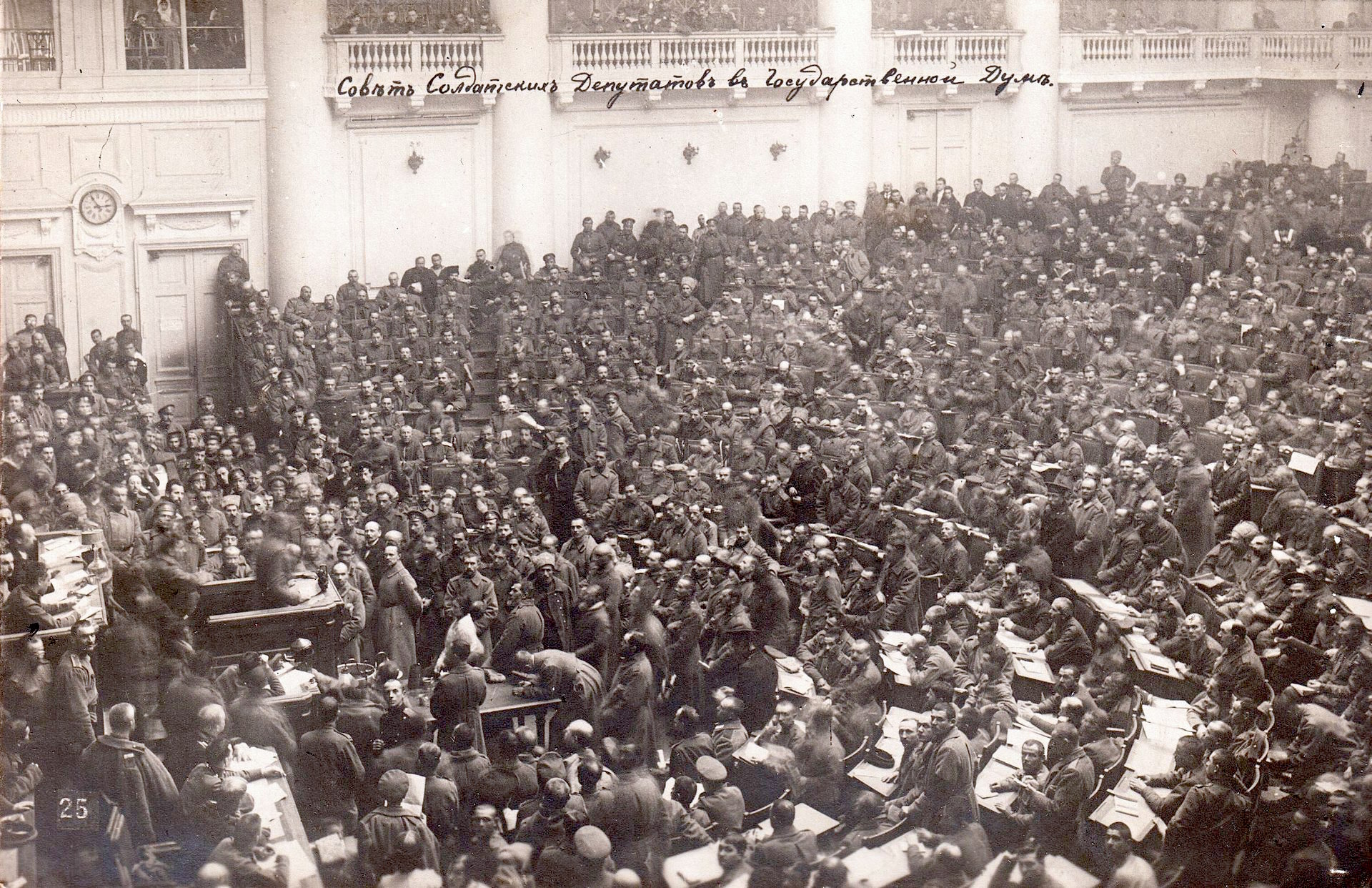
Far from the capital, Nicholas attempted to return to Petrograd, but events were already moving beyond his control. His train was halted before it could reach the city, and messages from generals and political leaders made the situation clear. The army could no longer be relied upon. The government had effectively collapsed. There was no force left willing or able to defend his rule. Faced with this reality, Nicholas had little choice. On March 15th, 1917, he agreed to abdicate the throne, bringing an end to more than three centuries of rule by the House of Romanov. The empire he had inherited no longer existed in any meaningful sense. Power had slipped away not through a single decisive blow, but through a rapid and total loss of authority.
In the aftermath, a new government was formed from members of the Duma, presenting itself as a temporary authority until elections could be held. It promised reform, freedom, and a new political future for Russia. However, even as it took power, it faced a fundamental problem. The conditions that had brought down the Tsar, the war, economic collapse, and popular unrest, remained unresolved. The February Revolution had succeeded in ending autocratic rule, but it had not stabilised the country. Instead, it created a fragile and uncertain system, in which authority was divided and the future unclear. Within months, that instability would lead to a second, more decisive revolution, one that would reshape Russia, and the world, entirely.