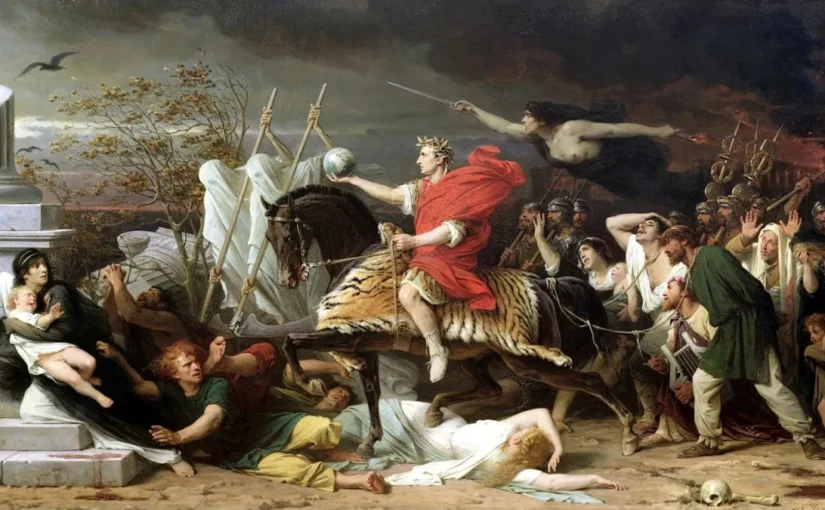
By 50BC, Julius Caesar had cemented himself as one of the most powerful, most wealthy and most influential men in Rome. Following his success in conquering Gaul, he had amassed vast quantities of personal wealth. Prior to his conquest, he had formed an informal political alliance with Pompey, Rome’s most famous general, and Marcus Licinius Crassus, the richest man in Rome, which allowed Caesar to govern the territories of Cisalpine Gaul, Illyricum and Gallia Narbonensis.
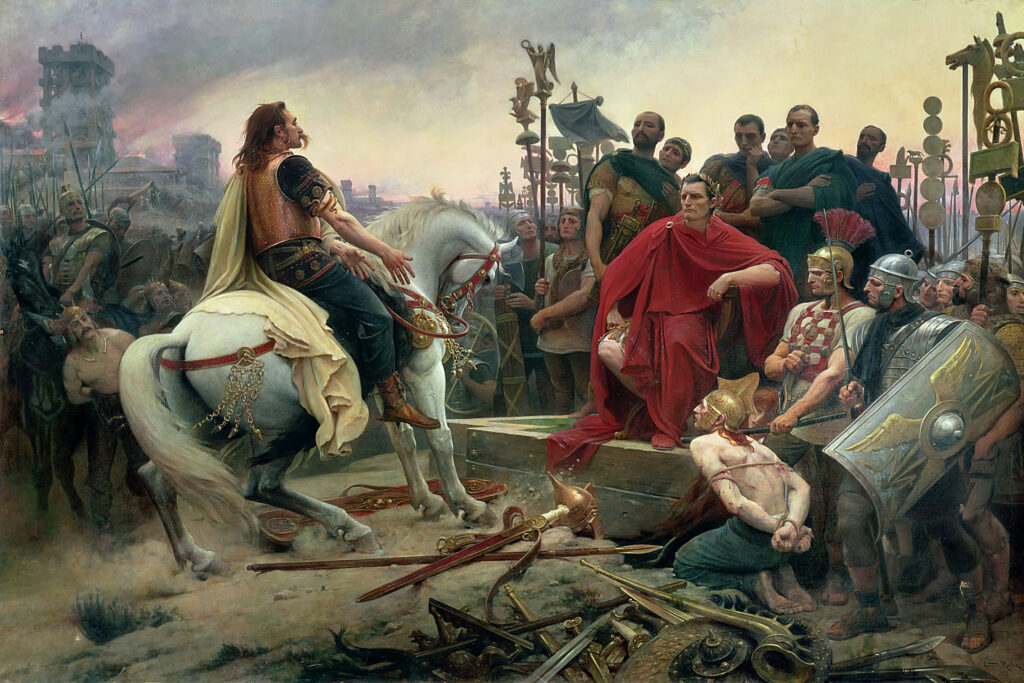
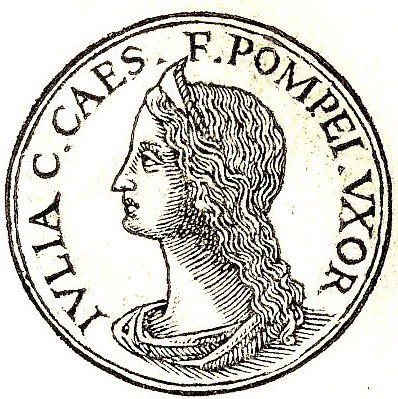
Historians call this arrangement the First Triumvirate. Although it had no legal basis, together the three men dominated Roman politics. Caesar gained the consulship in 59BC before securing an unprecedented five-year command in Gaul, while Pompey and Crassus used their influence in Rome to protect his interests. To strengthen the alliance further, Caesar married his daughter Julia to Pompey. By all accounts the marriage was a happy one, and for several years it helped maintain a genuine friendship between the two men. But the Triumvirate was built more on mutual advantage than mutual trust. Once that advantage disappeared, so too did the alliance.
The first blow came in 54BC when Julia died during childbirth. Pompey was devastated by her death, but politically it also removed the personal bond that had tied him to Caesar. A year later, Crassus invaded the Parthian Empire in search of military glory, only to be killed alongside much of his army at the disastrous Battle of Carrhae. With Crassus dead and Julia gone, the Triumvirate effectively ceased to exist. Rome’s two remaining strongmen were now left to compete against one another.
While Caesar continued winning spectacular victories in Gaul, Pompey remained in Rome. Increasingly, the Roman Senate viewed Pompey as the man best placed to defend the Republic against Caesar’s growing popularity. Many senators, particularly the conservative faction known as the Optimates, feared that Caesar’s immense wealth, battle-hardened army and popularity with the people would allow him to seize absolute power. They rallied behind Pompey, appointing him sole consul in 52BC during a period of political violence and unrest. Although Pompey still claimed to support the Republic, he was now closely aligned with many of Caesar’s fiercest political enemies.
As Caesar’s governorship of Gaul neared its end, the conflict came to a head. Under Roman law, a governor enjoyed legal immunity while commanding an army. The moment Caesar entered Italy as a private citizen, however, he could be prosecuted for alleged crimes committed during his consulship years earlier. His political opponents had made little secret of their intentions. Caesar believed that surrendering his command would almost certainly mean exile, political ruin, or even death.

Caesar proposed a compromise. Both he and Pompey would simultaneously lay down their military commands, allowing neither man to possess an army while elections took place. Pompey showed some willingness to negotiate, but many senators refused to accept the proposal. Instead, they demanded that Caesar alone dismiss his legions and return to Rome unarmed. When he hesitated, the Senate passed the Senatus Consultum Ultimum – the “Final Decree of the Senate” – granting Pompey extraordinary powers to defend the Republic against what they declared to be a threat from Caesar.
To Caesar, the message was unmistakable. The Senate had chosen Pompey over him. If he obeyed, he would stand trial at the mercy of his political enemies. If he disobeyed, he would become an outlaw. After years of political manoeuvring, there appeared to be no peaceful solution left. The fate of the Roman Republic would now depend upon a single river separating Caesar’s province from Italy itself: the Rubicon.
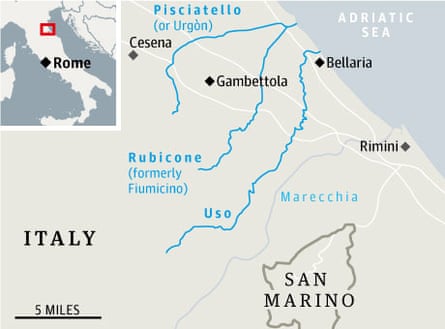
For centuries, the Rubicon had been little more than a modest river in northern Italy. It was neither particularly wide nor especially deep. Yet politically, it was one of the most important rivers in the ancient world. The Rubicon marked the southern boundary of Caesar’s province of Cisalpine Gaul and, beyond it, lay Italy itself. Under Roman law, no governor was permitted to lead an army across this frontier. The Republic had imposed this rule centuries earlier to prevent ambitious generals from marching on Rome and seizing power by force. A governor crossing the Rubicon with his legions was effectively declaring war against the Senate and the Roman state. There was no legal defence, no compromise and no turning back.
For several days in early January 49BC, Caesar lingered near the river, weighing his options. To obey the Senate meant dismissing the army that had loyally followed him through nearly a decade of campaigning in Gaul. Without its protection, he would enter Rome as a private citizen and almost certainly face prosecution at the hands of his political enemies. To cross the Rubicon, however, meant becoming an outlaw and plunging the Republic into civil war. It was a decision that would determine not only his own fate, but that of Rome itself.
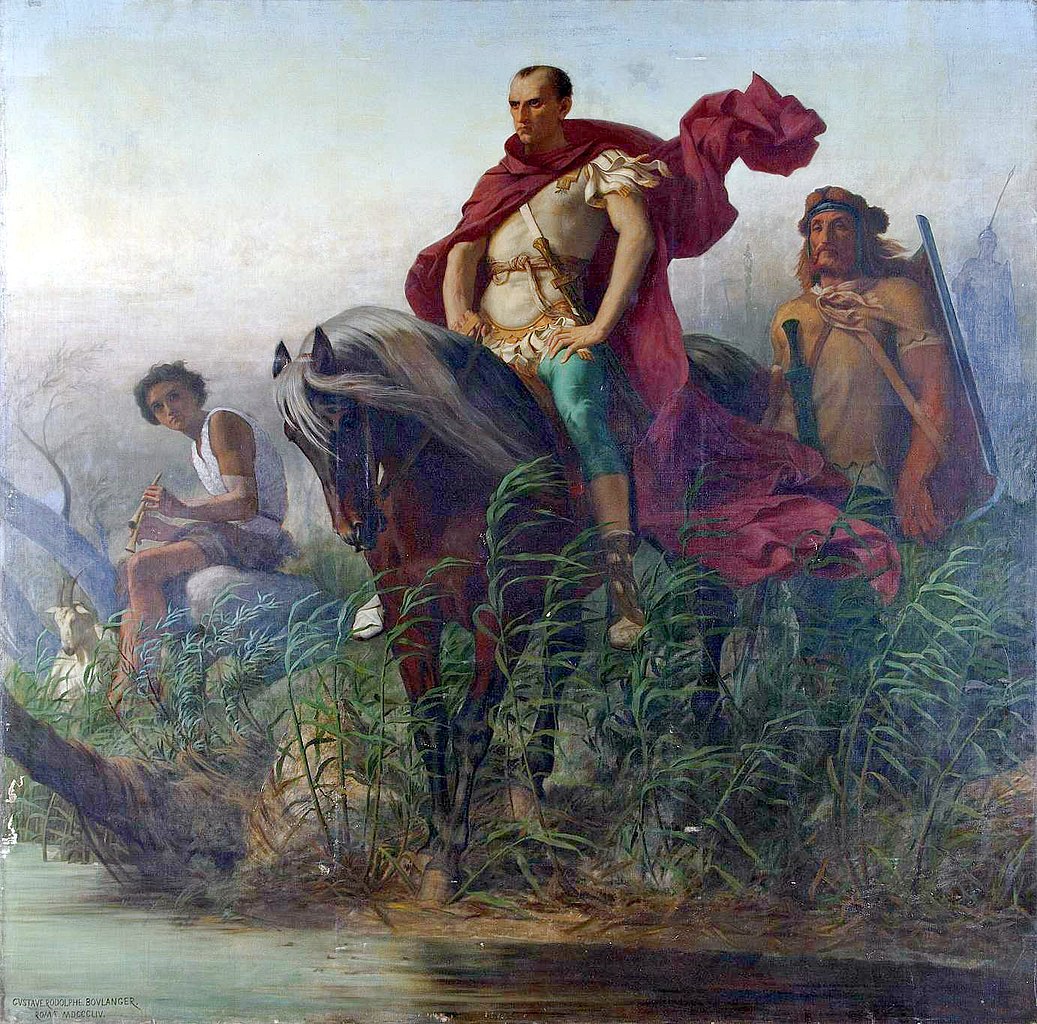
On the night of January 10th 49BC according to the modern calendar (January 11th in the Roman calendar then in use), Caesar finally made his choice. Accompanied by the veteran soldiers of the Thirteenth Legion, he rode to the banks of the Rubicon. Ancient writers describe him pausing one final time before ordering his men across the river. According to both Suetonius and Plutarch, Caesar then uttered the words that would echo through history:
Alea iacta est.
Caesar’s famous words before crossing the Rubicon
[The die is cast.]
With that, the legion crossed the river. In military terms, it was a relatively small movement of troops. Politically, it was revolutionary. Caesar had deliberately broken one of the Republic’s oldest constitutional laws and openly defied the authority of the Senate. News of the crossing spread rapidly through Italy, causing panic in Rome. Pompey and many senators, believing they lacked the forces to stop Caesar’s battle-hardened veterans, abandoned the capital and fled south before eventually escaping across the Adriatic Sea to Greece.
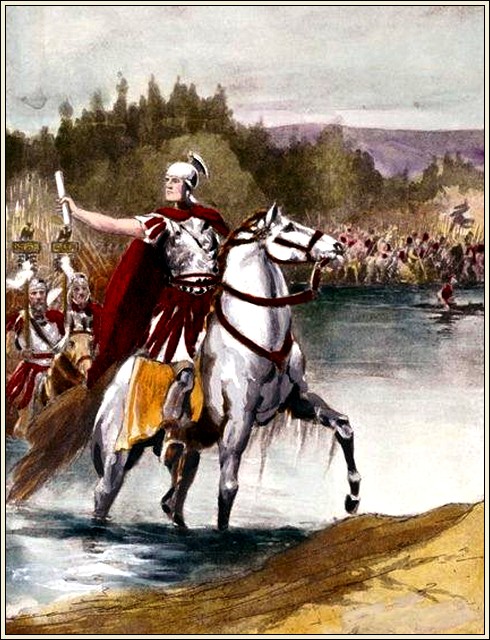
The Roman Civil War had begun. Within a generation, it would destroy the Roman Republic that had governed the Mediterranean for nearly five centuries and pave the way for the rise of the Roman Empire under Caesar’s adopted heir, Augustus. Even today, the phrase “crossing the Rubicon” survives as an expression meaning to pass a point of no return – a decision so momentous that its consequences cannot be undone.